
Trump Renames Strait of Hormuz ‘Strait of Trump’, Mojtaba Khamenei Vows to Secure It
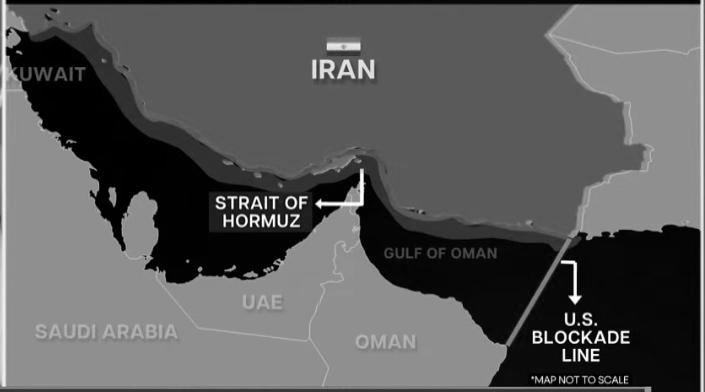
Day 62 of the US-Iran War dawned heavier than most. Seventeen days have passed since Washington imposed its naval blockade on Iranian ports, what Donald Trump, with characteristic flair, called "a stroke of genius" and the pressure is visibly mounting on both sides of the water.
Trump made his position unambiguous this week: "There will be no deal until Iran agrees to zero nuclear weapons. Zero." Yet in the same breath, he confirmed negotiations are continuing through back-channel phone calls .
Tehran, for its part, is not whispering. Mojtaba Khamenei delivered words that left little room for diplomacy: " America is the architect of instability in this region. Iran will secure the Gulf, with or without Washington's blessing. The Persian Gulf has always been ours, and it will remain so." His government followed with a stark warning that the US blockade is "doomed to fail" and announced, in deliberately vague but chilling language, that Iran "will unleash a new weapon positioned directly next to the enemy" , declining to specify what it is . One can only hope the analysts reading that statement didn't need their cardiologists on speed dial.
The blockade is drawing blood economically. US naval forces have intercepted 42 ships since the blockade began, cargo valued at over $6 billion . Trump, never one to undersell a moment, described the effect as " choking them like a stuffed pig .
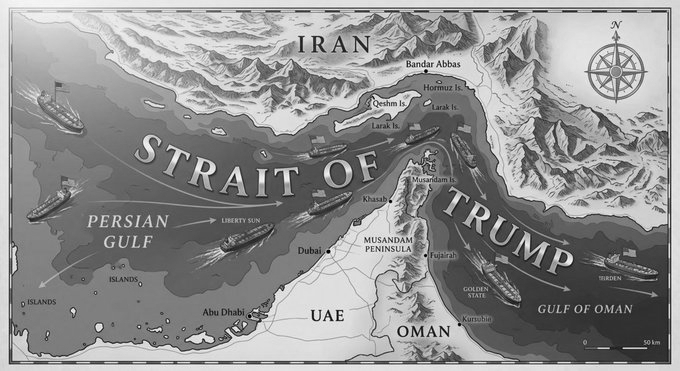
He also posted a modified map of the region, renaming the Strait of Hormuz "The Strait of Trump. " This follows his pattern of cartographic audacity, the same instinct that gave us the Gulf of America , Trump International Airport on old Washington Dulles signage, and passport covers briefly redesigned under his branding push that also rechristened the Kennedy Center . The map went viral. Iranian officials were not amused.
Abbas Araghchi* , Iran's Foreign Minister, responded with cold precision: _"Calling the Strait of Hormuz anything else is not just a mistake, it is an insult to geography, to history, and to the people of this region."_ His words carried extra weight given the numbers: *only 6 vessels are now passing through the Strait daily* , against a pre-war average of *60* . That tenfold collapse has sent oil markets into a spin, *Brent crude surged to $126 a barrel* before easing back to *$110* , still historically alarming and enough to squeeze economies from *Tokyo to Berlin.
In response, a growing coalition of nations has signed onto what is being called the Maritime Freedom and Navigation Alliance , joining US-led escort operations through the Gulf. Australia, Saudi Arabia, the UAE, Bahrain, and Japan are among those committing naval assets, though notably, this is not the first time Trump has sought allied support to reopen Hormuz. Earlier requests were quietly rejected . This time, with oil prices where they are, the math changed.
Germany, however, is a different story. Berlin is reportedly accelerating domestic production of the US-2 amphibious aircraft , a procurement pivot widely seen as hedging against American reliability. Trump wasted no time: when the German Chancellor called to discuss the regional crisis, Trump reportedly told him to "go fix his own broken country first." Berlin has not responded publicly. It rarely does when Trump turns the heat on.
Behind closed doors, the US military is preparing a formal briefing for the President , a war-planning session that, according to sources, lays out three operational options.
The first is a short, powerful strike campaign targeting Iranian infrastructure, ports, logistics hubs, communication nodes, designed not to topple the government but to shatter the blockade's architecture from within.
The second is more dramatic: a ground seizure of key sections of the Strait of Hormuz itself , physically wresting control of the chokepoint.
The third is the most sensitive: securing Iran's uranium stockpile. Intelligence assessments confirm Iran holds 440 kilograms of uranium enriched to 60% , dangerously close to the 90% weapons-grade threshold. Washington wants it gone. Tehran insists every gram is for civilian energy purposes only . The deeper problem is that nobody is entirely certain where all of it is, or whether the declared stockpile is the complete picture.
Hovering over all three options is Trump's Dark Eagle , the US hypersonic glide missile , capable of striking at over Mach 5 with near-zero intercept probability. Trump has reportedly asked advisers whether Dark Eagle has a role in any Iran scenario. The question alone signals how far the conversation has moved from sanctions and diplomacy.