
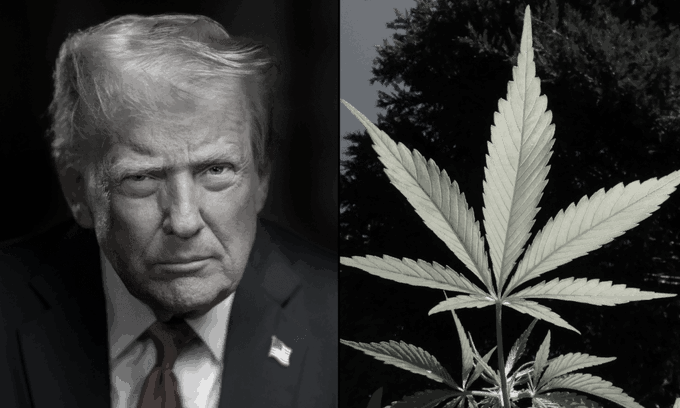
Trump orders marijuana reclassification, signalling major shift in US drug policy
US President Donald Trump on Thursday signed an executive order directing federal authorities to reclassify marijuana as a less dangerous drug, a move that signals a major shift in long-standing US drug policy and could have wide-ranging implications for research, business and federal-state relations, according to Al Jazeera.
The executive order requires Attorney General Pam Bondi to expedite the Drug Enforcement Administration’s process for reclassifying marijuana under the Controlled Substances Act. In the United States, drugs and chemical substances are divided into a five-tier classification system, with Schedule I representing the most restricted category and Schedule V the least. For decades, marijuana was listed under Schedule I, alongside drugs such as heroin and LSD, defined as having no accepted medical use and a high potential for abuse.
With Thursday’s order, marijuana would be fast-tracked to Schedule III, placing it in the same category as substances such as ketamine and anabolic steroids. Trump stressed that the decision does not amount to legalisation and does not sanction marijuana for recreational use, underlining that it remains illegal under federal law. He said the change was driven largely by the need to unlock scientific research, noting earlier in the week that reclassification is popular because it enables “tremendous amounts of research that can’t be done” under the current system.
While the order stops short of legalisation, it is expected to significantly ease restrictions on medical and scientific studies. Schedule I drugs are subject to some of the most stringent approval processes in US law, which researchers say has severely limited clinical trials and funding. Moving marijuana to Schedule III would require far fewer approvals, making it easier for universities, hospitals and pharmaceutical companies to study its medical potential.
The reclassification could also have economic consequences. Cannabis businesses operating legally in states where marijuana is permitted currently face heavy federal tax burdens because Schedule I status prevents them from deducting routine business expenses. A shift to Schedule III could allow licensed operators to deduct costs such as rent, payroll and marketing, providing financial relief, particularly for smaller companies.
Trump’s move aligns more closely with the reality across several US states that have already legalised marijuana for medical use, recreational use, or both. This has created a patchwork of state-level regulations that conflict with federal law, under which marijuana remains illegal. While the executive order does not eliminate this contradiction, it narrows the gap between federal policy and state practice.
The order also builds on steps taken by former US President Joe Biden , who had sought to ease federal penalties related to marijuana. Biden issued mass pardons for individuals convicted of simple possession and framed those actions as a way to address the disproportionate impact of drug laws on minority communities and reduce mass incarceration. His administration had also begun the process of reclassifying marijuana to Schedule III, but the effort was not completed before he left office in January.
Public opinion has continued to shift in favour of reform. Support for legalising marijuana for recreational use has nearly doubled over the past two decades, rising from 36 percent in 2005 to 68 percent in 2024, according to Gallup polls cited by Al Jazeera. Despite this growing support, critics argue that reclassification does not go far enough, pointing out that marijuana remains illegal at the federal level, while others warn that the move could send mixed messages about drug use and public health.
Even so, Trump’s executive order is being viewed as a landmark step in the evolving national debate over cannabis policy, reflecting a broader reassessment of how marijuana is treated under US law, even as full federal legalisation remains off the table for now.