
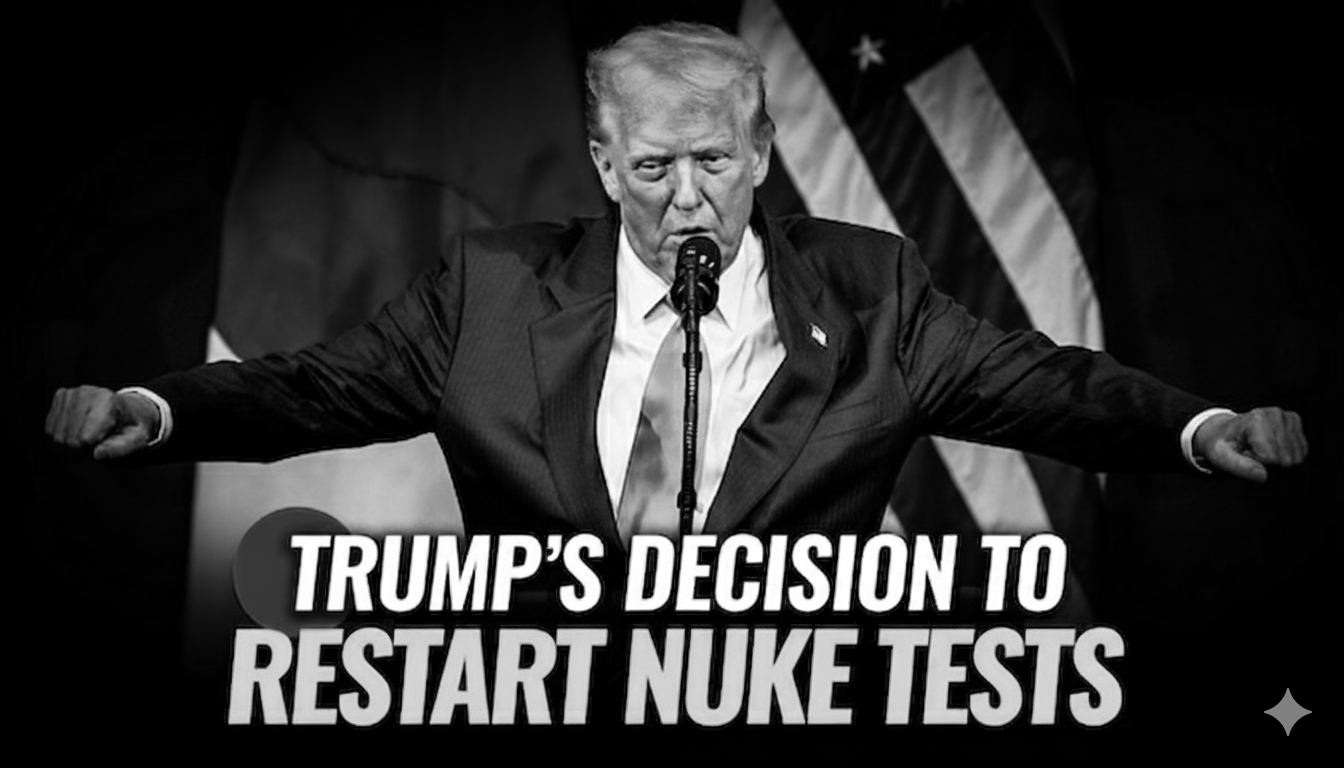
Trump orders immediate nuclear weapons testing after 33-year pause, ahead of Xi meeting
In a decision that has sent shockwaves across the world, U.S. President Donald Trump has ordered the Pentagon to immediately resume nuclear weapons testing , ending a 33-year moratorium that dates back to 1992. The announcement came moments before Trump’s meeting with Chinese President Xi Jinping in Busan, South Korea, marking the first such directive since the United States signed on to a global testing halt.
Trump posted the order on Truth Social, stating that he had instructed the “Department of War to start testing our nuclear weapons on an equal basis,” referring to the growing nuclear activity in Russia and China. “Russia is second, and China is a distant third, but will be even within five years,” he wrote.
The United States last conducted a nuclear test in 1992, after which it joined the Comprehensive Nuclear Test Ban Treaty (CTBT) , a global accord prohibiting all nuclear explosions. Although Washington signed but never ratified the treaty, it voluntarily observed the moratorium for more than three decades. Trump’s reversal now marks a historic departure from restraint, potentially dismantling decades of international arms control progress.
Why now, the China, Russia factor
Trump’s decision follows China’s rapid nuclear expansion , doubling its arsenal from 300 warheads in 2020 to around 600 in 2025, and Russia’s recent tests of advanced nuclear-powered systems, including the Poseidon undersea drone and the Burevestnik cruise missile. Defending his move aboard Air Force One, Trump said, “With others doing testing, I think it’s appropriate that we do also.”
Russia swiftly warned that the order could usher in “a new era of unpredictability and confrontation,” while China urged Washington to “abide by its moratorium and preserve global strategic balance.”
What does “equal basis” mean
Trump’s phrase “on an equal basis” has been interpreted by analysts as more rhetorical than literal . Russia and China have not been conducting live nuclear explosions, only testing delivery systems such as intercontinental ballistic missiles, hypersonic vehicles, and nuclear-powered drones.
In that sense, Trump’s statement may reflect an intent to match the scope and intensity of rivals’ testing programs , possibly through missile and warhead delivery system trials, subcritical tests, or computer simulations, rather than a decision to conduct full-scale nuclear detonations .
Experts note that it may be a political signal of parity and deterrence, aimed at projecting strength before negotiations, rather than an immediate technical escalation.
India’s strategic watch
New Delhi has not issued an official statement , but Indian defense analysts say the development will not go unnoticed. India, a non-signatory to the CTBT , maintains a “no first use” policy and a doctrine of credible minimum deterrence .
Renewed nuclear competition among major powers could, however, push regional actors like India and Pakistan to recalibrate their deterrence strategies , especially if testing resumes elsewhere.
A turning point for global security
Trump’s order represents more than a military instruction, it is a symbolic rupture in the global post-Cold War consensus . The reintroduction of nuclear testing risks unravelling decades of diplomatic progress that had kept nuclear thresholds high and rivalries contained.
For India and other emerging powers, the move serves as both a warning and a reminder of how fragile nuclear restraint truly is. It underscores the urgent need for renewed dialogue and confidence-building measures.
If cooler heads prevail, diplomacy may yet hold the line. If not, Trump’s order could become the opening chapter of a new nuclear age, one defined not by treaties, but by tests.