
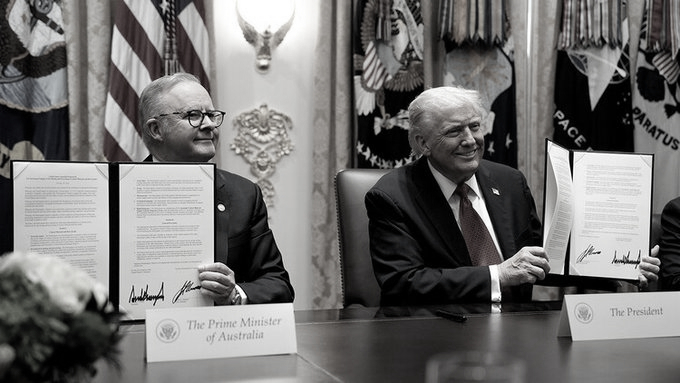
Trump makes rare earths deal with Australia to counter China
Washington and Canberra have signed a landmark $8.5 billion agreement aimed at reducing Western dependence on China’s dominance in rare earth elements (REEs), essential for clean energy, defense, and advanced technology. Announced on October 20, 2025, the deal commits both nations to invest $3 billion in critical minerals projects in Australia, including mining, processing, and refining operations, establishing a secure supply chain for the U.S.
Australia is rich in rare earths such as neodymium, praseodymium, dysprosium, terbium, and yttrium, which are crucial for high-tech industries, electric vehicles, wind turbines, and defense applications. However, the main limitation lies in refining capacity, an area where China dominates. China controls 90% of global rare earth refining and the vast majority of magnet production. Analysts estimate that building mines, processing plants, and logistics in Australia to fully supply the U.S. could take 5-7 years, though modest exports may start in 2-3 years.
The deal has already spurred investor confidence. The U.S. Export-Import Bank has issued over $2.2 billion in letters of interest to Australian miners, including Arafura Rare Earths, Northern Minerals, and Graphinex. The U.S. Department of Defense is also supporting a gallium refinery in Western Australia, which could supply up to 10% of global demand for this critical material used in semiconductors and defense technology.
Prime Minister Anthony Albanese highlighted Australia’s long-standing desire for nuclear-powered submarines, saying, “This capability has always been Australia’s desire to ensure our maritime security and strategic independence. The agreement with the U.S. brings that vision closer to reality.” President Donald Trump praised the partnership, stating, “Together with Australia, we are strengthening our defense, our industries, and our technological edge. This is a fantastic step toward reducing dependence on China while securing critical minerals for the future.”
The leaders also reaffirmed the U.S.-Australia security partnership and discussed the AUKUS pact, the trilateral alliance with Britain, confirming plans for delivery of nuclear-powered submarines by 2032. Nuclear-powered submarines are extremely restricted technology, operated only by a few countries-including the U.S., Russia, U.K., France, China, and India,because of their strategic, technical, and non-proliferation implications. Australia’s access through AUKUS represents a significant strategic leap.
China has responded to the deal by tightening export controls on rare earths, including samarium, graphite, lutetium, and terbium, reinforcing its dominance in global supply chains (69% of mining, 92% of refining, 98% of magnet production). The timing of China’s restrictions underscores the geopolitical importance of the U.S.-Australia deal. The U.S. has indicated readiness to negotiate with China, including potential tariffs if no agreement is reached.
The rare earth cooperation discussions between the U.S. and Australia began several years ago and intensified around 2023-2024, reflecting U.S. concerns over reliance on China. The concept of pipelines,mines under construction, planned processing plants, and funded projects,represents the future sources of rare earths that will eventually flow to the U.S.
India also has significant rare earth reserves along the Kerala, Tamil Nadu, Odisha, and Andhra Pradesh coasts, containing monazite sands rich in thorium, lanthanum, cerium, neodymium, and praseodymium. Like Australia, India faces challenges in refining capacity, limiting its role in global supply chains.
While the U.S.-Australia deal is a major strategic step toward diversifying rare earth supply chains and strengthening defense cooperation, experts caution it will not disrupt China’s market dominance in the near term. Its success depends on investment, technical expertise, long-term supply chain management, and shifting procurement behavior away from the cheapest Chinese sources.
U.S.-Australia rare earth deal reflects U.S. strategic selfishness. Australia had long requested nuclear-powered submarines, a request the U.S. repeatedly delayed. But following China’s rare earth restrictions, Washington engaged Canberra to secure critical minerals for itself, leveraging Australia’s resources for its own advantage. The submarines are now scheduled for delivery in 2032, seven years from now, underscoring how the deal serves U.S. interests while only gradually addressing Australia’s long-standing defense ambitions.