
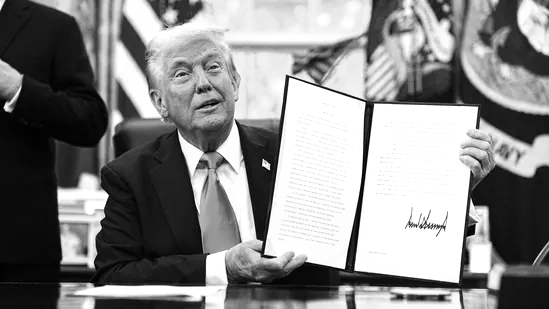
Trump imposes $100K H-1B Visa fee
In a major shake-up of the U.S. immigration system, President Donald Trump has signed an executive order imposing a $100,000 application fee for H-1B visas, a move aimed at curbing what his administration calls "systemic abuse" of the program. The new rule takes effect on September 21 for a 12-month period.The H-1B visa, created by Congress in 1990, allows U.S. companies to hire foreign workers in specialty occupations. The annual cap is set at 65,000, with an additional 20,000 for foreign graduates of U.S. universities.
The U.S. Commerce Secretary announced that the measure is intended to encourage companies to prioritize American talent. The proclamation specifically targets IT outsourcing firms, which the President alleges have misused the program by hiring foreign workers at a discount, thereby making it difficult for American college graduates to find jobs.
This policy is expected to disproportionately affect Indian tech workers, who constitute over 70% of H-1B visa holders. According to immigration lawyer Sophie Alcorn, while the fee may not force immediate returns, it will significantly increase costs for employers, making it harder for Indian professionals to change jobs or renew their visas. The move could prompt some to seek opportunities in other countries like Canada, the UK, and the UAE.
The H-1B program has been a subject of intense debate. Vice President J.D. Vance has criticized the practice of companies laying off American workers while simultaneously hiring foreign talent. He stated that the program should "supplement, not supplant" the U.S. workforce. However, the issue has also created internal divisions within the Trump administration, with some conservative commentators opposing the program while President Trump himself has previously expressed support for it. An Indian technologist on an H-1B visa noted the uncertainty surrounding the proclamation's legal basis, suggesting that it is likely to be challenged in court.
H-1B Visa fees: before and now
Previously, the cost for an H-1B visa application was a combination of several fees, typically ranging from $1,700 to around $4,500 depending on the company's size and other factors. These fees included:
• A lottery registration fee (e.g., $215).
• A base filing fee for the petition.
• An anti-fraud fee.
• An ACWIA education and training fee.
Under the new order, companies will now have to pay a $100,000 fee per year for each H-1B visa application, a significant increase from the previous cost.
Impact on students
This new policy will have a substantial impact on international students, especially those from India.
• Limited Job Opportunities: The massive increase in cost will likely deter companies, particularly small and mid-sized firms and IT outsourcing companies, from hiring entry-level professionals on H-1B visas. This makes it much harder for fresh graduates to secure a job in the U.S.
• Reduced Pathways: The H-1B visa has long been a primary pathway for students to transition from Optional Practical Training (OPT) to a long-term work visa. With this path becoming less viable, students may be forced to leave the U.S. after their OPT expires.
• Shift in Career Plans: Students may have to reconsider their career goals and be more open to seeking opportunities in other countries like Canada, the UK, or the UAE, which have more welcoming immigration policies.
• Focus on High-Paying Roles: Companies willing to pay the high fee will likely reserve H-1B visas for highly specialized, senior-level, and high-paying positions, making it an even more competitive environment for new graduate
Expected Impact on the United States
• Potential for Job Protection: The primary goal of the policy is to incentivize U.S. companies to hire American workers instead of foreign talent. By making H-1B visas prohibitively expensive, the administration hopes to reduce the alleged "systemic abuse" by IT outsourcing firms and protect American jobs, particularly for recent college graduates.
• Economic Consequences: The high fee could deter U.S. tech firms from hiring specialized foreign talent, potentially hindering innovation and growth in key sectors. Companies may struggle to fill roles that require specific skills not readily available in the domestic workforce. This could lead to a loss of competitiveness in the global market.
• Legal Challenges: The article notes that the proclamation's legal basis is uncertain and that it is likely to be challenged in court. This could create significant instability and uncertainty for businesses and visa holders until a final legal determination is made.
• Internal Political Division: The H-1B issue has created a divide within the Trump administration and its supporters. While some, like Vice President J.D. Vance, are critical of the program, Trump has also previously expressed support for it, highlighting a lack of a unified stance on the issue.
Expected Impact on India
• Financial and Career Hurdles: Indian tech workers are disproportionately affected as they hold over 70% of H-1B visas. The high fee will make it much harder for employers to sponsor new visas or renew existing ones. This will limit job mobility and increase the cost of staying in the U.S., placing immense financial strain on both employees and companies.
• Brain Drain Reversal: The policy could lead to a "reverse brain drain" as talented Indian professionals may be forced to leave the U.S. and return to India. This could be a positive for India's domestic tech industry, as a pool of highly skilled professionals with U.S. work experience becomes available.
• Shift in Talent Migration: The increased difficulty and cost of securing an H-1B visa could encourage Indian professionals to seek opportunities in other countries with more favorable immigration policies, such as Canada, the UK, the UAE, and Saudi Arabia. This would make the U.S. less attractive as a career destination for top Indian talent.
• Uncertainty and Anxiety: The policy creates significant uncertainty for the Indian diaspora in the U.S., especially for those on H-1B visas. The temporary, 12-month nature of the rule and the potential for legal challenges add to the anxiety, making long-term career planning in the U.S. extremely difficult.