
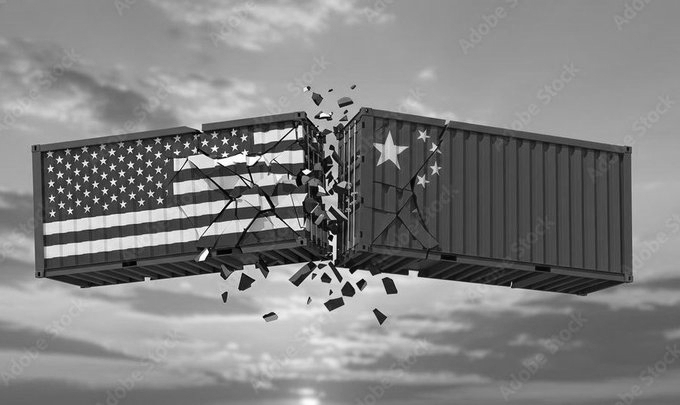
Trump imposes 100% tariff on China after rare earth export restrictions
President Donald Trump announced today that the United States will impose a 100% tariff on all Chinese imports, effective November 1, 2025. This action follows China's recent decision to restrict exports of rare earth minerals, which are critical to various U.S. industries, including defense, electric vehicles, and clean energy sectors.
In a post on his social media platform, Truth Social, President Trump described China's move as "an extraordinarily aggressive position on trade." He further stated that the new tariffs would take effect on November 1 or sooner, depending on any further actions or changes taken by China. Additionally, President Trump indicated that the U.S. would impose export controls on critical software and suggested that there may be "a lot more" on the table beyond software that could face export controls.
China's announcement on October 9 to restrict access to rare earths has raised concerns in the U.S., as the country relies heavily on these materials for various high-tech applications. Rare earth elements are essential in the manufacturing of components for electric vehicles, wind turbines, and semiconductor parts.
The Global Trade Research Initiative (GTRI) has projected that the new tariffs will lead to an immediate increase in production costs across sectors dependent on Chinese imports. GTRI noted that the U.S. will attempt to "friend-shore" its mineral supply chains to countries such as Australia, Vietnam, and Canada. In response, China is likely to redirect supplies toward its non-Western partners to strengthen alternative industrial networks.
Despite these efforts, analysts question whether the 100% tariff will genuinely reduce U.S. dependence on China or merely shift costs to consumers. The effectiveness of alternative partners like Vietnam and Canada in replacing China's industrial capacity remains uncertain, as both countries face limitations in scale and cost competitiveness compared to China.
The new 100% tariff will be added to existing duties, including a 50% tariff on steel, aluminum, and copper, a 20% tariff imposed earlier this year, and a 30% country-specific tariff following an executive order signed by President Trump in August. These cumulative tariffs have raised concerns about potential inflationary pressures and increased production costs in the U.S. market.
For India, the GTRI emphasized that no trade deal with the United States is ever final. The much-publicized U.S.-China "Phase One" trade deal of 2025, which capped U.S. tariffs at 30% and China's at 10%, has already been overtaken by the new 100% duty order. The report advised India to negotiate trade agreements carefully and on equal terms, ensuring reciprocity and preserving strategic autonomy. It further suggested that New Delhi focus on self-reliance in critical technologies and minerals to safeguard against future trade shocks and to strengthen ties with both Western and BRICS economies.
The GTRI report concluded that building resilience through diversified supply chains and domestic capacity would help India and other nations maintain economic stability amid ongoing global trade realignments.