
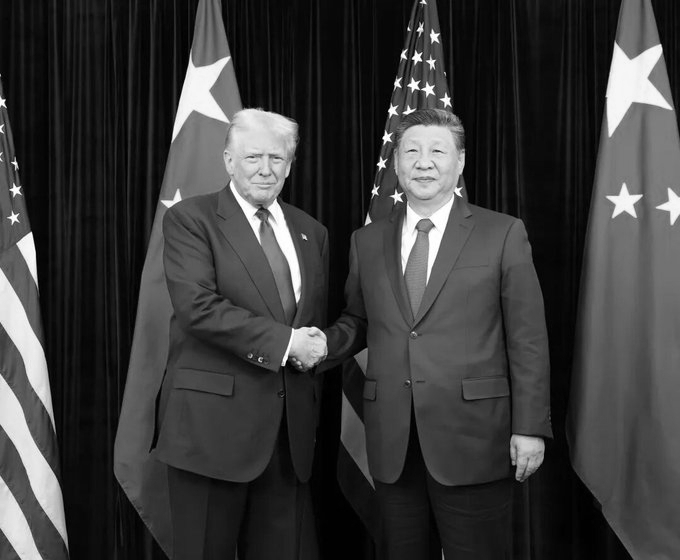
Trump Heads to Beijing as China Holds the Strategic Upper Hand
When Donald Trump first flew into Beijing in 2017 , Xi Jinping rolled out the kind of welcome reserved for emperors. Forbidden City tours, opera performances, layers of deliberate symbolism. It was a theatre designed to flatter. Eight years later, the theatre has given way to something far more serious. As Trump heads back to Beijing for what may be the most consequential summit of his presidency, China is no longer playing the gracious host . It is playing the stronger hand.
The shift in tone is unmistakable. Beijing is not projecting itself as a rising power eager to find its place at the table. It is projecting itself as a superpower that believes the table already belongs to it . Xi Jinping has long held that the East is rising and the West is declining, and from Beijing's vantage point, recent years have only added weight to that conviction. When Trump's tariffs climbed above 140 percent last year, China did not flinch and simply retaliate in kind. It reached for something far more powerful. Its dominance over rare earth minerals and critical supply chains , the very materials that go into missiles, semiconductors, electric vehicles, and advanced manufacturing, gave Beijing a structural weapon that Washington had no quick answer to. The United States, entangled in deep industrial and technological dependencies, found its room to escalate dangerously narrow.
That dominance has not gone away. China controls the midstream processing of critical minerals in a manner that the United States and its allies are scrambling to replicate, but those alternative supply chains could take years, even decades to build . For now, Beijing holds an advantage that no tariff announcement can quickly undo, and Xi knows it.
China's ambitions for this summit are not necessarily a sweeping grand bargain. Beijing's true goal is time. Time to deepen its technological self-sufficiency, stabilize its domestic economy, and keep Washington locked in a managed, predictable relationship that does not disrupt China's longer trajectory. Beijing may offer symbolic gestures, purchases of Boeing aircraft, soybeans, liquefied natural gas, the kind of large headline numbers that have historically satisfied Trump's appetite for visible wins. But China has played this particular game before . Grand announcements have a way of dissolving upon closer inspection, delivering optics without structural concessions.
Then there is Taiwan, and this is where Beijing may sense its greatest opening of all . Trump's response when asked whether the United States should continue selling weapons to Taiwan was, to put it diplomatically, less than reassuring for Taipei. He spoke of having that discussion with Xi, of good things happening, of Xi bringing it up more than he would. For Beijing, even a whisper of American ambivalence on Taiwan is worth more than years of diplomatic maneuvering . Any shift in posture, any signal that Washington's commitment to Taipei carries conditions or hesitation, would represent a profound strategic victory for China without a single shot being fired.
The war in West Asia has added yet another layer of complexity to Trump's position. As the United States Navy intercepts tankers through the Strait of Hormuz, China, which remains Iran's single largest crude oil buyer , has been quietly insulating itself through strategic stockpiles, supply diversification, and its long-term push toward electrification. Trump needs energy market stability with considerably more urgency than Xi does, and Beijing is well aware of that asymmetry.
Yet it would be a mistake to read this summit as entirely one-sided. Washington still carries formidable weapons into that room. Tariffs remain a blunt but potent instrument of economic pressure. American control over the world's most advanced semiconductor technology continues to place a ceiling on China's high-end technological ambitions. The threat of secondary sanctions targeting Chinese firms that support Iran gives Washington additional leverage. Agriculture purchases, energy flows, and the broader architecture of global trade still run through channels that the United States can meaningfully influence.