
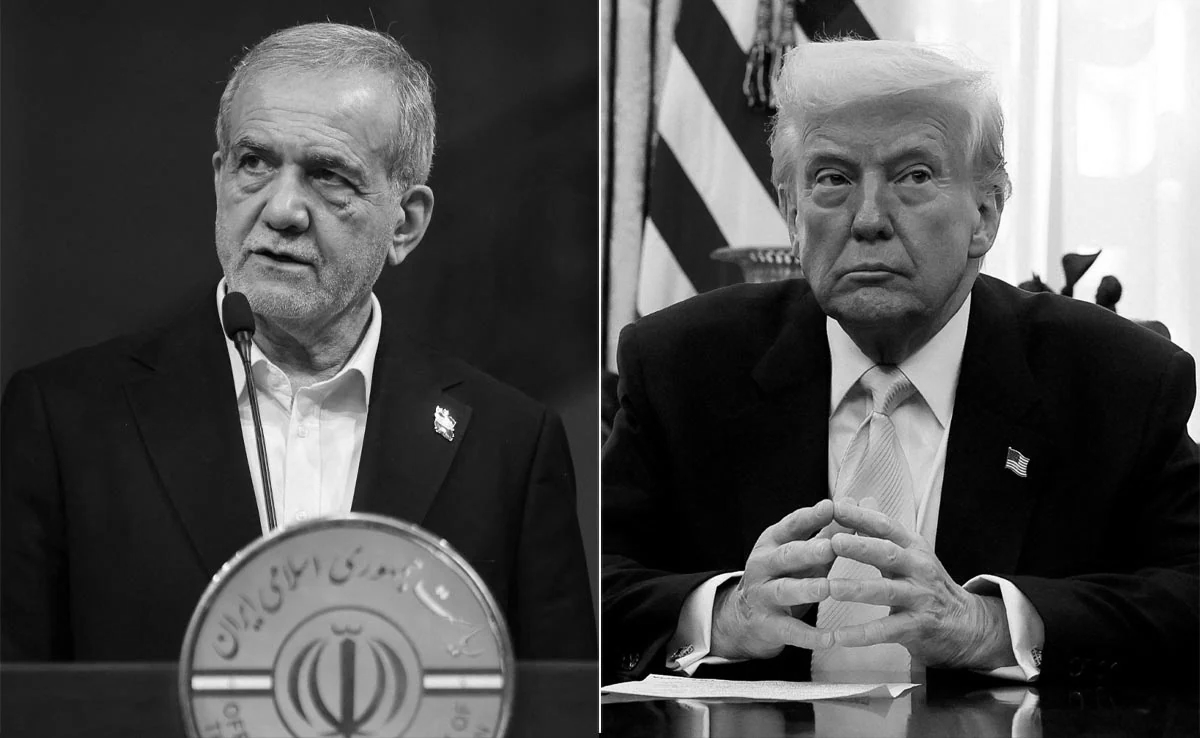

Trump Dismisses Low Munitions Reports as Iran Says US-Israel's '48 Hour Plan' Failed
US President Donald Trump has dismissed reports that the United States is running low on key missiles, insisting the country has " massive amounts " of munitions. His remarks came as Iranian President Masoud Peshkan claimed that an alleged US-Israel plan to bring down the Islamic Republic within 48 hours had failed, adding another layer to growing tensions across the Middle East.
Peshkan praised the resilience of the Iranian people during months of conflict, sanctions and international pressure. He argued that the campaign against Iran was never only about its nuclear program. Instead, he claimed the real objective was to divide Iranian society from within and weaken the country's political system.
Peshkan further alleged that the United States and Israel wanted to turn Iran into another Syria, referring to the devastating civil war that shattered the country after 2011. According to him, that plan failed because Iranians remained united throughout the conflict. He credited Supreme Leader Mojtaba Khamenei with keeping the country stable despite external pressure.
However, the speech came amid continuing speculation over Iran's leadership. Khamenei has not appeared in public since succeeding his father, the late Ayatollah Ali Khamenei, who was killed during the conflict. Peshkan acknowledged that communication with the Supreme Leader has become difficult but insisted his leadership continues to guide the country. Reports have also claimed that IRGC commander Ahmad Vahidi has taken a greater role in national security decisions and negotiations with the United States, although Iranian authorities have not confirmed those reports.
While Iran projected confidence, Washington has been dealing with questions over its own military preparedness. The United States has used a significant number of long range precision weapons, including the Army Tactical Missile System (ATACMS) and the newer Precision Strike Missile (PrSM), during the conflict. Other reports have suggested that inventories of Patriot and THAAD interceptors have also fallen after months of defending US bases, naval assets and regional allies from Iranian missile and drone attacks. Some analysts argue that replenishing these advanced weapons could take months or even years because of production limits.
The Washington Post also reported that Trump privately questioned Defense Secretary Pete Hegseth over reports of declining missile inventories during a recent Cabinet meeting. The report claimed Hegseth blamed communication failures within the Pentagon rather than shortages themselves. However, the White House strongly rejected the report. Officials said Trump continues to have full confidence in Hegseth and dismissed the story as an attempt to create divisions within the administration.
Trump also pushed back publicly against the reports, writing that the United States has " massive amounts " of munitions and that production is expanding rapidly. He said new defense manufacturing facilities are being built across the country and insisted the US military has everything it needs for current and future operations. The Pentagon echoed that message, saying American forces remain fully prepared for any mission.
Meanwhile, tensions across the region remain high. Iran backed Houthi rebels in Yemen have continued launching missile and drone attacks. In one of the deadliest recent incidents, Houthi forces carried out strikes that reportedly killed 28 people and injured 29 others, underscoring the fragile security situation in Yemen and the continuing threat to Saudi Arabia and the wider Gulf region.
Diplomatic efforts are also continuing. Iran has indicated that discussions with Oman over maritime security and the Strait of Hormuz are making progress, even as broader disagreements over sanctions and the future of nuclear negotiations remain unresolved.