
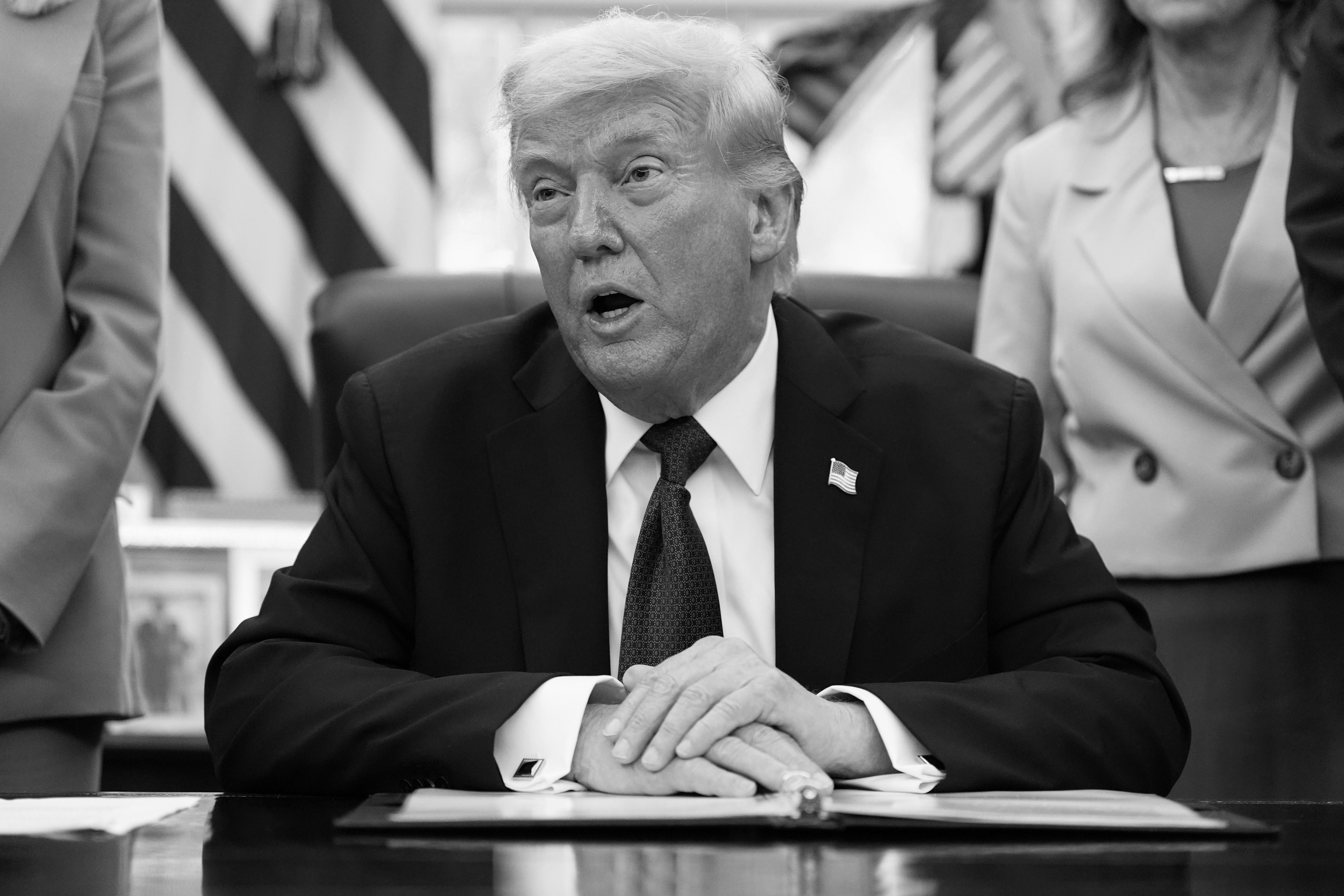
Trump defends H-1B visa programme amid crackdown, calls global talent ‘necessary’ for U.S. growth
U.S. President Donald Trump has been heard defending the H-1B visa programme, stating that America must continue to bring in talent from around the world as the country “does not have certain talents.” His remarks were made during an interview with Laura Ingraham on Fox News, even as his administration’s crackdown on alleged H-1B abuses was being intensified.
During the interview, Trump was asked whether the H-1B issue would remain a low priority for his administration in light of his earlier “America First” economic stance. In response, he was quoted as saying, “It was agreed that talent must be brought in. You don’t have certain talents, and people have to learn.”
When Ingraham observed that “we have plenty of talent,” the president was heard countering, “No, you don’t, no you don’t. You don’t have certain talents.” He further remarked that people could not simply be taken “off an unemployment line” and placed into high-skilled jobs.
Examples were cited by the president, including a factory in Georgia where South Korean workers with experience in battery manufacturing were reportedly asked to leave the country. “You can’t just say a country is coming in to invest $10 billion and you’re going to take people off an unemployment line who haven’t worked in five years, and they’re going to start making missiles. It doesn’t work that way,” he was quoted as saying.
Crackdown* *c* *ontinues* *d* *espite* *s* *oftened* *r* *hetoric :
Trump’s remarks have been perceived as a partial defence of skilled immigration, marking a contrast with the harsher tone previously adopted by his administration. However, it has been clarified that a massive enforcement drive was still underway to identify abuses in the H-1B programme, which allows U.S. companies especially in the technology and healthcare sectors to employ highly skilled foreign workers.
According to the U.S. Department of Labor, around 175 investigations have been launched into suspected H-1B misuse, including false worksite claims, underpayment of wages, and the illegal practice of “benching” employees without pay. A statement on social media by the Department read that “every resource is being used to put a stop to H-1B abuse and to protect American jobs.”
Labour Secretary Lori Chavez-DeRemer was quoted as say ing that under the leadership of President Trump, “action will continue to be taken to ensure that high-skilled job opportunities go to American workers first.”
New* *v* *isa* *r* *ules and* *i* *ndustry* *c* *oncerns :
In September 2025, a Presidential Proclamation titled ‘Restriction on Entry of Certain Nonimmigrant Workers’ was issued as part of a broader visa reform plan. Under the order, new H-1B petitions filed after September 21, 2025 must be accompanied by an additional USD 100,000 payment as a condition of eligibility. The rule described by U.S. officials as a “deterrent against misuse” has been criticised by industry groups as prohibitively expensive and detrimental to innovation.
No details have been provided by the administration on whether the payment would apply per applicant, per company, or per project, leading to confusion among employers and legal experts.
Indian professionals, particularly engineers and physicians remain the largest cohort of H-1B visa holders, forming a crucial part of the American technology and healthcare workforce.
The National Association of Software and Service Companies (NASSCOM) has expressed concern that new restrictions could disrupt bilateral trade and talent mobility between India and the United States. It was stated by a NASSCOM s pokesperson that the two countries “have built decades of cooperation in technology exchange, and sudden cost barriers would negatively affect both economies.”
Economic and* *d* *iplomatic* *i* *mplications :
Economists have observed that America’s dependence on high-skilled immigrants has grown in sectors such as semiconductors, AI, and defence manufacturing, areas where the local talent pipeline remains limited. Analysts have suggested that Trump’s acknowledgment of these “missing skills” reflects a pragmatic shift in tone ahead of the 2026 presidential race, where job creation and manufacturing are expected to remain central themes.
Officials in New Delhi have so far avoided direct criticism, but diplomatic sources indicated that the issue of visa fairness is likely to be raised at the next U.S.–India ministerial commercial-and-strategic engagement (last held October 2024), which is expected to reconvene in 2025.
Foreign policy experts have noted that while Trump’s comments may have been intended to reassure investors and manufacturers, the s imultaneous enforcement drive and added visa costs could send mixed signals to foreign partners especially India, which has repeatedly urged Washington to ensure a predictable and non-discriminatory visa system.
Balancing* *p* *rotectionism and* *c* *ompetitiveness :
Observers in Washington have pointed out that the contradictory messaging defending global talent while tightening visa rules illustrates the administration’s attempt to balance domestic employment concerns with America’s need for innovation leadership.
It has been noted that nearly 70 percent of H-1B visas issued annually go to professionals in STEM fields, where domestic shortages have been documented by U.S. labour studies.
Conclusion :
Trump’s remarks, though framed as a defense of the need for global expertise, have come amid the most aggressive tightening of the H-1B system in recent years. With 175 active investigations, a new $100,000 filing fee, and an election year approaching, uncertainty continues to cloud the future of skilled migration to the United States.
Whether this signals a genuine policy recalibration or merely a political repositioning, observers agree that the H-1B debate has once again become a central test of how Washington balances protectionism and innovation in a global economy.