
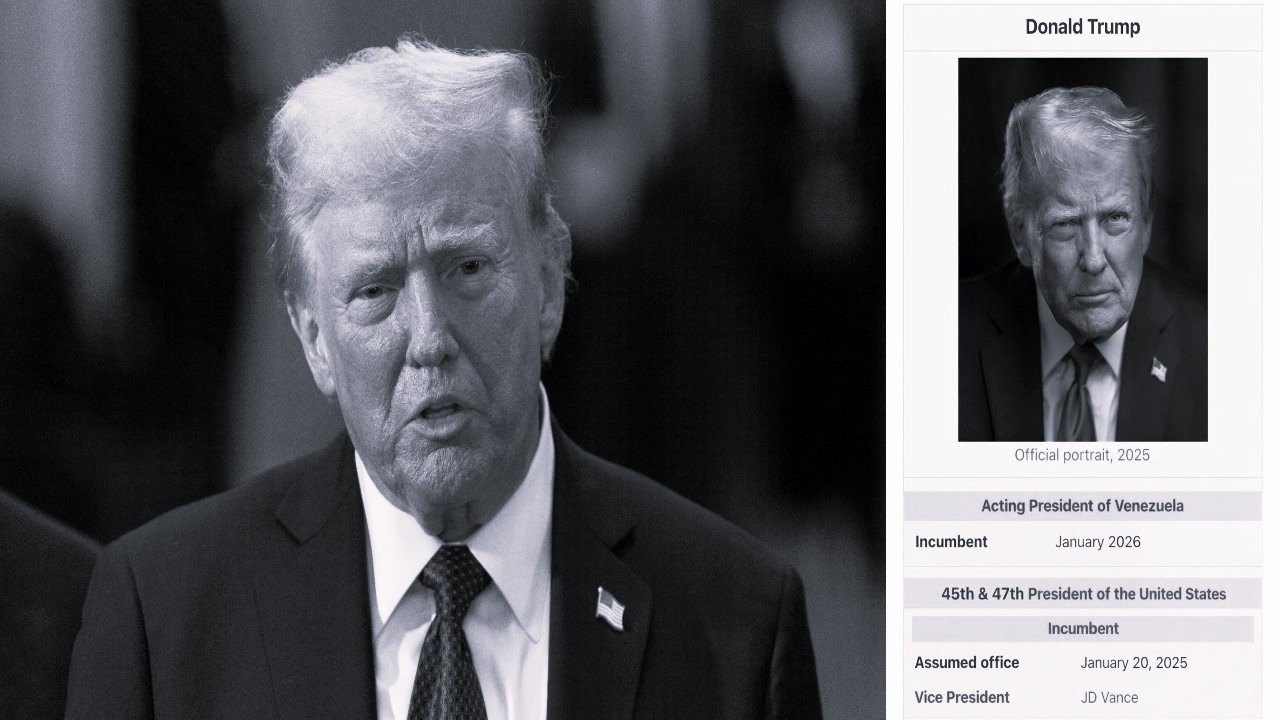
Trump Claims Role as Venezuela’s ‘Acting President’, Sparks Global Outrage
US President Donald Trump has sparked fresh international controversy after posting a viral image on his social media platform Truth Social that described him as the “Acting President of Venezuela.” The image, styled like a Wikipedia entry, quickly spread across social media, drawing mixed reactions, mockery in some quarters and alarm in others because it came amid a rapidly intensifying crisis in the oil-rich South American nation. Though the post was not an official policy statement, analysts said it reflected the aggressive posture Washington appears to be adopting toward Venezuela’s political transition.
The controversy follows reports that Venezuela’s President Nicolás Maduro and his wife Cilia Flores were detained in a dramatic US operation in Caracas earlier this month and later transported to the United States. Maduro has reportedly been produced before a federal court in New York, where he is facing charges related to narcotics trafficking and has pleaded not guilty. The episode triggered deep political uncertainty within Venezuela, with state institutions scrambling to respond and public anxiety rising over the country’s leadership vacuum and international legitimacy.
In the immediate aftermath, Vice President Delcy Rodríguez assumed charge as interim leader, publicly condemning Maduro’s arrest and warning that it could inflict long-term damage on Venezuela-US relations. However, even as she criticised Washington’s actions, the interim administration entered into discussions with the Trump camp and US officials, particularly on oil and economic arrangements. Observers noted that the political transition in Caracas now appears inseparable from negotiations over Venezuela’s massive crude reserves, which are the largest proven reserves in the world and central to global energy calculations.
Trump has repeatedly signalled that Venezuela’s oil will be a decisive factor in shaping the transition, calling for major restructuring and increased access for US interests. Reports suggest that an oil arrangement has been reached to send significant quantities of Venezuelan crude to the United States, with estimates ranging from multi-billion-dollar shipments to a possible 50 million barrels export plan under evolving terms. Trump claimed that tankers carrying Venezuelan oil had already departed for American ports, framing the development as a strategic win that strengthens the US energy position while weakening alternative regional blocs.
In a parallel move, Trump has signed an executive order declaring a national emergency to protect Venezuelan funds and oil-related revenues held inside the United States. The order reportedly prevents private claims and court seizures of Venezuelan money in US financial institutions and places the revenues under a controlled framework that Washington says will support stability and reconstruction. Critics, however, argue the step effectively grants the US a powerful lever over Venezuela’s resources, intensifying accusations that Washington is attempting to exert direct influence over the country’s governance and financial future.
Meanwhile, uncertainty continues over who will ultimately lead Venezuela in the longer term. While there has been speculation about opposition figures gaining control after Maduro’s removal, reports indicate Trump is not inclined to back some leading candidates, including Nobel-recognised opposition leader Machado, citing concerns over political strength and mass support. That ambiguity has fuelled new debate about whether Venezuela is headed toward genuine democratic transition or a US-controlled restructuring shaped primarily by energy and strategic interests.
The crisis has also begun triggering regional shockwaves. Venezuela’s historical oil relationship with Cuba has come under strain, with reports suggesting Washington has moved to curb Venezuelan energy flows to Havana, a step that could worsen Cuba’s energy shortages and heighten regional tensions. With Venezuela’s sovereignty, leadership legitimacy and oil wealth all tied together in this fast-moving standoff, international observers warn the crisis could push up global oil price volatility, deepen geopolitical divisions in Latin America, and leave Venezuela facing long-term instability if a widely accepted political settlement is not reached.