
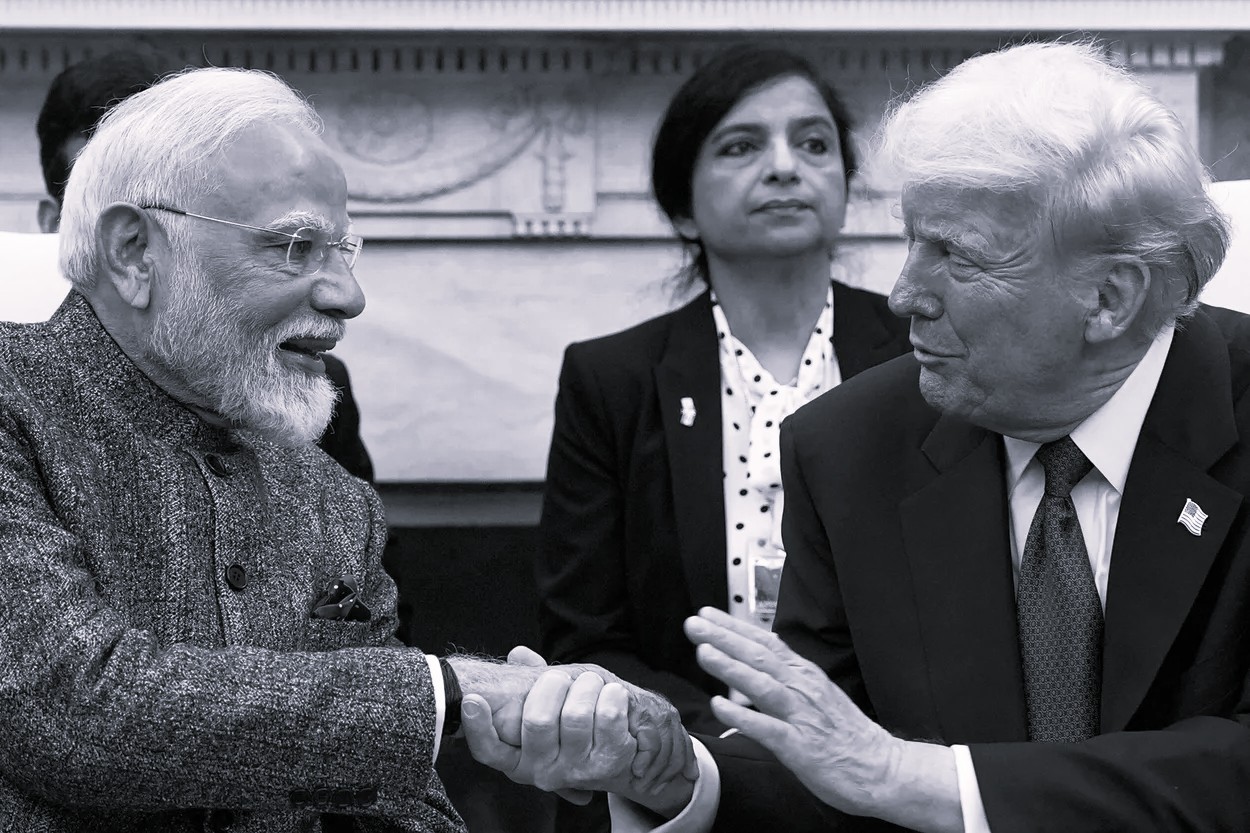
Trump claims Modi vowed to halt Russian oil; MEA avoids direct denial
India has reaffirmed its commitment to an independent energy policy, with all import decisions guided by national priorities and the imperative to protect Indian consumers. The Ministry of External Affairs (MEA) emphasized that India’s energy strategy aims to ensure stable prices, secure supply, and diversify procurement sources to navigate a volatile global market. MEA spokesperson Randhir Jaiswal noted, “India is a significant importer of oil and gas. Our priority has consistently been to safeguard the interests of Indian consumers.” Against this backdrop, Russia’s Ambassador to India, Denis Alipov, highlighted that Moscow’s cooperation with New Delhi in the energy sector aligns with India’s national interests. The remarks come amid renewed scrutiny over India’s oil imports from Russia following statements by U.S. President Donald Trump.
Speaking during a media interaction in Washington, Trump claimed that Prime Minister Narendra Modi had assured him India would stop purchasing Russian oil, calling it “a big step” in global efforts to increase pressure on Moscow. He also suggested that China should follow a similar path. Regarding India, he said, “Yeah, sure. He’s a friend of mine. We have a great relationship... I was not happy that India was buying oil. And he assured me today that they will not be buying oil from Russia.”
Reflecting on the Russia-Ukraine war, Trump noted that he had initially predicted Russia would win within the first week, a forecast that has proven inaccurate as the conflict enters its fourth year. He added that once the war concludes, India could resume importing oil from Russia, and China would similarly be able to do so.
Responding to questions on India’s continued oil imports from Russia, Ambassador Denis Alipov said that the decision rests with the Indian government, which prioritizes the country’s national interest. India continues to import Russian oil not only because of its long-standing energy ties with Moscow but also due to limited alternatives. Efforts to diversify from countries like Iran and Venezuela have been constrained by US pressure. New Delhi has offered the US options to cooperate on energy supplies, but Washington has insisted on exclusive sourcing from India, leaving India to balance its energy security with geopolitical realities.
India maintains an independent energy policy, prioritizing consumer interests, stable supply, diversified sourcing, and ongoing cooperation with the US.
US ambassador’s visit and strategic engagement
Alipov’s remarks come shortly after the visit of U.S. ambassador-designate Sergio Gor to India from October 9 to 14, 2025, his first official trip following Senate confirmation. Gor held high-level meetings with Prime Minister Narendra Modi, foreign minister S. Jaishankar, and national security advisor Ajit Doval, focusing on trade, defense, technology, and critical minerals. His visit highlighted Washington’s interest in strengthening ties with India, even as energy sourcing remains a sensitive point.
Strategic autonomy and geopolitical implications
India’s continued purchase of Russian oil underscores its commitment to strategic autonomy, a cornerstone of its foreign policy. As an import-dependent nation sourcing nearly 85 percent of its crude oil from abroad, India relies heavily on cost-effective supplies to safeguard its energy security. Russian crude, which now accounts for around 35 percent of India’s total oil imports, plays a crucial role in keeping domestic fuel prices stable and shielding consumers from global market volatility.
Impact on India-US trade discussions
The energy issue adds complexity to ongoing India-U.S. trade negotiations. Washington may perceive continued Russian oil imports as a sign that India prioritizes energy security over alignment with U.S. geo political objectives. However, India’s diversified energy sourcing and transparent policy approach position it to continue trade discussions, covering technology, defense, and market access, without letting its energy choices derail progress. Apart from Russia, India also imports crude from Iraq, Saudi Arabia, the United Arab Emirates (UAE), and the United States, ensuring a balanced supply mix. This diversification helps New Delhi maintain flexibility, prevent overdependence on any single partner, and reinforce its stance that energy security must remain separate from geopolitical pressures.
India’s stance on Russian oil reflects a careful balancing act: safeguarding national energy security, maintaining strategic autonomy, and managing complex international relationships. By asserting its independent approach, India signals that it can pursue energy and economic interests while sustaining strong diplomatic and trade partnerships, including with the United States.