
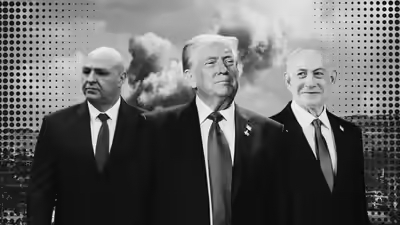
Trump announces 10-day Israel-Lebanon ceasefire, just a bargaining chip for an Iran deal?
Donald Trump announced that Israel and Lebanon had agreed to a 10-day ceasefire , effective at 5 p.m. ET , following what he called "excellent conversations" with Lebanese President Joseph Aoun and Israeli Prime Minister Benjamin Netanyahu . He then invited both leaders to the White House for what he described as "the first meaningful talks between Israel and Lebanon since 1983 ." Trump directed Vice President JD Vance, Secretary of State Marco Rubio , and the Chairman of the Joint Chiefs to work toward a lasting peace.
But the road to this announcement was anything but smooth. Lebanon's government was caught off-guard by Trump's post. Lebanese officials said it was initially unlikely Aoun would agree to speak to Netanyahu. At one point Thursday, Aoun outright refused to speak directly with Netanyahu, remarks made during a call with Rubio, who "understands Lebanon's position." The ceasefire, in effect, was something Trump pushed through , not something both sides arrived at willingly.
And here lies the central question: can Netanyahu actually be trusted to honour it?
Just days ago, Netanyahu visited Israeli troops inside the so-called "security zone" carved out in southern Lebanon, declaring "the war continues." He then ordered the IDF to expand the buffer zone further , pushing Israeli forces toward the Litani River , demolishing structures and displacing communities in what his defence minister called replicating "the Gaza model." A person briefed on the talks told NPR that until Israel sees progress on Hezbollah's disarmament , it has " no intention of withdrawing from the buffer zone for the coming months, maybe years."
This is the central contradiction at the heart of the White House talks. Lebanon insists on a ceasefire first before engaging in further negotiations, while vowing to work toward disarming Hezbollah. Israel, meanwhile, has framed the talks not as a ceasefire but as peace negotiations , with Hezbollah's disarmament as a precondition, not an outcome. Israel has flatly refused to discuss a ceasefire with Hezbollah at all, calling the group "the main obstacle to peace."
There is also a broader geopolitical calculation at play. The ceasefire plan is politically sensitive for Netanyahu , but it could help Trump reach a wider peace deal with Iran , a parallel diplomatic effort currently underway. Iran has said it will not engage in negotiations without a ceasefire in Lebanon, while Israel has continued its military campaign even as a fragile US-Iran truce holds elsewhere in the region.
Meanwhile, on the ground, the numbers are staggering. Israeli attacks have killed at least 2,196 people in Lebanon and displaced more than one million , 20 percent of the country's population .