
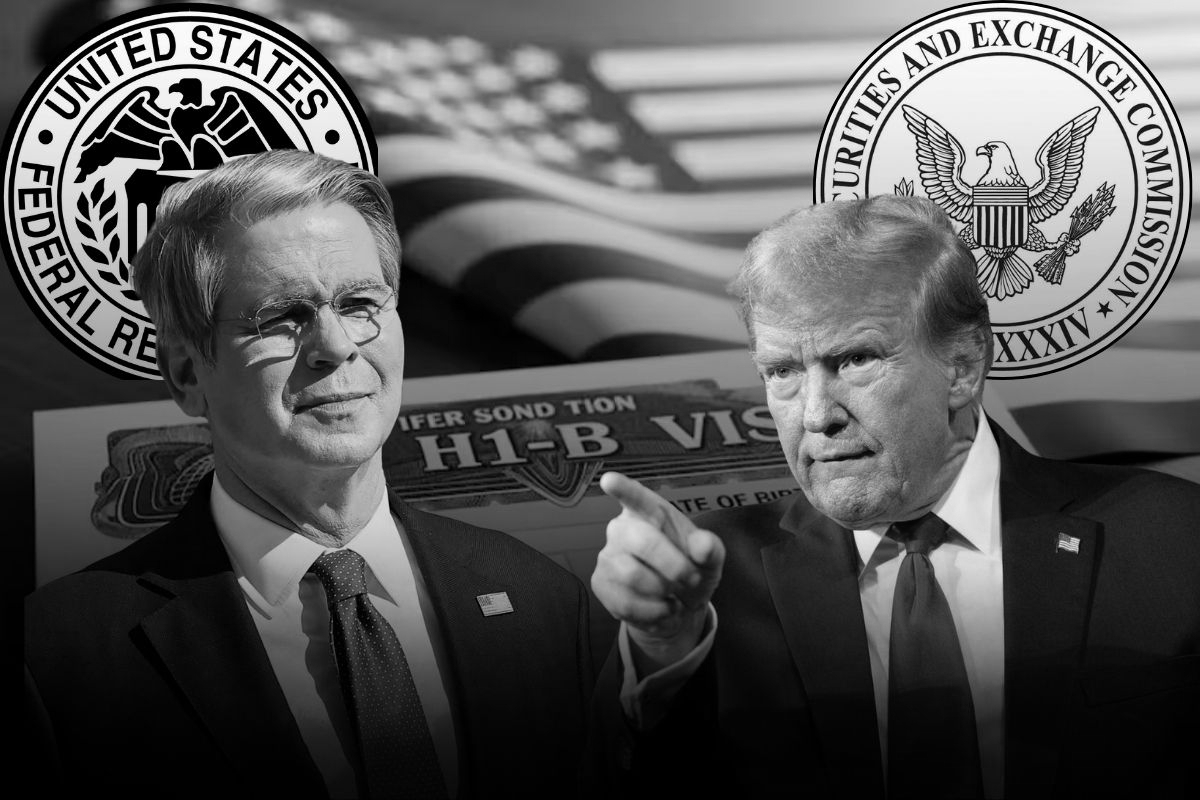
Trump administration clarifies H-1B vision: skilled labour to train Americans
A day after the H-1B visa programme was defended by US President Donald Trump, a clearer picture of the administration’s approach was presented by Treasury Secretary Scott Bessent, who stated that the goal was for skilled overseas workers to be brought in temporarily to rebuild critical industries and train American workers.
It was stated by Bessent in an interview with Fox News on Wednesday that “the President's vision here is to bring in overseas workers, where these jobs went, who have the skills. Three, five, seven years to train the US workers, then they can go home. The US workers fully take over.”
His remarks were seen as another clarification on the ongoing debate surrounding the H-1B visa programme, which has been subjected to criticism and policy uncertainty in recent years. It was emphasised by Bessent that precision manufacturing jobs had been offshored by the US for decades, and that foreign talent was now required to help restore sectors such as semiconductors and shipbuilding.
It was further explained by him that “the President's point here is, again, we can't snap our fingers and say, ‘You're going to learn how to build ships overnight’. The semiconductor industry is wanted back in the US.”
The comments were made after the H-1B visa programme had been defended by Trump, who said that talent must be brought in from abroad because “certain talents” were not available domestically. It was said by him that the intention was not to flood the market with foreign workers, but to allow people with specialised skills to enter so that American workers could be trained by them.
According to experts, this clarification was viewed as a shift towards a balanced H-1B policy, one that recognised the country’s dependence on foreign expertise while maintaining the administration’s “America First” stance. Analysts have long maintained that America does not have enough highly trained professionals to support full localisation of advanced industries such as chipmaking, defence manufacturing, and battery technology.
It has been pointed out by industry observers that “the idea that the US can instantly replace decades of lost industrial skills is unrealistic. What is being described now as temporary skilled migration for technology transfer is exactly what experts have been suggesting.”
Despite this shift in tone, the administration’s enforcement actions have been intensified. A Proclamation titled ‘Restriction on Entry of Certain Nonimmigrant Workers’ was issued in September, under which H-1B petitions filed after September 21, 2025, were required to include an additional $100,000 payment. Furthermore, 175 investigations into alleged H-1B visa abuse including low wages, non-existent worksites, and employee “benching” were launched by the US Department of Labour.
It was stated by Labour Secretary Lori Chavez-DeRemer that every available resource was being used “to put a stop to H-1B abuse and protect American jobs,” while reaffirming that investments in the domestic workforce would continue.
With this latest clarification, the administration was seen to be signalling a more pragmatic approach, one that accepted the need for short-term skilled immigration to revitalise key industries, while ensuring that long-term technological and manufacturing leadership would ultimately rest with American workers.