
Tropical Depression Moke Threatens Fresh Flooding in Hurricane-Hit Hawaii
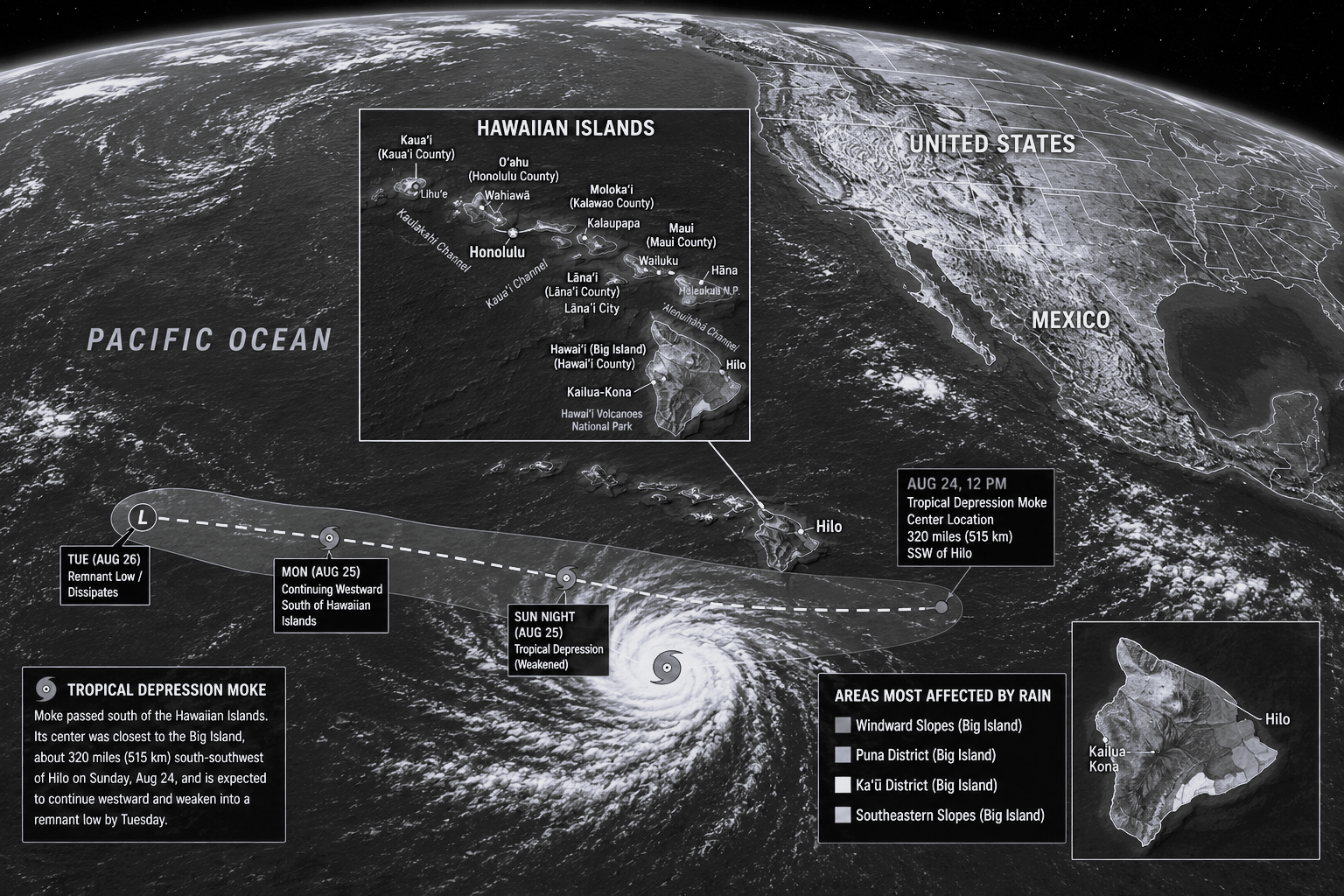
Tropical Depression Moke was moving westward south of the Hawaiian Islands on Monday after weakening from a tropical storm, but the system continued to pose a serious flash-flood and mudslide threat to the Big Island, where communities are still recovering from the devastation caused by Hurricane Lala.
Importantly, Moke did not make a direct landfall in Hawaii. Its center passed south of the Big Island on Sunday and was forecast to continue well south of the smaller main Hawaiian Islands. The storm's center had earlier been about 320 miles (515 km) south-southwest of Hilo, but its outer rainbands and moisture brought heavy rain and gusty winds to Hawaii Island.
The National Hurricane Center said Moke had weakened to a tropical depression, with maximum sustained winds of about 35 mph (55 kph). Earlier forecasts called for 5–10 inches (13–25 cm) of rain across the Big Island, with isolated areas potentially receiving up to 15 inches (38 cm). The heaviest threat was concentrated on the windward and southeastern slopes, particularly the Kaʻū and Puna areas, where steep terrain and saturated ground could trigger life-threatening flooding and mudslides. Eastern Maui was forecast to receive 3–6 inches, while other islands faced lower rainfall totals.
The danger is heightened by Hurricane Lala's recent devastation. The Big Island's northeast coast received about 1.1 metres (43 inches) of rain, while Lala destroyed more than 200 homes and 15 businesses, damaged roads, bridges, power and water infrastructure, and was linked to two deaths, including 93-year-old May Doi.
Emergency operations have expanded as a result. The Hawaii National Guard has been supporting debris removal, search-and-rescue and recovery operations, while crews have cleared roads and helped residents regain access to damaged properties. At Nāʻālehu Cemetery, where Lala's flooding displaced human remains, Guard personnel have recovered 72 remains in a culturally sensitive operation.
Officials also prepared critical infrastructure for another round of rain. Crews cleared drains and culverts, while state and county emergency-management agencies coordinated response operations. A major military airlift was organized to bring heavy equipment and power-grid resources to Hilo, with C-17 aircraft transporting equipment and utility personnel assisting Hawaiian Electric.
Power restoration remains a major concern. Lala initially left more than 111,000 utility customers without electricity, prompting Hawaiian Electric to deploy helicopters and drones to inspect hard-to-reach damage. Thousands of customers on Hawaii Island remained without power as Moke approached.
Governor Josh Green urged residents to stock food, medicine and other essentials, while emergency officials advised people to stay off hazardous roads and shelter in place when necessary. The state has also sought federal assistance for the recovery.
Although Moke has weakened and its center has moved past the Big Island, officials continue to warn that even moderate additional rainfall can be dangerous on ground already saturated and destabilized by Lala. The immediate threat therefore comes not from a direct tropical-storm strike, but from Moke's lingering moisture triggering flooding, mudslides, debris flows, road failures and further power disruptions across communities still struggling to recover.
Meanwhile, Tropical Storm Iselle was strengthening far offshore in the eastern Pacific, although it posed no immediate coastal threat to Hawaii.