
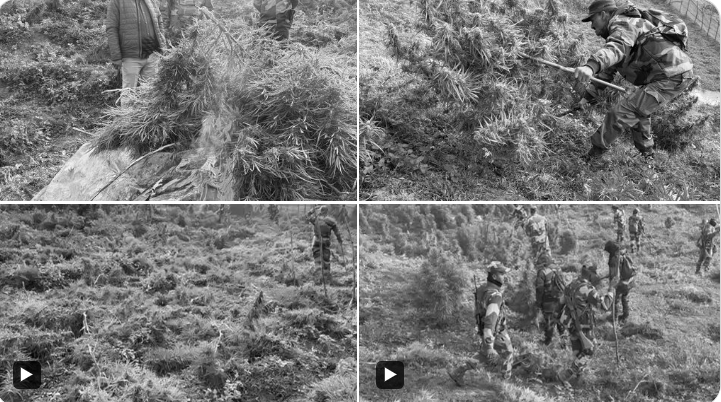
Tripura police destroy Ganja plants worth ₹100 Cr in Sepahijala district
Tripura Police on Sunday said they destroyed around 19 lakh premature ganja plants valued at approximately ₹100 crore during a major anti-narcotics operation in Sepahijala district , marking the largest single-day seizure of its kind in the state.
The day-long operation was carried out on Saturday by a joint team of the Tripura Police, Border Security Force (BSF) and Tripura State Rifles (TSR). Acting on specific intelligence inputs, nearly 600 personnel were deployed to uproot around 19 lakh premature ganja plants spread across about 650 acres of forest land .
Officials said the drive covered forested areas in North Kalamchoura, South Kalamchoura, Anandapur and Ghatigarh. Drones were used extensively to identify ganja cultivation in dense and inaccessible forest regions before ground teams were mobilised to destroy the crops.
Additional Superintendent of Police of Sepahijala district Rajib Sutradhar said the use of aerial surveillance has enhanced the effectiveness of enforcement operations. He added that the anti-cannabis drive would continue as part of the state’s sustained effort to curb narcotics cultivation and trafficking.
Sonamura police station officer-in-charge Tapan Das said preliminary findings indicated that local residents had illegally cultivated ganja on forest land, though no arrests have been made so far. Investigations are ongoing to identify those involved in the cultivation and supply network.
Police officials said the narcotics trade is often linked to organised crime networks operating across state borders. In some cases, security agencies have also flagged indirect links with extremist and insurgent groups, which allegedly benefit through extortion or protection rackets along smuggling routes. Such financial flows, officials said, exacerbate law and order challenges and pose risks to internal security in the northeastern region.
Illegal cultivation of ganja and opium remains a serious challenge in parts of the Northeast, with far-reaching social and economic consequences. Officials say the narcotics trade not only encourages substance abuse but also pulls vulnerable communities, particularly young people, into illegal activities, eroding traditional livelihoods and social structures. Studies and enforcement agencies have flagged rising drug use among youth in several northeastern states, where early exposure to cannabis and opioids has been linked to school dropouts, unemployment, health complications and increased susceptibility to crime. The illegal trade also accelerates forest degradation and land encroachment, while generating steady revenue for organised crime networks involved in smuggling and cross-border trafficking, further straining the region’s law and order machinery.
Officials reiterated that sustained enforcement, community awareness and intelligence-led operations are essential to dismantle narcotics networks and restore social and economic stability in the region.