
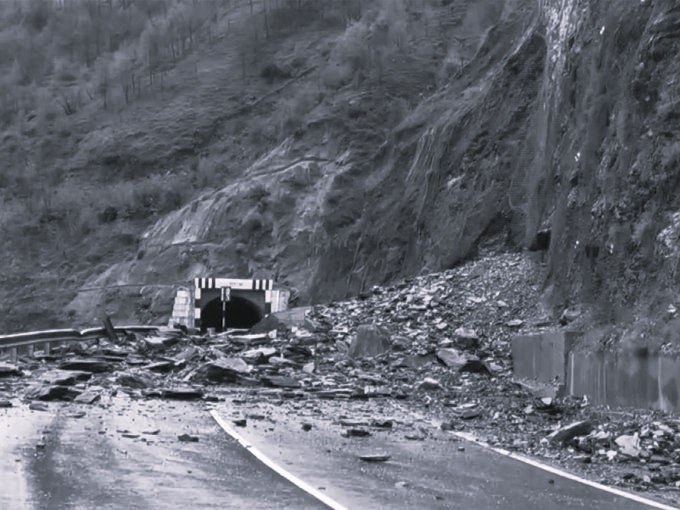
Traffic Suspended on Jammu–Srinagar Highway After Landslides in Ramban
On the winding stretches of the Jammu–Srinagar National Highway , trucks stood in a long, silent line, their engines cold, their drivers restless. For Bashir Ahmad, a fruit trader from Srinagar , this road was more than asphalt it was survival. His truck, loaded with fresh apples, had been stranded near Ramban district since dawn. Up ahead, a landslide had buried the highway under mud and boulders.
Bashir stepped out, pulling his shawl tighter against the chill. Around him, drivers gathered in small groups, exchanging worried glances. Some had been on the road for over 12 hours. A few kilometers away, machines clawed at the debris, their metallic groans echoing through the valley. “This road feeds us,” Bashir muttered. “When it stops, everything stops.”
He wasn’t wrong. The highway (NH-44) is the only all-weather link connecting the Kashmir Valley to the rest of India. Every day, it carries trucks filled with fruits, vegetables, medicines, fuel, and essentials. When landslides strike, it’s not just traffic that halts it’s livelihoods, supplies, and time itself.
In a bus further back, a young student named Ayesha stared anxiously at her phone. She had an exam in Jammu the next morning. Each passing hour tightened the knot in her chest. “What if I don’t make it?” she whispered. Nearby, an ambulance waited, its siren silent but urgent. Inside, an elderly man needed treatment in Jammu. His son paced outside, eyes fixed on the blocked road, as if willing it to open.
The rain intensified. Officials moved quickly men and machines battling both time and terrain. But the mountains were unforgiving. Loose rocks continued to tumble, reminding everyone who truly controlled the road.
For locals, this was not new. Every monsoon, every spell of heavy rain brought the same fear. Shops in the Valley would soon feel the shortage of supplies. Fuel stations might run dry. Prices would rise. And those dependent on daily transport drivers, traders, laborers would bear the immediate blow.
As dusk approached, the line of stranded vehicles stretched further, like a frozen river of steel. Bashir climbed back into his truck and looked at his cargo. If the road didn’t open soon, the apples would spoil. Weeks of hard work would be lost. He closed his eyes, not in anger, but in quiet resignation.
Because here, on this fragile highway carved through mountains, life was always at the mercy of the weather. And when the road breaks, it is not just a journey that is delayed it is an entire region that pauses.