
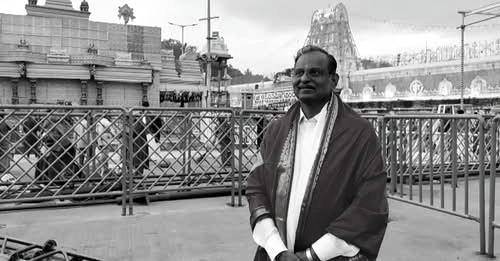
Tradition Meets Technology, ISRO Chief Visits Tirumala Temple ahead of PSLV-C62 launch
In a unique blend of tradition and technology, ISRO Chairman V. Narayanan visited the Tirupati temple on Saturday and offered prayers ahead of the PSLV-C62 mission , scheduled for launch on January 12, 2026 , from the Satish Dhawan Space Centre (SDSC-SHAR), Sriharikota .
Officials from ISRO accompanied Narayanan, carrying a miniature replica of the launch vehicle while offering prayers. Speaking to reporters, he said: “On January 12, we are going to launch PSLV-C62 carrying the EOS-N1 satellite,” adding that the target orbit for the mission is a polar sun-synchronous orbit . The 25-hour countdown is scheduled to commence on January 11 , and the launch will mark the 64th flight of PSLV . PSLV has completed 63 flights so far, including notable missions like Chandrayaan-1, Mars Orbiter Mission (MOM), and Aditya-L1 .
The primary payload, an Earth observation satellite built collaboratively by Thailand and the United Kingdom , will fly alongside 14 other co-passenger satellites , deployed into orbit roughly 17 minutes after lift-off . Notably, this will be ISRO’s first launch of 2026 , taking the total number of foreign satellites launched from Indian soil to 442 .
PSLV-C62 Mission: Multi-Payload Launch and Commercial Satellites:
The PSLV-C62 mission is the 9th dedicated commercial mission by NewSpace India Limited (NSIL) , which provides satellite launch services and manages the integration of 15 co-passenger satellites . The launch will use the PSLV-DL variant with two solid strap-on motors .
A notable feature is the Kestrel Initial Technology Demonstrator (KID) — a small-scale re-entry vehicle developed by a Spanish startup . KID will be the last co-passenger to deploy and is expected to re-enter the Earth’s atmosphere , splashing down in the South Pacific Ocean .
Integration of the vehicle and satellites has been completed, with pre-launch checks underway . The lift-off is scheduled for 10:17 hours IST from the First Launch Pad at Sriharikota .
Students’ CubeSat: Project SBB-1:
Adding a new dimension to the mission, a group of 17 students from Blue Blocks Montessori School, Hyderabad , have developed a flight-ready CubeSat payload , Project SBB-1 (Satellite Blue Blocks-1) , officially cleared by ISRO for launch.
Unlike typical school STEM projects, the students independently designed, assembled, and coded the payload , working with commercial sensors , soldering components, and writing firmware for real-time telemetry . While scientists from Take Me 2 Space provided guidance, the students carried out all engineering tasks themselves .
“Debugging the code when the sensors failed to communicate was the toughest part. We didn’t want to just watch a launch; we wanted to be on the rocket,” said one student.
The project, developed under the Blue Blocks Micro Research Institute using a Structural Autonomy framework , encourages problem-solving with minimal adult supervision. Co-founder Pavan Goyal said, “They are not future engineers. They are flight-ready engineers today.”
The initiative has gained international recognition , with invitations for Goyal to present at the Nobel Peace Center, Oslo , and for the students to deliver a technical review at the AMI Conference in Mexico .
Hyperspectral EOS-N1 Satellite and Other Co-Passengers:
The EOS-N1 satellite (codenamed ‘Anvesha’) is a hyperspectral Earth observation satellite , developed primarily for the Defence Research and Development Organisation (DRDO) . Hyperspectral imaging allows the satellite to observe Earth in hundreds of wavelengths , enabling precise identification of materials and objects. Besides strategic applications like border surveillance and national security , EOS-N1 will also support civilian uses such as agriculture planning, urban mapping, mineral detection, and environmental monitoring .
The mission also carries 17 commercial payloads from startups and academic institutions in India, Mauritius, Luxembourg, UAE, Singapore, Europe, and the United States . Notable Indian payloads include: OrbitAID Aerospace’s AayulSAT — India’s first on-orbit satellite refuelling demonstration, CV Raman Global University’s CGUSAT-1, Dhruva Space’s DA-1, Space Kidz India’s SR-2, Assam Don Bosco University’s Lachit-1, Akshath Aerospace’s Solaras-S4, Dayanand Sagar University’s DSAT-1
AayulSAT aims to demonstrate in-orbit refuelling technologies that could extend satellite lifespans and improve sustainability in increasingly crowded orbital environments .
PSLV: ISRO’s Workhorse:
The Polar Satellite Launch Vehicle (PSLV) has successfully completed 63 flights , including landmark missions like Chandrayaan-1, Mars Orbiter Mission, Aditya-L1, and Astrosat . Notably, in 2017, PSLV set a world record by launching 104 satellites in a single mission , and the upcoming PSLV-C62 flight will be the 64th PSLV mission .