
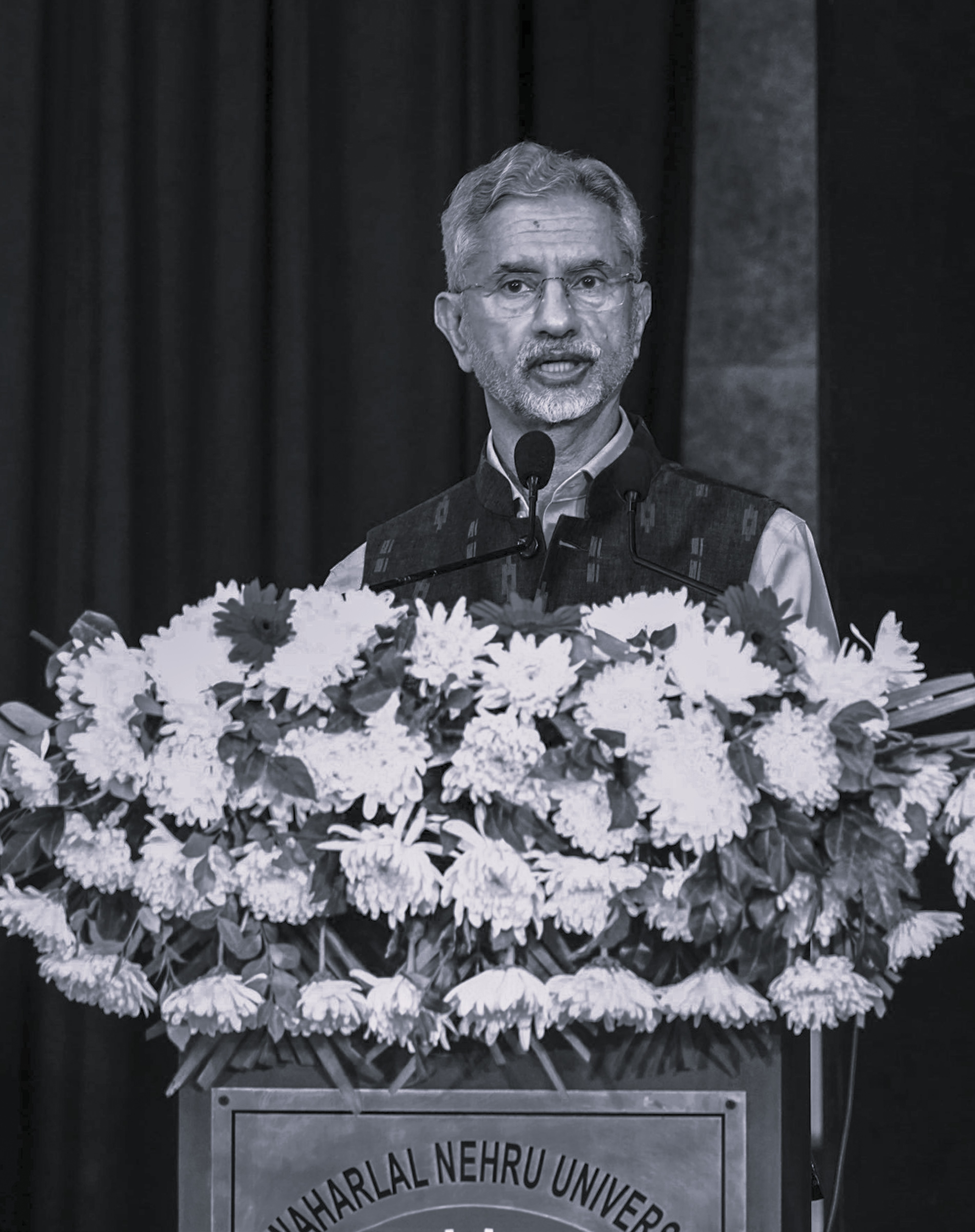
Trade calculations being overturned by tariff volatility: EAM Jaishankar
Trade calculations are being disrupted globally due to “tariff volatility,” External Affairs Minister S. Jaishankar said on Monday, in the context of economic disturbances triggered by Washington’s trade tariff policies.
Addressing an event, Jaishankar discussed the “strategic consequences” of profound changes in the geopolitical landscape, including the concentration of one-third of global manufacturing in a single geography, apparently referring to China. “Consider the global landscape today and reflect on the intensity of this transformation and its implications. A third of global manufacturing has shifted to a single geography, with significant consequences for supply chains,” he said. “There is rising anti-globalisation sentiment in many societies. Trade calculations are being overturned by tariff volatility,” he added, in a veiled reference to Washington’s tariff policies.
Jaishankar was speaking at the first Aravali Summit, hosted by Jawaharlal Nehru University’s School of International Studies, on the occasion of its 70th anniversary. His remarks on tariff volatility come amid a downturn in India–US relations after US President Donald Trump doubled tariffs on Indian goods to 50%, including an additional 25% duty on India’s purchase of Russian crude oil. “The global energy scenario has changed profoundly, with the US becoming a major fossil fuel exporter and China emerging as a key player in renewables. Competing models in data utilization and the evolution of Artificial Intelligence are jostling with each other,” Jaishankar said.
He highlighted the growing influence of Big Tech and the emergence of new connectivity routes, some with strategic purposes. “The mobility debate seeks to reconcile skills, demand, and societal reactions,” he noted. The External Affairs Minister also pointed to sanctions, asset “seizures,” and the rise of cryptocurrencies as elements reshaping global finance. “Competition for rare earths and critical minerals has become intense, even as technology controls have further tightened,” he said. “The quality of weaponry and the nature of warfare have transformed, making conflicts more stand-off, impactful, and risk-prone,” he added.
Jaishankar also expressed concern over the “erosion of sovereignty” facilitated by what he termed “tech penetration and manipulation.” “Global rules and regimes are being revisited and, at times, even discarded. Cost is no longer the sole criterion in economic transactions; ownership and security are equally critical,” he said.
“End-to-end risks are rising, beginning with production concentration, moving through limited supply chains, and culminating in dependence on key markets. A belief in balance of power is being replaced by actions based on margins of power. Cumulatively, the world is witnessing more competition and fewer compacts. The needle has shifted toward intersections of interests and away from the promise of cooperation,” he observed. “It is driven by the weaponisation of everything, with fewer inhibitions in using available tools. All nations now face these predicaments,” he added. While most countries are struggling to cope or defending their interests, Jaishankar said India must strategize and continue to rise amid such volatility.
“The challenge for analysts and practitioners alike is to accurately read this complex and evolving landscape. Only then can we determine how India can best calculate and respond,” he said. “This is by no means a defensive stance. We must safeguard our interests while continuously advancing on the global hierarchy. We need to de-risk our exposures and engagements, yet take calculated risks when necessary,” he added. Responding to a student’s question about whether India’s foreign policy is “agnostic or independent,” Jaishankar said, “To some extent, it is both agnostic and independent.”
He elaborated, “Even in the past, regarding the Indo-Soviet relationship, we acted in our national interest. At that time, we were constrained by a US-Pakistan-China triangle. It was not the moment to claim neutrality. There was only one side of ours. That dictated that whatever actions we took in our national interest were justified.” He further added, “Even today, countries sometimes cite international law principles. I ask them where were these principles when they applied to India? It is not that these principles do not matter, but ultimately, national interest takes precedence.”