
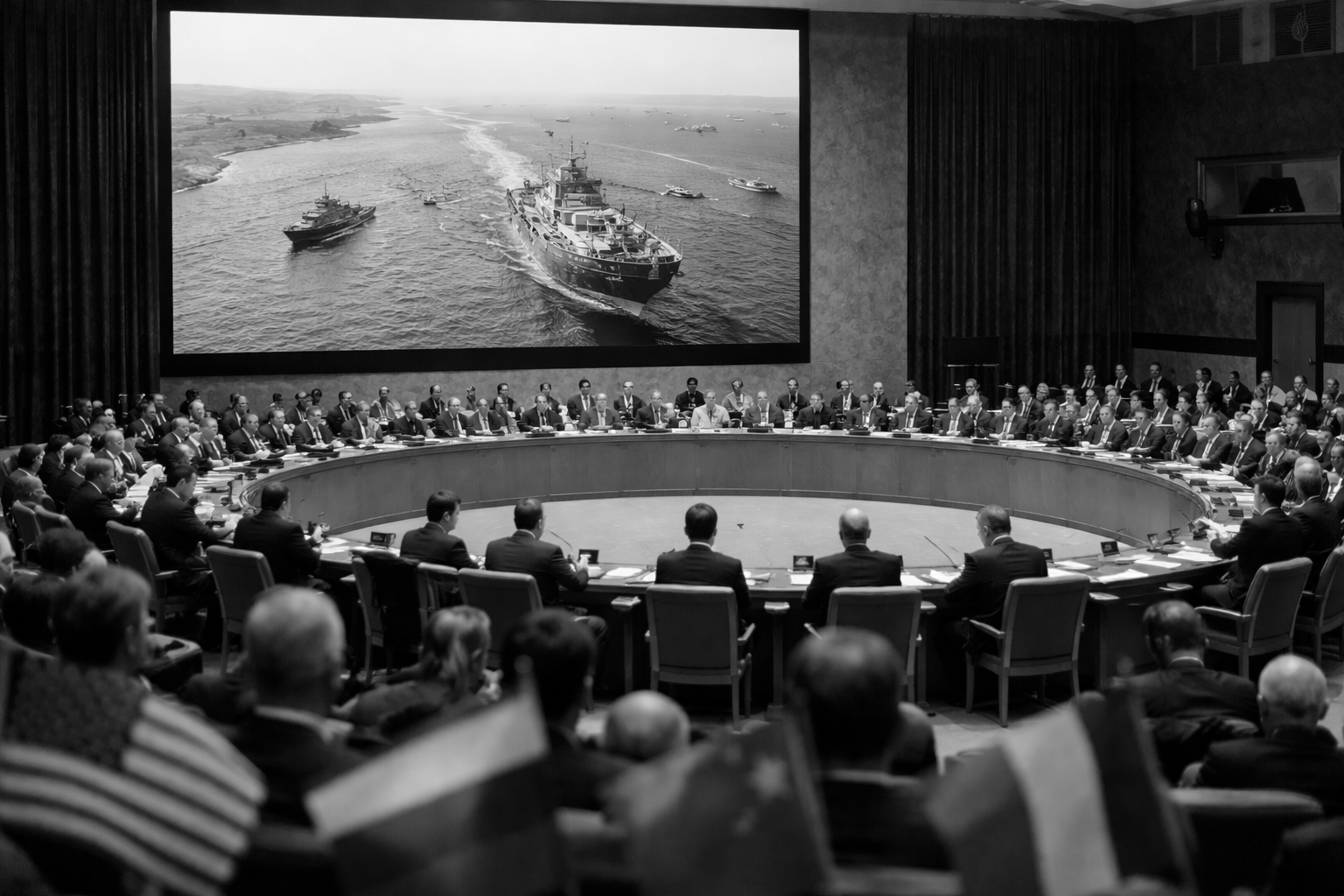
Too little, too late? UN's watered-down Hormuz plan leaves allies unconvinced
A high-stakes vote at the United Nations Security Council on protecting the Strait of Hormuz , one of the world’s most vital energy corridors, has been postponed at the last minute, raising questions among diplomats about the sudden change in schedule.
The 15-member Security Council had been expected to vote Friday morning on a draft resolution proposed by Bahrain , but the meeting was quietly pushed back late Thursday night, with officials citing a public holiday . The explanation surprised many observers since the holiday had been known when the vote was initially scheduled. No new date for the vote has yet been announced.
The delay comes at a time of growing global concern. Iran has tightened its grip on the Strait of Hormuz , a narrow maritime route through which nearly one-fifth of the world’s oil shipments pass. The move is seen as retaliation for US-Israeli military strikes , which triggered a Middle East conflict that has now entered its second month.
The near-closure of the strategic waterway has begun to affect global markets. Supplies of oil, liquefied natural gas and fertilisers moving through the strait have been severely disrupted, sending energy prices climbing worldwide and unsettling economies far beyond the Gulf region.
In response, Bahrain circulated a revised draft resolution that has been significantly watered down from its earlier version. The new proposal allows countries, acting individually or through voluntary multinational naval partnerships , to use “all defensive means necessary” to secure shipping and deter interference with international navigation for at least six months .
However, the revised draft avoids explicitly invoking Chapter VII of the UN Charter , the provision that allows the Security Council to authorise the use of armed force to restore peace.
Even with these concessions, major divisions remain among the Council’s powerful members. China’s UN Ambassador Fu Cong warned that authorising force could “legitimize the unlawful and indiscriminate use of force” , potentially escalating the conflict further. Russia , a close partner of Tehran, has also criticised the proposal as one-sided .
Analysts say the resolution may face serious hurdles. According to Daniel Forti of the International Crisis Group , the text “faces tall odds” of passing the Council given the current geopolitical divisions.
France has indicated a more cautious openness to the revised language. France’s UN Ambassador Jérôme Bonnafont said it is now up to the Council “to quickly devise the necessary defensive response.”
The situation was further complicated by remarks from US President Donald Trump , who told countries struggling with fuel shortages to “go get your own oil” in the strait, adding that American forces would not assist them, comments that unsettled global oil markets.
Meanwhile, diplomatic efforts are intensifying elsewhere. Britain hosted talks with more than 40 countries on Thursday to discuss ways to reopen the strait and voiced support for Bahrain’s proposal. The Arab League , led by Secretary-General Ahmed Aboul Gheit , has also backed the initiative.
On the other side, Iran’s Islamic Revolutionary Guard Corps has made its position clear, declaring that the Strait of Hormuz will remain closed to what it calls the country’s “enemies.”
Whenever the Security Council finally holds the vote, it will be one of the most consequential diplomatic decisions in recent years , a test of whether the world body can respond decisively to a crisis that is squeezing economies from Mumbai to Madrid .