
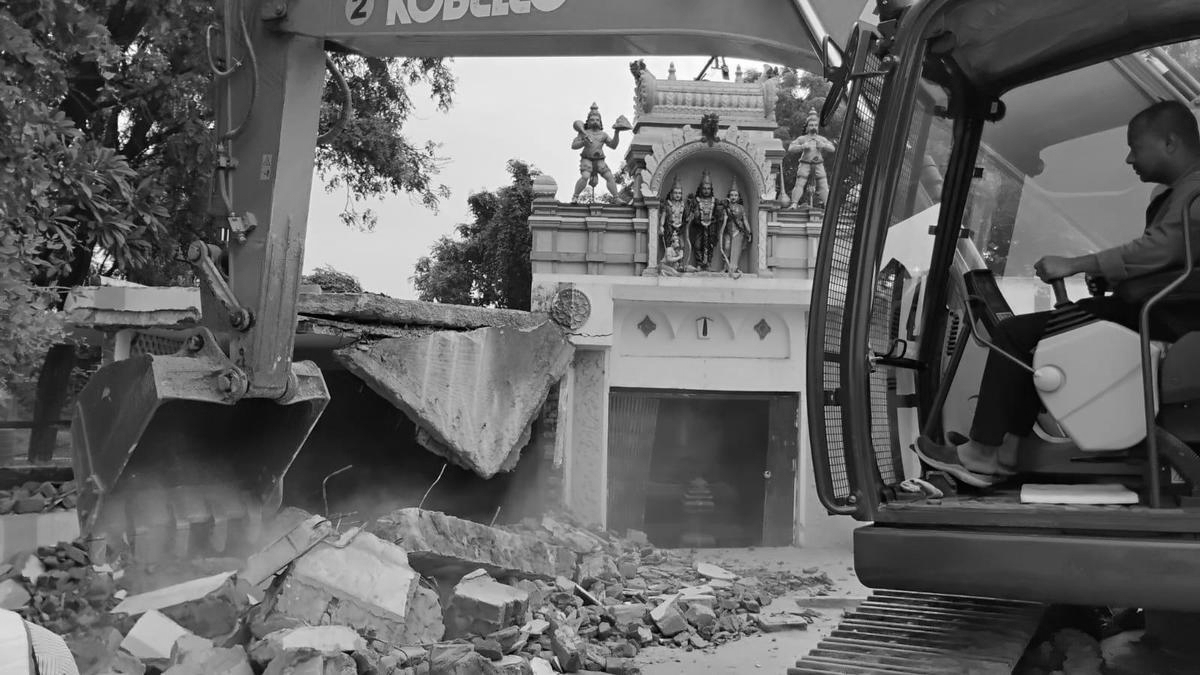
Tirupati Collector Defends Temple Relocation For NH-716 Expansion, Cites Villagers' Consent
Tirupati District Collector S Venkateswar on Thursday defended the relocation of the nearly 60-year-old Abhayanjaneya temple at Anjaneyapuram to facilitate the expansion of National Highway-716, saying the process was carried out with the consent of villagers and in accordance with religious customs.
The temple, located in Renigunta mandal, was removed on November 23 as part of the highway expansion project connecting Kadapa and Renigunta. Its main idols were shifted to a nearby government-allotted site a day earlier after priests performed traditional rituals, including Balalayam and Shanti Homam.
Addressing a press conference on Wednesday, Venkateswar said the administration had consulted villagers, priests and Endowments Department officials before proceeding with the relocation. He was accompanied by representatives of the village, the Endowments Department and the National Highways Authority of India (NHAI).
The Collector said the highway alignment was finalised in 2019, while the land acquisition notification was issued in January 2023 and the award passed in August that year, during the previous YSRCP government. He added that the district administration had no authority to modify the alignment approved by the Union Ministry of Road Transport and Highways.
Following discussions with village elders, Rs 59.3 lakh was deposited with the Endowments Department in August 2026 as compensation for the temple. The villagers requested that the amount be used for constructing a new shrine. While the original temple stood on 10 cents of land, the administration allotted 50 cents for the new temple and arranged a temporary facility to ensure daily worship continued uninterrupted.
Hemant Kumar, son of the temple's founder Sukhadanayya, said the family had been informed about the relocation around four years ago. He maintained that villagers agreed to the proposal and that there was no pressure or coercion. Priests said the idols were ceremonially transferred to temporary arrangements following prescribed rituals, including their invocation into temporary idols and placement in Navadhanyas (nine grains).