
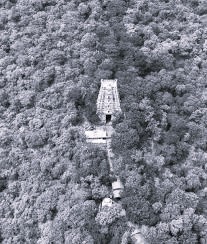
Tirumala Forest Cover Touches 89.4 Per Cent: ISFR Report
The Tirumala hill range , home to the revered shrine of Lord Venkateswara, continues to stand out not only as a major pilgrimage centre but also as a highly preserved ecological landscape, according to the latest findings of the India State of Forest Report (ISFR) .
The report highlights that forest cover in the Tirumala region has reached 89.4 per cent , placing it among the most densely green pilgrimage zones in the country. Of the total 2,719 hectares of land managed under the jurisdiction of the Tirumala Tirupati Devasthanams (TTD) , about 2,431 hectares are under thick forest cover.
Officials noted that this balance between large-scale pilgrim management and ecological protection reflects decades of sustained conservation efforts in the Seshachalam Hills . The TTD has been actively involved in protecting the region’s biodiversity since 1980 , treating forest conservation as an integral part of temple administration.
To strengthen protection measures, the TTD maintains a dedicated forest division with four forest range offices spread across Tirumala and Tirupati. These units are supported by special flying squads that conduct continuous surveillance to prevent illegal tree cutting, wildlife disturbance, and activities such as red sanders smuggling , which has historically been a concern in the region.
During the dry summer months, when forest fire risks increase, the department prepares preventive fire lines stretching approximately 26.5 kilometres each year . These cleared strips act as barriers, slowing or stopping the spread of accidental fires and safeguarding both vegetation and wildlife habitats.
In recent years, ecological restoration has also become a focus area. The TTD has gradually replaced non-native plantation species like acacia with indigenous trees suited to the local ecosystem. Plantation drives across nearly 576 hectares have introduced species such as peepal, banyan, sandalwood, red sanders, mango, and jamun, supported by dedicated nurseries for medicinal and flowering plants.
The forest division also plays a role in maintaining ecological balance around pilgrim routes. Measures include creating artificial water sources inside forest areas to prevent wildlife from moving towards human settlements and deploying rescue teams to manage snake encounters along walking paths.
Beyond conservation, the department also supplies essential natural materials used in temple rituals, including sandalwood, firewood, and darbha grass, while contributing to greenery development across Tirumala and Tirupati through plantation and landscaping activities.