
Three-Language Framework Gains Ground, Karnataka SSLC Move Draws Scrutiny
India’s school education landscape is entering a phase of significant transition, as reforms at both the national and state levels reshape how students learn languages and are assessed academically.
The Central Board of Secondary Education (CBSE) has introduced a new curriculum aligned with the National Education Policy (NEP) 2020 and the National Curriculum Framework (NCF) 2023 , with implementation beginning from the 2026–27 academic session . A central feature of these reforms is the structured three-language framework , which will be rolled out from Class 6 .
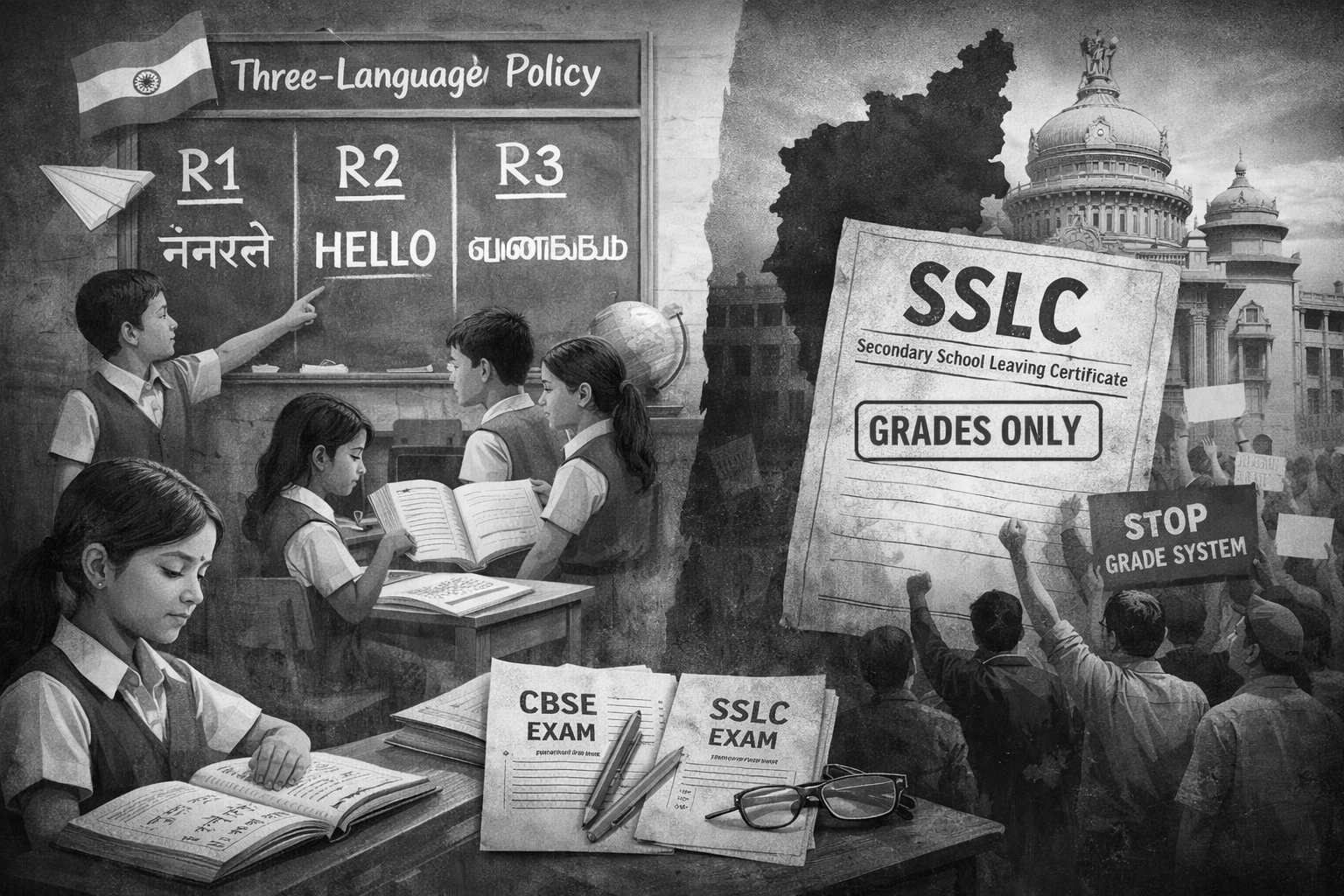
Under this model, languages are organised into three categories - R1, R2, and R3 . R1 refers to the student’s primary language , usually the mother tongue or regional language , studied with the highest proficiency. R2 is a second language, often Hindi or English, while R3 is a third language introduced from Class 6 to expand linguistic exposure. The framework mandates that at least two of the three languages must be Indian , aiming to promote multilingualism, cultural understanding, and cognitive development while offering flexibility in language choices.
Alongside language reforms, CBSE has proposed a two-tier system for mathematics and science starting in Class 9 . All students will take a standard-level examination (80 marks) , while those seeking advanced learning can opt for an additional 25-mark paper designed to assess analytical and higher-order thinking skills . This advanced component will be recorded separately and will not impact the overall aggregate. The first batch of students under this system is expected to appear for Class 10 board exams in 2028 .
However, the broader push for multilingual education has not been without debate. Across the country, the three-language framework has drawn criticism on political, academic, and practical grounds . Some states, particularly in southern India, have raised concerns about the perceived imposition of Hindi , arguing that it could undermine regional linguistic identity and create imbalances in opportunities. While the Centre maintains that no language is compulsory, critics contend that implementation patterns may still favour certain languages.
Education experts have also pointed to practical challenges , including a shortage of trained language teachers , uneven infrastructure, and lack of clarity in execution. Concerns about the academic burden on students have also surfaced, with questions over whether learning multiple languages simultaneously may affect comprehension and overall outcomes. Additionally, some states have emphasized that education falls under their jurisdiction , calling for greater flexibility or even alternative models such as a two-language system .
A related debate has emerged in Karnataka, where the state government recently decided to award only grades, without marks , for the third language in the SSLC examination (Secondary School Leaving Certificate) , which is the Class 10 public board exam conducted by state boards .
The move has prompted the Governor of Karnataka to call for a comprehensive review , following concerns raised by the Association for Preservation of Local Languages, Bengaluru . The representation highlighted that the third language plays a crucial role in fostering linguistic diversity, intellectual growth, and cultural awareness , and warned that removing marks could reduce its academic importance and weaken student engagement.
Teachers, parents, and educationists have also expressed concerns about the long-term impact on the quality and inclusiveness of education. In response, the Karnataka government has defended its decision , stating that the policy is intended to reduce student stress and improve learning outcomes . Officials noted that while the subject remains mandatory, it will be assessed through grades and excluded from the overall aggregate. The government also cited high failure rates in the third language in previous years as a key reason for the shift.
It further clarified that the decision is not directed against any specific language and is aimed at creating a more balanced and student-friendly system. The Governor has now directed Chief Secretary Shalini Rajneesh to examine the matter in consultation with the Department of School Education and other stakeholders, taking into account both academic and administrative implications.
Together, these developments highlight the evolving nature of India’s education system, where efforts to promote multilingual learning, flexibility, and conceptual understanding are being balanced against concerns over implementation challenges, student workload, and educational equity .