
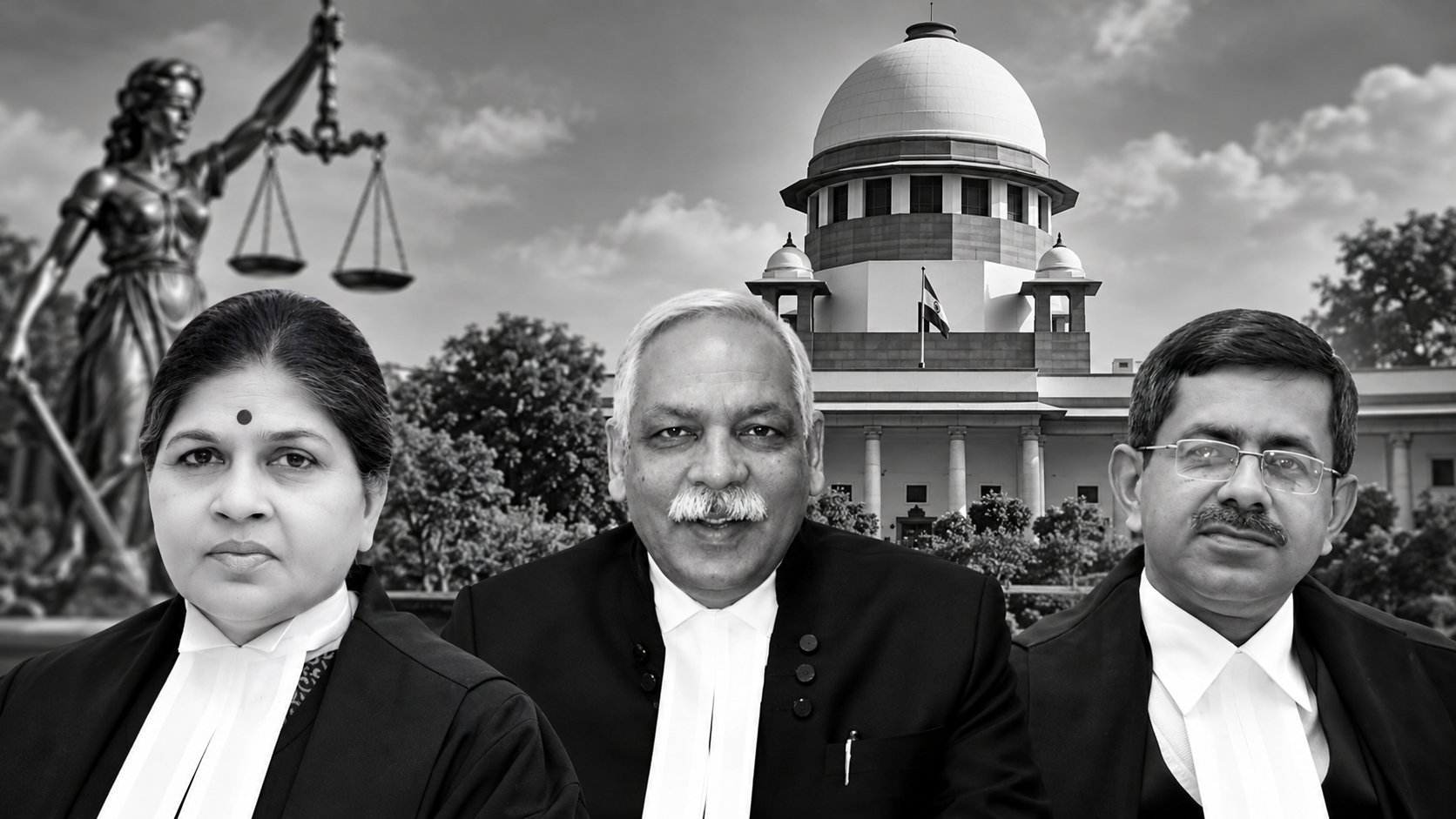
Three New Judges Likely to Join Supreme Court Next Week
The Supreme Court is likely to get three new judges next week, with the elevation of three serving High Court Chief Justices expected to take the apex court's working strength to 37 against a sanctioned strength of 38. The Supreme Court Collegium, headed by Chief Justice of India Surya Kant, recommended the elevation of Justice Sunita Agarwal, Chief Justice of the Gujarat High Court; Justice Devendra Kumar Upadhyaya, Chief Justice of the Delhi High Court; and Justice Aparesh Kumar Singh, Chief Justice of the Telangana High Court at its meeting on September 28. The recommendations are being processed through the established appointment procedure, with reports indicating that formal appointments could be completed in the coming week.
At present, the Supreme Court has 34 sitting judges, including the CJI. If the three recommendations are approved, notified and followed by oath-taking, the working strength will rise to 37, leaving one vacancy against the sanctioned strength of 38.
The latest appointments come after a significant expansion of the Court's statutory strength earlier this year. The process began on May 16, 2026, when the President promulgated the Supreme Court (Number of Judges) Amendment Ordinance, 2026, increasing the number of judges other than the CJI from 33 to 37 and taking the total sanctioned strength from 34 to 38.
The government subsequently introduced the Supreme Court (Number of Judges) Amendment Bill, 2026 in the Lok Sabha on July 20. The Lok Sabha passed it on August 3, followed by the Rajya Sabha on August 5. President Droupadi Murmu gave her assent on August 11, turning it into the Supreme Court (Number of Judges) Amendment Act, 2026, or Act No. 14 of 2026. The Act is deemed to have come into force from May 16 and repealed the earlier Ordinance while preserving actions taken under it.
The expansion was intended to strengthen the Court's capacity amid its substantial workload and provide greater flexibility to constitute Constitution Benches. The legislation came against a backdrop of 92,101 cases pending before the Supreme Court on January 1, 2026, while 75,410 fresh matters were instituted and 65,615 disposed of during 2025.
The latest recommendations follow a major appointment round in June, when five judges were sworn in, taking the Court's working strength to 37 before subsequent retirements reduced it to 34. The September recommendations would therefore mark the second major appointment cycle following the expansion.
The three nominees bring extensive judicial and administrative experience. Justice Sunita Agarwal, whose parent court is Allahabad, has headed the Gujarat High Court since 2023. Her elevation would take the number of women judges on the Supreme Court to three, alongside Justices B.V. Nagarathna and V. Mohana. Justice Upadhyaya, also from Allahabad, has headed the Bombay and Delhi High Courts, while Justice Aparesh Kumar Singh, from the Jharkhand High Court, has served as Chief Justice of Tripura and Telangana.
The appointments assume significance amid the Court's continuing workload. As of September 1, 22 five-judge, five seven-judge and two nine-judge Constitution Bench matters were pending. A larger bench strength can provide greater flexibility to hear such matters while maintaining regular benches for appeals and other cases.
However, additional judges alone may not automatically reduce pendency, as fresh filings, disposal rates, hearing time, case complexity and bench allocation also influence the backlog.
The proposed appointments also come ahead of scheduled retirements, including Justice Satish Chandra Sharma in November 2026 and CJI Surya Kant in February 2027. Thus, even after the three elevations, maintaining the Supreme Court near its 38-judge sanctioned capacity will remain an ongoing process.