
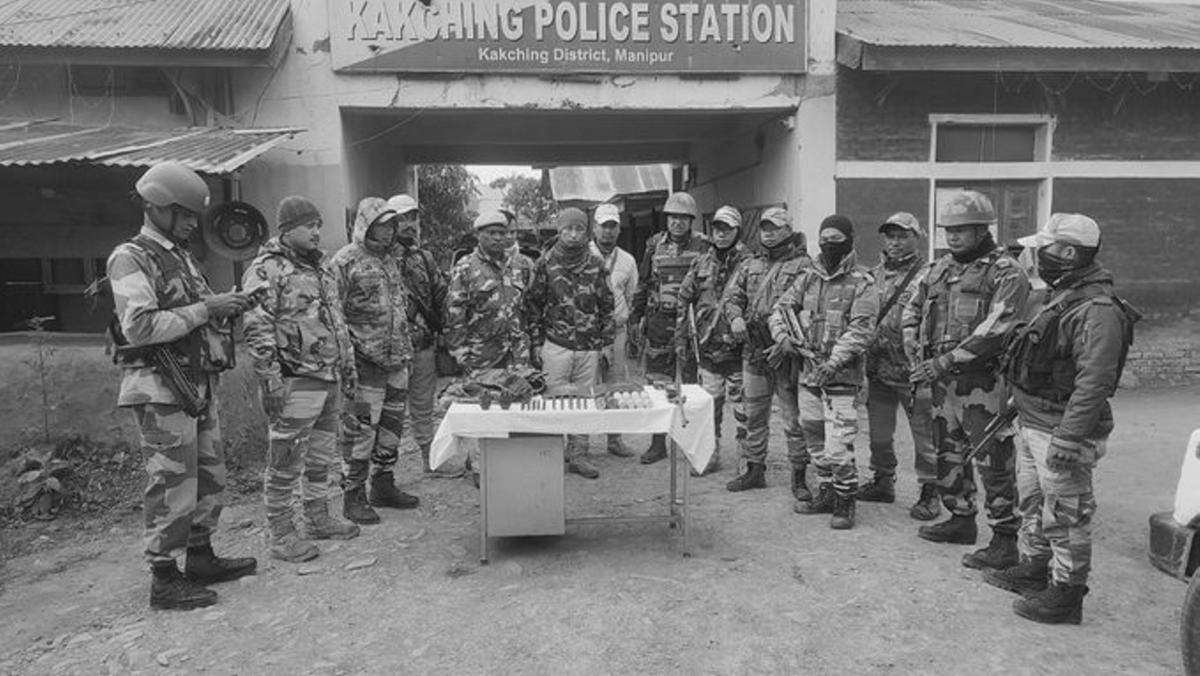
Three militants arrested, arms and ammunition recovered in Manipur amid ongoing ethnic violence
Security forces have intensified counter‑insurgency operations in Manipur’s valley districts, arresting three militants linked to different proscribed outfits and recovering weapons, amid a wider campaign to restore stability in the violence‑wracked northeastern state, police said on Saturday. A senior officer said an active cadre of the banned Kangleipak Communist Party (Noyon) was detained on Thursday in the Kongpal Chingangbam area of Imphal East district, and a 50‑year‑old member of the outlawed Prepak (Pro) was arrested that day in Imphal West’s Amboikhongnangkhong area. Another suspect, a cadre of the banned People’s Liberation Army , was held from the Nagaram area of Imphal West for alleged extortion, and demand notices were seized from his possession. During separate operations, security forces recovered arms and ammunition from the Ikop Pat area in Thoubal district, and from the hill ranges of Natum Ching and Sanasabi in Imphal East, where a country‑made AK rifle, a hand grenade and bombs were found. These actions are part of ongoing search and combing operations that have been in place since ethnic violence erupted in May 2023.
The broader security situation in Manipur remains highly volatile with militant activity ongoing across both valley and hill districts. Recent operations by police and paramilitary forces have resulted in the seizure of large caches of weapons, ammunition, anti‑riot guns and improvised explosive devices in several districts, reflecting the persistence of illegal arms proliferation fueling unrest and criminality.
Manipur has been subject to decades of insurgency involving multiple groups across ethnic lines, but the current crisis stems from deep‑seated tensions between the majority Meitei community of the Imphal valley and tribal Kuki‑Zo communities from the surrounding hills. This violence, now in its third year, has killed hundreds, displaced thousands into relief camps with lingering hardship, and disrupted economic life, with retailers, hospitality and transport sectors particularly affected as markets and highways were closed or rendered unsafe.
The central government responded to the escalation by imposing President’s Rule in Manipur in early 2025 after the resignation of Chief Minister N Biren Singh , taking direct control as law and order deteriorated. The state assembly remains under suspended animation. In the months since, authorities have pursued a multi‑pronged strategy to regain control: establishing buffer zones manned by the Army and central forces to reduce direct ethnic clashes and dismantling illegal bunkers and checkposts that had divided communities.
To reduce the circulation of weapons, government officials previously set deadlines and incentives for the surrender of looted and illegal arms, with some community organisations, including armed groups, turning in significant numbers of firearms under assurances of non‑prosecution and future security guarantees efforts seen as part of confidence‑building to reduce violence.
Authorities have also sought structured dialogue with community leaders to foster long‑term peace, including extending Suspension of Operations (SoO) pacts with various armed groups and smaller armed outfits to limit hostilities while confidence‑building measures advance.
The judiciary has entered the fray too, with the Supreme Court recently ordering a forensic probe into disputed voice recordings allegedly implicating the former Chief Minister in aspects of the 2023 unrest, indicating heightened legal scrutiny into the political dimensions of the crisis.Beyond arrests and weapons seizures, authorities face grassroots resistance and fragile cooperation in some areas: in mid‑2025, a six‑hour standoff occurred in Churachandpur when villagers blocked security forces trying to arrest a suspected militant, underlining ongoing mistrust and volatility at the local level. National and humanitarian organisations have repeatedly expressed concern about civilian protection, including justice for horrific crimes committed during the violence, such as the gang rape and public humiliation of women in May 2023 cases for which trials are now underway in special courts.
While the situation has not returned to normalcy, there are tentative signs of stabilisation: in late 2025, over 250 internally displaced families were able to return home with government support for reconstruction and rehabilitation, a milestone that authorities hope signals the beginning of gradual recovery.