
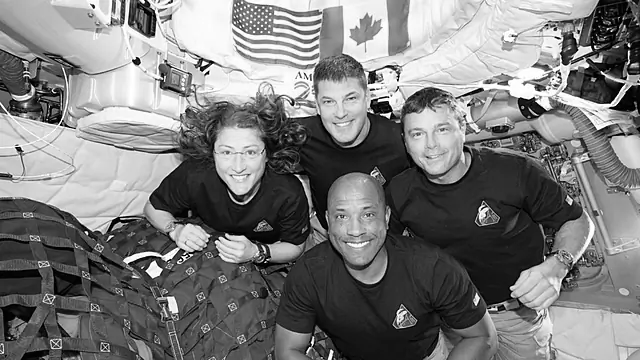
They touched the edge of space, now Earth reaches out to catch them: Artemis II comes home
For the first time in over half a century , humanity sent four people around the Moon, and tonight, they come home.
Commander Reid Wiseman, pilot Victor Glover, mission specialist Christina Koch, and Canadian Space Agency astronaut Jeremy Hansen are set to splash down in the Pacific Ocean off the coast of San Diego at approximately 8:07 p.m. EDT on Friday, April 10 , wrapping up a breathtaking 10-day mission.
The crew launched from Florida on April 1, and made history on April 6 when they reached 248,655 miles from Earth , surpassing the farthest distance ever traveled by humans, a record previously held by Apollo 13 in 1970. As they emerged from behind the Moon, they witnessed a total solar eclipse from deep space , pilot Glover called it "one of the greatest gifts." Being cut off from all of humanity while behind the Moon was especially "surreal", commander Wiseman reflected. "There's a lot that our brains have to process," he said. "It is a true gift."
Now the mission enters its most dangerous chapter . Orion will reenter Earth's atmosphere southeast of Hawaii, flying nearly 2,000 miles to its splashdown site, in what NASA describes as "13 minutes of things that have to go right." A six-minute communications blackout will follow just 24 seconds after atmospheric entry, as plasma engulfs the capsule, before parachutes deploy to slow the spacecraft to a safe splashdown speed.
Flight Director Jeff Radigan was blunt about the stakes: the capsule must hit the reentry angle within a single degree . NASA also modified the capsule's descent profile after Orion's 2022 uncrewed test flight revealed more heat shield damage than expected. Future missions, Artemis III and beyond, will fly with entirely redesigned heat shields .
NASA is targeting early 2028 for the first Artemis lunar landing as part of Artemis IV, with a lunar surface mission expected by late 2028 under Artemis V, all building toward a permanent human presence on the Moon .
For now, the world watches. "If you can't take love to the stars," said NASA Associate Administrator Amit Kshatriya, " what are we doing? "
Artemis II didn’t just go to the Moon, it pushed humans farther than ever before and restarted the deep-space exploration era after 50 years.