
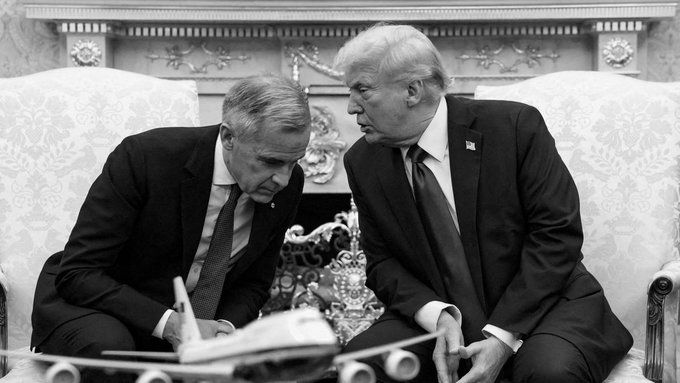
The West can no longer pretend to be a ‘collective West’, Trump shows everyone their place
The latest tariff threat from US President Donald Trump against Canada goes beyond a routine trade dispute. It underlines a deeper shift in global economic relations, where the idea of a unified, values driven “collective West” is steadily giving way to blunt power politics.
Trump’s warning that he could impose a 100 per cent tariff on Canadian goods if Ottawa proceeds with a limited trade deal with China sent shockwaves through markets. The move was framed as a response to concerns that Canada could become a transit point for Chinese products entering the US, but its implications stretch far wider.
Canada’s agreement with China, which involves easing tariffs on Chinese electric vehicles in return for lower duties on Canadian agricultural exports, is modest in scale. Yet Trump’s reaction was swift and confrontational, signalling that even limited strategic autonomy by allies may invite economic retaliation.
While Trump’s warning carries legal pathways under US trade law, analysts say a blanket 100 per cent tariff on Canada would be difficult to sustain in practice. Canada is protected under the Canada–US–Mexico Agreement , the trade pact that governs economic and tariff relations between the US, Canada and Mexico, and any extraordinary tariff action would likely face legal challenges, domestic political resistance and economic blowback within the US itself. As a result, the threat is widely viewed as a pressure tactic rather than an immediately executable policy, aimed at deterring Ottawa and signalling Washington’s red lines to other allies.
From a business standpoint, the costs of such a move would not be one sided. Canada is the largest export destination for 36 US states, with nearly USD 3.6 billion worth of goods and services crossing the border every day. The US depends heavily on Canada for crude oil, electricity, steel, aluminium, uranium and critical minerals vital for manufacturing and national security. A punitive tariff would raise costs for US industries, disrupt deeply integrated supply chains and invite swift retaliation from Ottawa, effectively boomeranging back into the US economy.
The political clash has also spilled onto the global stage. Speaking at the World Economic Forum in Davos , Canadian Prime Minister Mark Carney warned that middle powers must work together to resist coercion by major powers, remarks widely interpreted as a response to Trump’s trade posture. Trump, in turn, intensified his rhetoric, questioning Canada’s sovereignty and publicly belittling its leadership.
For decades, Western leaders have spoken of shared values and collective decision making. Trump has made little effort to preserve that language. His approach is openly hierarchical, transactional and unapologetic, redefining alliances not as partnerships but as leverage points.
The episode leaves businesses and policymakers facing a sobering reality. The West can no longer convincingly present itself as a single, coherent economic bloc. Instead, it is increasingly shaped by power asymmetry, with allies forced to weigh compliance against economic risk. Trump is not merely exposing these fault lines. He appears determined to enforce them.