
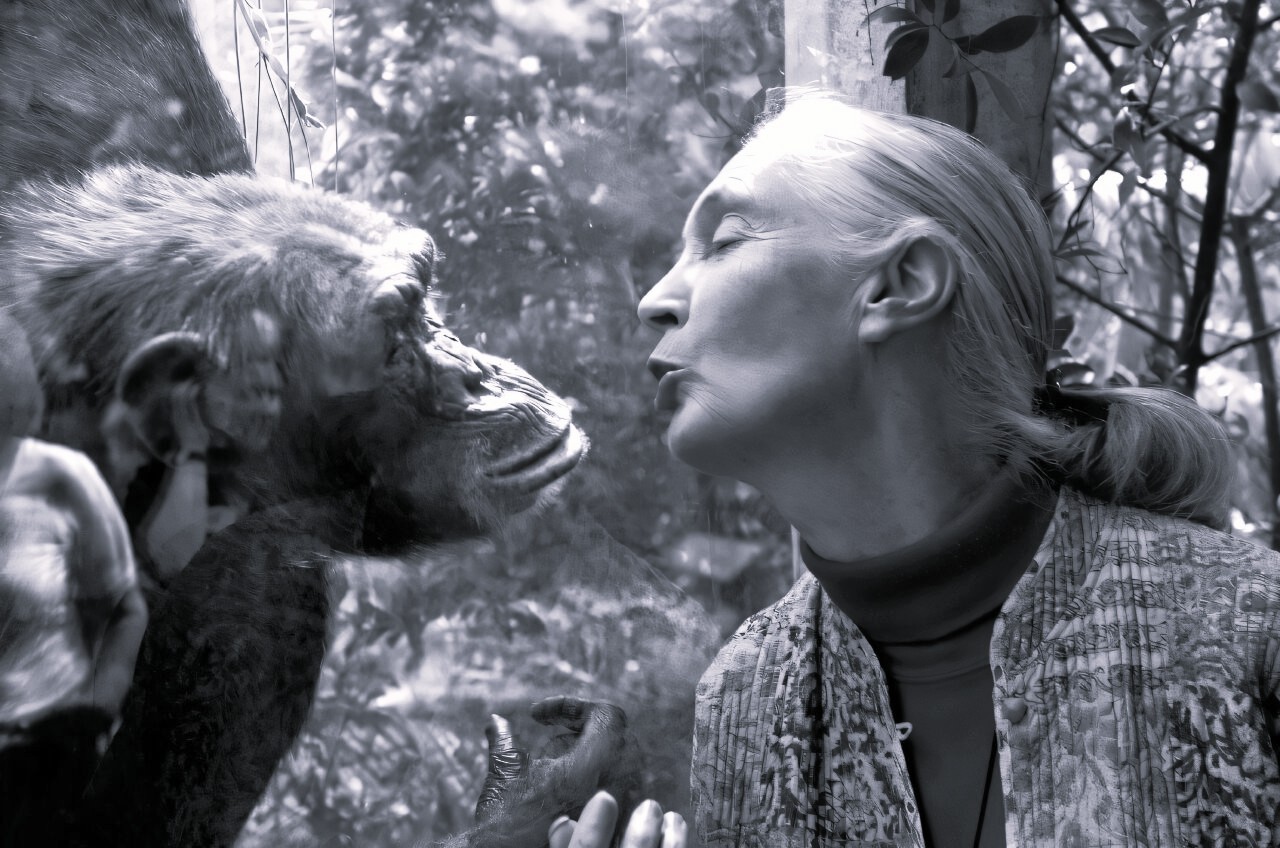
The Unspoken Bond: What Jane Goodall learned from Chimps that changed Her—and Us
Jane Goodall, the world-renowned conservationist and primatologist, died on Wednesday in Los Angeles at the age of 91. She gained international recognition for studying wild chimpanzees in East Africa, observing behaviors such as tool use, meat-eating, rain dances, and organized conflict. Her death occurred while she was on a speaking tour. Goodall rose to scientific prominence at age 29, when National Geographic published her 7,500-word, 37-page study of chimpanzees in the Gombe Stream Chimpanzee Reserve in Tanzania. Her groundbreaking research there was supported financially by the National Geographic Society.
She and the chimps:
Gombe Stream, 1960. A dream realized, a reputation risked. A young Englishwoman, Jane Goodall, arrived in the vast, intimidating jungle with nothing but an insatiable curiosity and a mother to chaperone her (colonial rules forbade a woman traveling alone). She wasn't a doctor of science; she was a dreamer armed with a childlike sense of wonder, and the establishment was ready to scoff.
But Jane didn't care about their textbooks.
She abandoned the clinical distance of traditional research, instead practiced radical patience. She sat, day after day, week after week, until she was just part of the background, a silent fixture in the trees. Her subjects weren't research items; they were neighbors. She gave them names—like the dignified David Greybeard and the playful Fifi—a deeply personal act that broke every scientific rule but unlocked their secrets.
The moment the world shivered
It was a quiet afternoon when David Greybeard performed the act that would rock anthropology. Jane watched as she broke a twig, stripped the leaves, and poked it into a termite mound to "fish." It was a moment of pure ingenuity, a flash of problem-solving that made her heart pound.
When she reported the finding, her mentor, Louis Leakey, sent back a telegram for the history books: "Now we must redefine 'man,' redefine 'tool,' or accept chimpanzees as human." That discovery didn't just change the dictionary; it changed Jane, forcing her to confront the unsettling reality that the intelligence we cherished as uniquely ours was shared. The line we drew in the sand between us and them simply vanished.
Flo’s hug and the shadow of war
As Jane stayed—for months that became years, and years that became a lifetime—the chimps revealed the full, messy spectrum of existence.
She saw the tender, fierce love of mothers like Flo, whose children thrived because of her competence and devotion. She documented families holding tight to each other, feeling joy, and sinking into palpable grief when a loved one died. These were not automatons; they were individuals with moods, rivalries, and life stories as complex as any human family.
But then came the darkness.
Jane documented the chilling Gombe Chimpanzee War, a sustained campaign of lethal violence. She saw systematic brutality, territorial raids, and murder that made her question everything she thought she knew about nature. "It was a difficult, painful truth to document," she said, admitting it forced her to confront the capacity for evil that exists in both human and chimpanzee nature. The Gombe forest became a mirror, reflecting our own worst impulses.
The Unwavering Message of a 90-Year-Old
The realization that our closest relatives face the same struggles and exhibit the same extremes of kindness and cruelty was a turning point. Jane couldn't just study them anymore; she had to fight for them.
She traded her jungle boots for business attire and her patient silence for a tireless speaking schedule. She founded the Jane Goodall Institute (JGI) and the Roots & Shoots program to inspire kids worldwide.
She travelled almost constantly, a beacon of persistent hope. Her message isn't shouted; it's a calm, insistent plea: "Every individual matters. Every individual has a role to play. Every individual makes a difference."
Jane Goodall’s true gift was not classifying an animal, but teaching us to see a reflection of our best and worst selves in their eyes. She proved that science needs a heart, and that to save the chimps, we first have to recognize and act upon the shared connection that makes us all just one big, messy, complicated family on a single planet.
It’s time we give it a thought to- what small act of compassion in our own life will we choose to make a difference today?