
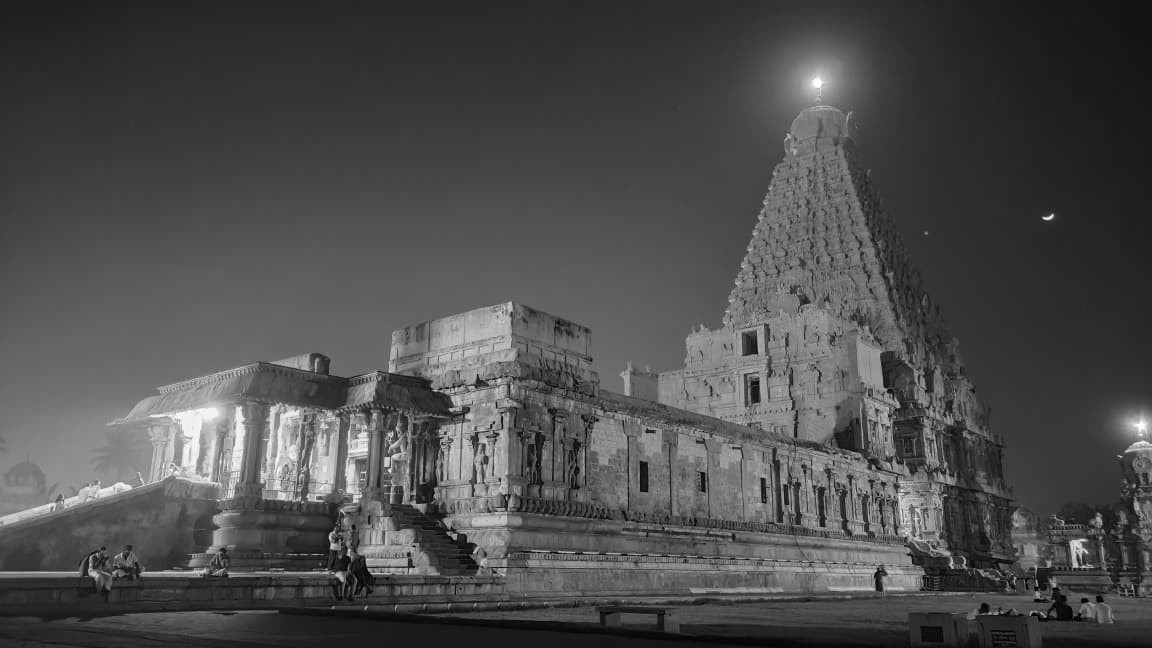
The Thanjavur Brihadeeswara Temple: Mysteries Behind the Marvelous Creation
Thanjavur... stands as a glorious chapter in the history of Tamil Nadu. This land is the silent witness to the immense splendor and extraordinary engineering of the Chola Emperors. The Sri Brihadeeswara Temple located here is not merely a place of worship; it is an undisputed benchmark for 11th-century sculpture and architectural science. Recognized as a World Heritage Site by UNESCO, this temple is a source of pride for every Indian citizen.
The temple's height, its construction, and the fact that it has stood firm for over a thousand years remain unanswered questions even for modern technology. Here, we present an investigative article about the history, miracles, and the ancient construction style hidden behind this great structure.
The Chola Emperor’s Resolve: History Behind the Construction
The story of the Brihadeeswara Temple is deeply linked to the firm resolve of the Chola Emperor Rajaraja Chola I (A.D. 985–1014).
Rajaraja Chola was not just a great warrior; he was also a devout worshipper of Shiva, a patron of the arts, and a forward-thinking ruler. After establishing Thanjavur as the capital of his empire, he determined to build a vast, towering temple for his beloved deity, Lord Shiva. His goal was for this temple to serve not just as a religious center, but as a testament to the unrivaled power and wealth of the Chola Empire.
From Foundation to Completion
The construction of this temple began in the year A.D. 1003. History indicates that Rajaraja Chola completed the entire massive structure in just seven years (by 1010 AD, according to some sources) and consecrated the temple in A.D. 1010. Achieving such a colossal construction in just seven years, given the limited resources and the absence of modern machinery of that era, is truly a historical miracle. Thousands of sculptors, engineers, laborers, and artists participated in the temple’s construction.
Divine Architectural Style: The Dravidian Grandeur
The Brihadeeswara Temple is a masterpiece of the Dravidian architectural style. A unique feature of its construction is that it was built entirely on soft, sandy soil, not firm ground.
1. The Main Vimana (Tower)
The biggest attraction of this temple is its main tower (Vimana). The height of this Vimana is approximately 216 feet (66 meters). This made it the tallest temple tower in the world at that time. It was constructed with 13 tiers. The unique aspect is that, unlike other Dravidian temples, here the main tower (Vimana) is much taller than the Rajagopuram (the tower over the entrance gate). This architectural choice symbolizes the strength and spiritual superiority of the Chola kings.
2. Nandi Mandapam
At the front of the temple, there is a spacious Nandi Mandapam. The Nandi idol within it is one of the largest monoliths carved out of a single stone. This massive Nandi statue is approximately 13 feet high, 16 feet long, and 5 feet wide. This huge statue further enhances the temple's architectural grandeur.
3. Inner Mandapas and Mythological Sculptures
The temple complex spans approximately 240 meters in length and 120 meters in width. Inside the temple, the Shiva Lingam stands about 13 feet high. The walls are adorned with magnificent sculptures depicting mythological stories, the victories of the Chola kings, and the divine play of Lord Shiva. The quality and detail of these sculptures, which remain intact after centuries, reflect the extraordinary skill of the sculptors of that time.
Unsolved Engineering Mysteries: The Technical Challenge
The Brihadeeswara Temple is not merely an artifact; from an engineering perspective, it is a technical challenge. Several aspects continue to baffle experts today.
Mystery 1: The Shadow Phenomenon
The most fascinating belief about the temple is that the shadow of the main Vimana (the 216-foot tower) does not fall on the ground at noon. However, researchers argue that the shadow cannot disappear completely. Instead, the tower was designed in such a specific way that when the sun is directly overhead (around 12 noon), the shadow falls only on the temple's base and does not spread visibly on the outside ground. This construction skill points to the astronomical knowledge of the engineers of that time.
Mystery 2: Transporting the 80-Ton Capstone
The capstone on the spire of the Vimana, known as the 'Kumbam,' is an enormous monolith weighing approximately 80 tons. How was such a heavy stone carried to a height of 216 feet in an era without modern cranes? This remains a critical question.
Expert Opinion:
It is believed that for this monumental task, a sloping ramp was constructed, possibly extending up to 6 kilometers long. Elephants and humans would have slowly pulled the massive stone up this incline to the top of the tower. The effort and dedication involved in this construction are a testament to unusual sacrifice.
Mystery 3: Foundation on Sandy Soil
The soil of Thanjavur mainly consists of soft sand and alluvial clay. Building a 216-foot temple capable of bearing an 80-ton load on such an unstable foundation, and keeping it intact for over a thousand years, is an engineering marvel. Researchers suggest that ancient architects secured the foundation by embedding heavy stones deep into the ground and utilizing an inter-locking technique.
The Science of Stability: Cement-Free Construction
Just as cement and steel are essential for modern buildings, heavy stones and a precise inter-locking system were vital for this temple's construction.
1. The Inter-locking Method
The Brihadeeswara Temple was built without the use of binding materials like cement or lime. Instead, the stones were carved at precise angles and fitted together like a lock-and-key mechanism. This is known as the Inter-locking Technique. This system utilizes the weight of the tower itself to press the stones tightly, providing immense stability that can withstand even earthquakes. This indicates the superior standards of engineering of that time.
2. Ventilation and Air Circulation
The inner halls and surrounding towers of the temple created a natural system for air circulation (Ventilation). The ancient architects ensured that the temple maintained a cool atmosphere even during the summer. This is a prime example of the sustainable use of natural resources found in centuries-old Indian Vastu Shastra (Architecture).
3. Records Through Epigraphs
Thousands of inscriptions (Epigraphs) are carved on the temple walls and around the complex. These inscriptions clearly detail the temple’s construction, the reign of Rajaraja Chola, the donations made, and even explicitly mention the names of the chief sculptors and architects involved. These details indicate that the temple functioned not only as a religious center but also as the record-keeping center of the Chola Empire.
A Modern Viewpoint
The Thanjavur Brihadeeswara Temple sends a strong message to the modern age. For the people of that time, technology wasn't just mobile phones or computers; for them, technology meant achieving the impossible with limited resources.
This temple is not just a masterpiece of art; it is an example of harmony, foresight, and collective effort. The resolve of Rajaraja Chola, the intelligence of the ancient engineers, and the labor of thousands of workers all came together to make this miracle possible. This incredible structure remains a great school for today's modern engineering and technology sectors.
The story of the Brihadeeswara Temple is a golden chapter in Indian history. It is the responsibility of all of us to preserve this immense glory and study its mysteries.