
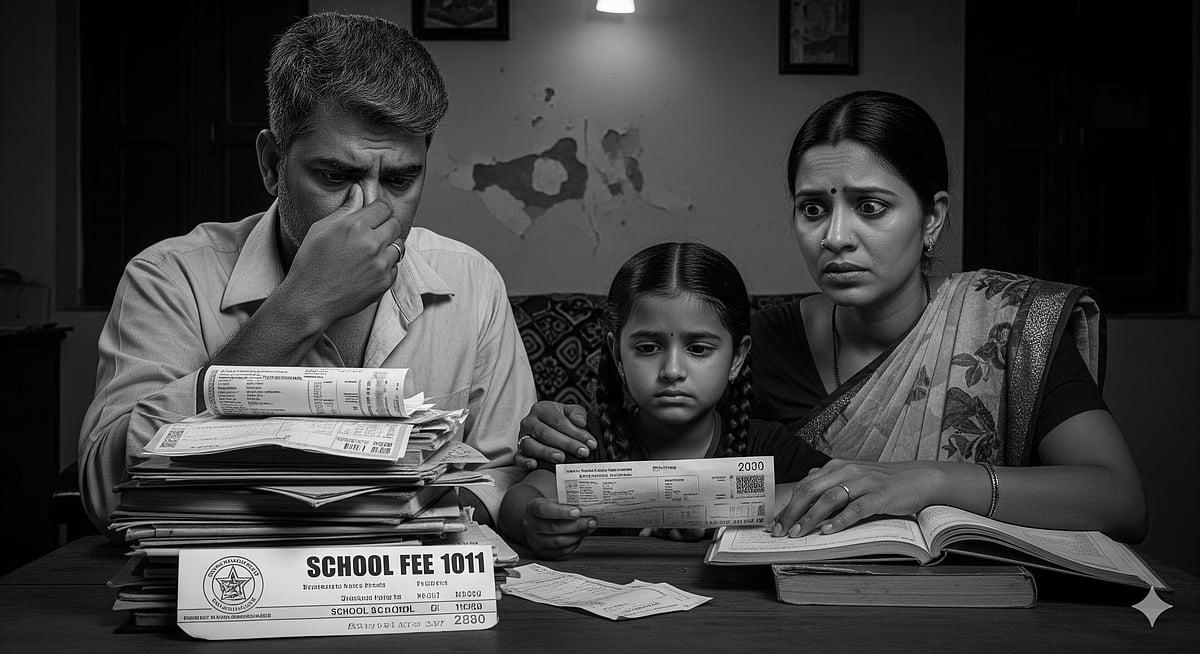
The Silent Financial Burden: How Education Costs Are Reshaping Middle-Class Family Budgets
Education has long been considered one of the most important investments a family can make in a child's future. For middle-class households, providing quality education is a priority, even if it means cutting down on personal expenses, postponing major purchases or sacrificing savings. However, with rising school fees, transportation charges, textbooks, uniforms, private tuition and extracurricular activities, educating children is increasingly becoming a significant financial challenge.
For many parents, the actual cost of education extends far beyond the tuition fee mentioned in a school's admission brochure. Admission charges, annual fees, examination costs, digital learning subscriptions, school events, educational trips and additional coaching contribute to the overall expenditure. As these expenses accumulate year after year, families are finding it increasingly difficult to balance their children's educational needs with other household responsibilities.
The Comprehensive Modular Survey (CMS) on Education 2025, conducted by the Ministry of Statistics and Programme Implementation (MoSPI), provides an indication of the financial gap between different types of schools. According to the survey, the average annual household expenditure per student was ₹2,863 in government schools, compared with ₹25,002 in non-government schools across the country. The survey covered 52,085 households and 57,742 students between April and June 2025.
The difference highlights how the choice of school can significantly influence a family's annual budget. However, expenditure varies considerably depending on the location, institution, class and facilities offered. In urban areas, the financial commitment is often higher because of increased transportation costs, private coaching and additional educational facilities.
Private schools remain a preferred choice for many urban families because of their infrastructure, English-medium instruction, extracurricular opportunities and perceived academic advantages. However, these facilities often come with substantial financial commitments. In Hyderabad, the cost of private education can be considerably higher than national averages. A June 2025 report by The News Minute highlighted that kindergarten tuition at some private schools reached around ₹1 lakh annually. Transportation, food, uniforms, books, learning materials and other activities could add more than ₹50,000 to the bill.
At the secondary level, the overall annual expenditure at some institutions was reported to approach ₹2 lakh or more. In December 2025, Deccan Chronicle also reported that some private schools in Hyderabad were quoting annual tuition fees of ₹1.1 lakh to ₹1.5 lakh for Class 1 admissions for 2026–27, while certain international schools charged considerably more. Such figures illustrate the wide variation in school expenses across the city.
Fee increases are adding to parental concerns. A June 2026 report by The Times of India highlighted the experience of a parent in Nagaram whose child's annual school fee increased from ₹35,000 to ₹55,000 in one year. Transport charges rose from ₹15,000 to ₹25,000, taking the combined annual expenditure from ₹50,000 to ₹80,000. Such increases can place families under pressure, particularly when their salaries do not rise at the same pace. Parents often have little flexibility once the academic year begins, as shifting children to another school can disrupt their education and adjustment.
Government schools offer a comparatively affordable option for families struggling with private education expenses. The MoSPI survey found that average annual household expenditure per student in government schools was ₹2,863, significantly lower than the ₹25,002 recorded in non-government schools. Government schools accounted for 55.9 per cent of total student enrolment nationally, while private unaided recognised schools accounted for 31.9 per cent. The difference in expenditure is largely associated with the lower course fees charged by government institutions.
However, some parents continue to prefer private schools because of concerns about infrastructure, teacher availability, English-language instruction, individual attention and access to additional activities. These perceptions, along with differences in school facilities and local circumstances, influence parental decisions. For middle-class families, choosing between government and private education is therefore not always a straightforward financial decision. Parents must weigh affordability against their expectations regarding teaching standards, facilities and future opportunities.
One of the biggest challenges for parents is the accumulation of expenses that are not always included in the advertised tuition fee. School admission and registration charges, annual development fees, examination fees, textbooks, stationery, uniforms, shoes and school bags can substantially increase the overall bill. Transportation is another major expense, particularly for families living far from their children's schools. Monthly bus charges, fuel costs and occasional private transport arrangements add to household spending. Parents of younger children may also have to consider daycare, after-school care and lunch expenses.
Extracurricular activities create another layer of expenditure. Sports coaching, music and dance classes, art workshops, competitions, annual-day programmes and educational trips are increasingly becoming part of children's school experiences. Although these activities contribute to students' overall development, they can place additional pressure on families. Digital education has also introduced new expenses. Smartphones, laptops, internet connections, online learning platforms and educational applications have become important requirements for many students. Families may have to purchase separate devices or arrange additional internet facilities, particularly when more than one child attends online classes or uses digital learning resources. These costs are often overlooked when parents initially calculate their education budget. By the end of the academic year, the cumulative expenditure can be considerably higher than the amount paid towards tuition alone.
Another growing concern is the increasing dependence on private tuition and coaching. Even after paying school fees, many parents spend additional amounts on subject-specific tutors, homework assistance, competitive examinations and entrance preparation. According to the CMS Education 2025 survey, 27 per cent of students were taking or had taken private coaching. The proportion was higher in urban areas at 30.7 per cent, compared with 25.5 per cent in rural areas.
Urban households spent an average of ₹3,988 annually per student on private coaching, while expenditure among rural households stood at ₹1,793. At the higher-secondary level, average annual coaching expenditure in urban areas reached ₹9,950. The growing demand for additional academic support reflects the pressure students face to perform well in examinations and secure admission to competitive courses. Parents often feel that regular classroom instruction may not be sufficient to meet these expectations. For families with limited financial resources, however, paying for both school education and private coaching can become difficult. Some parents enrol their children in tuition classes by reducing spending on other household requirements, while others depend on relatives or lower-cost neighbourhood tutors.
The financial pressure becomes more complicated for families with two or more school-going children. Unlike single-child households, parents with multiple children must manage separate tuition fees, uniforms, books, transport charges and extracurricular expenses for each child. Even when children attend the same school, their class levels and educational requirements may differ. Older students may need additional coaching, examination preparation and digital devices, while younger children require books, activity materials and other learning requirements.
For example, a family spending ₹80,000 annually on one child's education could face an expenditure of ₹1.6 lakh for two children, even before accounting for additional tuition, unexpected school charges or other learning requirements. Families with three children may face an even greater financial commitment. Parents often respond by reducing discretionary spending, postponing holidays, limiting entertainment expenses and using their savings to meet school-related payments. Some families also depend on personal loans, credit facilities or borrowing from relatives when several major expenses arise together.
Education costs can therefore affect other important financial priorities, including healthcare, housing, retirement planning and emergency savings. For households with fixed monthly incomes, managing these competing responsibilities requires careful budgeting throughout the academic year. Parents may also have to reconsider their spending on household essentials to ensure that school fees are paid on time. In some cases, education expenses take priority over personal needs and long-term financial goals.
The issue of private school fee increases has also brought renewed attention to regulation and accountability in Telangana. Parents' associations and education activists have repeatedly called for a transparent mechanism to prevent unreasonable fee hikes and ensure that schools clearly explain the charges collected from families. In an important development, the Telangana School Education Department directed private unaided schools in August 2026 to publicly display their class-wise fee structures for the 2026–27 academic year. Schools were instructed to submit their fee details and supporting documents to the department's portal and display the information on their premises and websites. Officials were also directed to issue show-cause notices to institutions that failed to comply.
However, questions remain about effective implementation, monitoring and the ability of parents to challenge excessive charges. A September 2026 report by Hyderabad Mail alleged that nearly 90 per cent of private schools in Hyderabad were not complying with the fee-disclosure directions. Parents' groups continue to seek stronger safeguards, including clear guidelines on annual fee revisions, transparency in additional charges and accessible grievance-redressal mechanisms. School managements, meanwhile, need to explain their operating costs, including staff salaries, infrastructure maintenance, transportation and other educational facilities. A balanced approach is necessary to protect parents from unreasonable financial demands while allowing educational institutions to maintain quality standards.
For middle-class families, education is not simply another monthly expense. It represents an investment in children's future, career opportunities and social mobility. Consequently, parents are often reluctant to compromise on schooling, even when the financial burden becomes difficult to manage. However, rising education expenses are forcing families to reconsider their priorities. Some are comparing schools more carefully before admission, while others are exploring affordable institutions, scholarships, government facilities and low-cost coaching options. Planning for annual fees, purchasing books in advance, reusing uniforms where possible and setting aside monthly savings are among the ways families attempt to manage costs.
Education experts and parents' representatives believe that greater fee transparency, affordable quality education and improved public-school infrastructure can help reduce the pressure on households. Ultimately, the challenge is not merely about how much parents spend on education, but how much they must sacrifice to provide their children with better opportunities. When school fees and associated expenses consume a growing share of household income, education risks becoming a financial strain rather than an accessible pathway to a better future. Ensuring that quality education remains affordable is therefore essential for both families and society.