
The Sea, The Sky & The Falcons - A survival story above the clouds
The Amur Falcon (Falco amurensis) stands as one of nature’s most remarkable migratory raptors, renowned for a transcontinental journey that stretches the limits of endurance and navigational precision. These small birds, weighing approximately 150–180 grams, begin their story each year in the Amur River basin of southeastern Russia, Mongolia, and northern China where they breed in the warmth of the Asian summer. But with the onset of winter and diminishing food resources, millions of Amur Falcons are compelled to embark on an epic migration, one of the longest and most demanding journeys made by any bird species on earth.
As they set out in late October, the birds traverse vast distances across China and Southeast Asia, eventually descending into Northeast India’s hilly terrain. Here, in Nagaland and Manipur, they encounter one of their most critical stopover habitats. For nearly two weeks, local forests teem with flocks resting and feeding on swarms of termites and other insects, replenishing their strength for what lies ahead. The arrival of the falcons has become a much-anticipated local phenomenon and, importantly, a testament to community-led conservation.
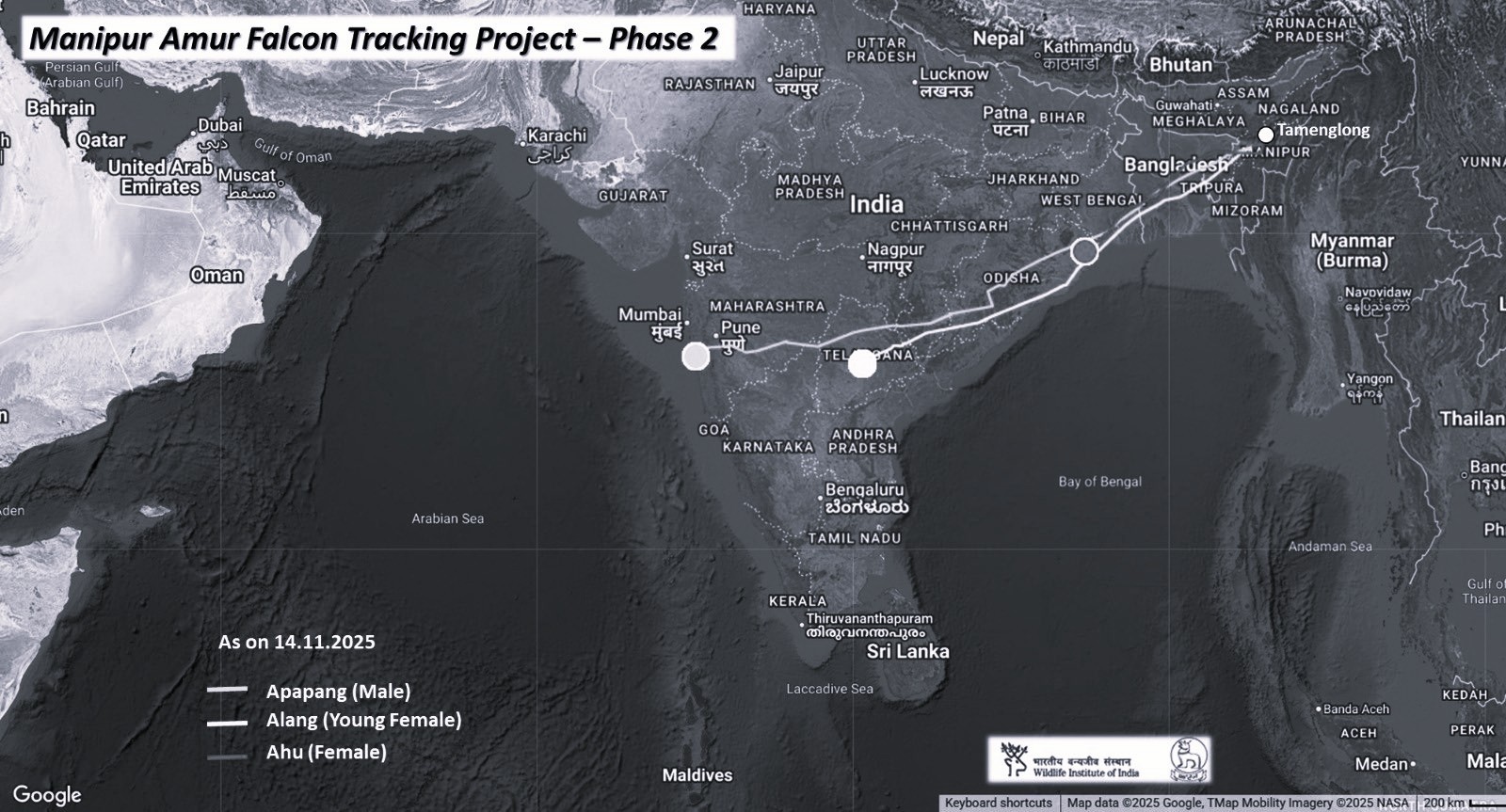
The Amur Falcon Tracking Project in Manipur represents a milestone for avian research and migratory bird protection in India. Initiated in response to a history of mass hunting that once threatened large populations of these birds, the project is led by the Wildlife Institute of India (WII) and local partners. By harnessing advanced technology attaching lightweight satellite transmitters to selected falcons scientists can monitor the birds’ exact flight paths, speeds, and behaviors in real time. The project’s newest phase, launched in November 2025, saw three individuals tagged at Tamenglong: Apapang (adult male, orange track), Alang (young female, yellow track), and Ahu (adult female, red track).
The information gleaned from this research has been nothing short of extraordinary. Just days after tagging, Apapang amazed trackers with a non-stop journey of over 3,100 km in 76 hours, averaging more than 1,000 km per day across India and the Arabian Sea, aided by robust easterly tailwinds. These distances and speeds highlight both the harsh requirements and specialized adaptations of the Amur Falcon’s migration. All three tagged falcons are now engaged in the formidable final leg, a solitary, non-stop oceanic crossing of roughly 3,000 km to Somalia in East Africa, one of the longest open-sea flights attempted by any raptor.
Why is this project crucial? Beyond pure scientific curiosity, the data is instrumental for global conservation. Northeast India’s forests and agricultural lands serve as the critical last refuelling and rest points before the oceanic leap, making habitat protection here indispensable. The satellite mapping helps pinpoint migration bottlenecks and threats like habitat loss, changing climate, and unsafe roosting areas while also reinforcing India’s global responsibility for migratory species welfare. Success stories from Manipur and Nagaland, where coordinated education campaigns turned local hunters into protectors, serve as powerful models for community-driven conservation worldwide.
But the Amur Falcon’s journey is not only a biological feat; it’s a living illustration of international collaboration. The species’ flyway spans at least 15 countries, demanding shared stewardship and consistent protection. The annual cycles departing Asia in autumn for Africa, returning in spring for breeding underscore the interconnectedness of ecosystems separated by oceans and continents.
Today, the Amur Falcon is celebrated in both science and local culture. In Northeast India, festivals mark their passage, and conservationists gather valuable ecological insights while the community embraces a renewed sense of pride. Each bird that successfully completes its journey validates years of conservation, research, and cross-border cooperation. As Apapang, Alang, and Ahu drone westward over the Arabian Sea, their progress streams into satellite data and social media updates, captivating audiences and reminding us all of the marvels of migration.
The reinforced protection of key stopover sites is vital, for the fate of millions of Amur Falcons depends on safe passage through India’s landscapes. From the misty forests of Manipur to the vast grasslands of Africa, these raptors symbolize the power of shared commitment between scientists, villagers, and global partners to preserve life’s extraordinary journeys. Their story, charted in the sky and in data, is more than a migration; it is an unfolding epic of resilience, hope, and unity across nations.