
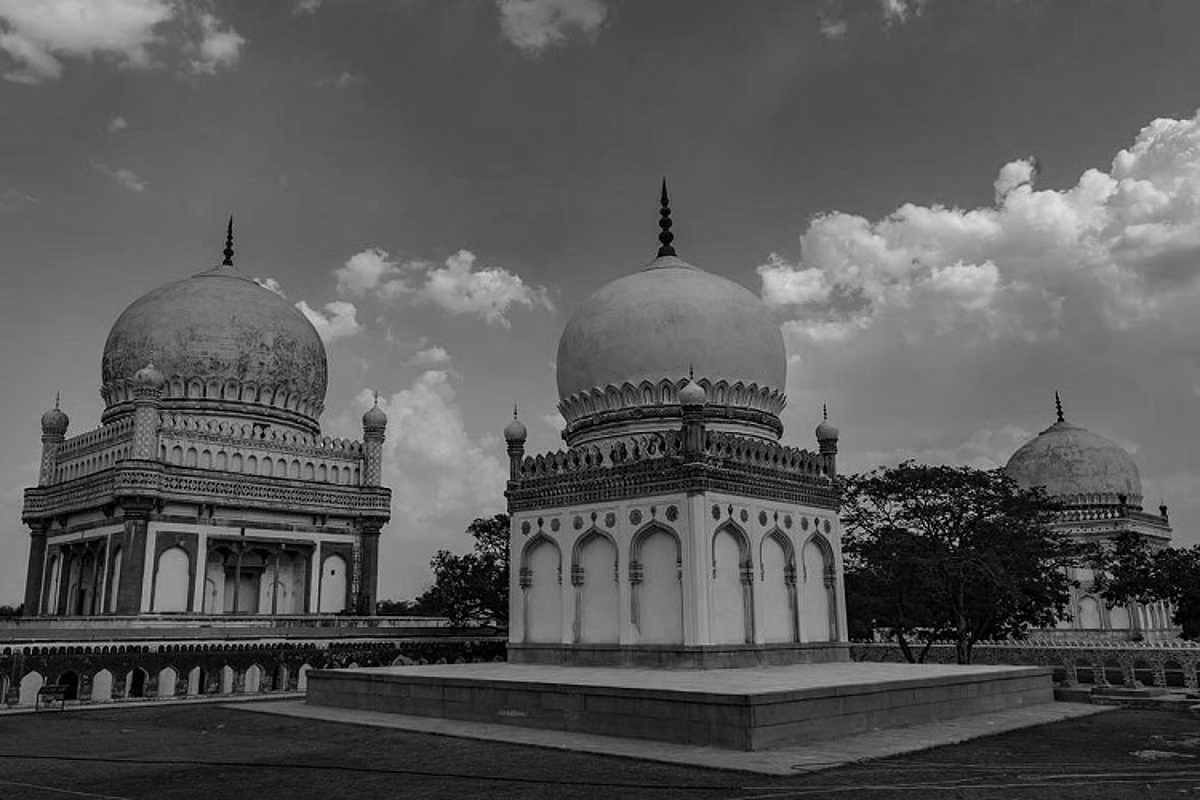
The Qutb Shahi Tombs: The Saga of a Royal Dynasty
Long ago, a glorious dynasty flourished in South India - the Qutb Shahis . They were Shukia Shiah Islamic rulers who governed the regions surrounding Golconda for approximately 169 years (from the 16th to the 17th century). Their kingdom earned global acclaim for its unique culture, architecture, and thriving commerce.
To immortalize their legacy, the Qutb Shahi kings commissioned a massive, artistically profound necropolis. They envisioned a site that would reflect not just their sovereignty, but also the faiths, artistic methods, and philosophies of that era. This vision manifested as the Qutb Shahi Heritage Park . These tombs are more than mere "structures"; they are emotional masterpieces. Within this park, a special place was accorded to every king, their family members, and their well-wishers. Each tomb, rising like a grand silhouette, was designed with a unique architectural blueprint.
A Historic Site
Constructed in memory of the departed royals of the Golconda Sultanate, these tombs stand as magnificent architectural monuments that have defied time and nature. They are located near the Banjara Darwaza , about one kilometer north of the Golconda Fort. Serving as living witnesses to the grandeur of the Golconda kings, they remind visitors of the majesty of the rulers buried there. These tombs are recognized as some of the oldest and most significant historical monuments in Hyderabad.
Architectural Features
The tombs are built as a cluster on elevated platforms. Their architectural style is a unique blend of Persian, Pathan, and Hindu influences. Constructed primarily from grey granite and adorned with intricate stucco decorations, this site is rare because it houses the tombs of an entire dynasty in one location. They stand amidst beautifully landscaped gardens, showcasing exquisite stone carvings.
Historical Significance
The Qutb Shahi tombs serve as authentic evidence of the dynasty’s history and architectural traditions. Every arch, pillar, dome, minaret, and gallery was crafted with immense skill. The surrounding garden is known as "Ibrahim Bagh." This complex houses the tombs of seven of the Qutb Shahi kings.
Structural Design
These tombs are dome-shaped structures built on square bases, surrounded by delicately carved pointed arches. Each tomb ranges from 9 to 15 meters in height. While smaller tombs consist of a single story, larger ones are two-story structures. Historically, these domes were decorated with blue and green tiles, though only fragments remain today. The major tombs feature massive circular domes that reflect pioneering craftsmanship. The designs represent a fusion of Persian and Islamic Deccan styles. The complex also includes small mosques, stepwells (Baolis), and a Hamaam (mortuary bath), reflecting the spiritual and daily lifestyle of the period.
Dynasty History
The Qutb Shahi dynasty ruled from 1518 to 1687 . Emerging after the collapse of the Bahmani Kingdom, it was one of the five prominent Islamic Sultanates in the Deccan. Seven rulers governed for 170 years, successfully resisting Mughal invasions until 1687. It was the last Deccan kingdom to be absorbed into the expanding Mughal Empire.
The Splendor of the Qutb Shahis
The tombs are characterized by beautiful minarets. One particularly grand tomb stands 42.5 meters tall with a massive dome. Historically, these mausoleums were adorned with soft curtains on silver poles and magnificent chandeliers. They were the most opulent resting places of the Golconda Sultans. It is said that during the Qutb Shahi era, these tombs were considered so sacred that even criminals who sought refuge there were granted clemency.
Reflections of Royal Politics
The complex is a rare example where not only rulers but also their wives, disenfranchised sons, and loyalists were given tombs. Some evidence suggests that certain rulers were intentionally excluded from the royal burial grounds due to political reasons.
A Testament to Multicultural Heritage
These monuments testify to the blend of cultures, languages, and ethnicities in medieval India. The dynasty, though descended from Iranian immigrants, successfully integrated with local Deccani Muslims and the Telugu-speaking Hindu nobility. This synergy resulted in a Persian-Indian architectural fusion.
The evolution of their style is evident: the first tomb (Sultan Quli, d. 1543) shows heavy Bahmani influence, while the tomb of the seventh king (Abdullah, d. 1672) showcases a fully developed Qutb Shahi style, including octagonal structures and Iranian-style Talars .
The Tomb of Sultan Quli Qutb-ul-Mulk
The most significant yet simplest tomb belongs to the founder, Sultan Quli Qutb-ul-Mulk . Remarkably, he built his own tomb during his lifetime and supervised the project. He established the tradition of building tombs for non-ruling family members, including sisters and nephews. The complex contains 30 tombs, mosques, and a bathhouse, housing royals and their faithful courtiers.
From Decay to Restoration
Following the end of the dynasty, the tombs fell into neglect. Restoration began in the 19th century under Salar Jung III . Today, the Department of Archaeology and Museums, along with private trusts, manages the site.
In 2012-13, a major project was launched by the Telangana Heritage Department in collaboration with the Aga Khan Trust for Culture (AKTC) and Tata Trusts . This was not just a repair job but a journey to revive the original artistry, environment, and hydrology of the 106-acre park.
Qutb Shahi Heritage Park & UNESCO Recognition
The park contains 80 historical monuments , including 40 tombs, 23 mosques, 7 stepwells (Baolis), and a Hamaam. In 2022, the project received the UNESCO Award of Distinction for the conservation of the six Baolis.
Restoration involved removing inappropriate modern "cement" repairs and reapplying traditional lime plaster. Artisans recreated over 80,000 green glaze tiles based on 19th-century archival photos. The project also revived the ecosystem by planting over 3,300 trees and 2,000 saplings.
Stepwells (Baolis)
Dating back to the 16th and 17th centuries, these wells (such as Badi Baoli and Hamam Baoli) have a rainwater harvesting capacity of 1.5 crore liters. Restoring these has revived the local ecology and showcased the dynasty’s advanced water management systems.
Visiting Information
The site is now a major destination for tourists, students, and historians.
• Timings: 9:30 AM to 4:30 PM (Closed on Fridays).
• Entry Fee: ₹10 for adults, ₹5 for children, and ₹20 for photography.
Visiting this site is not just about seeing "old stones"; it is an experience of hearing the echoes of kings through the music of the wind, the soil, and the water that has sustained this legacy for centuries.