
The National SC-ST Hub: Creating Entrepreneurs, Not Just Beneficiaries
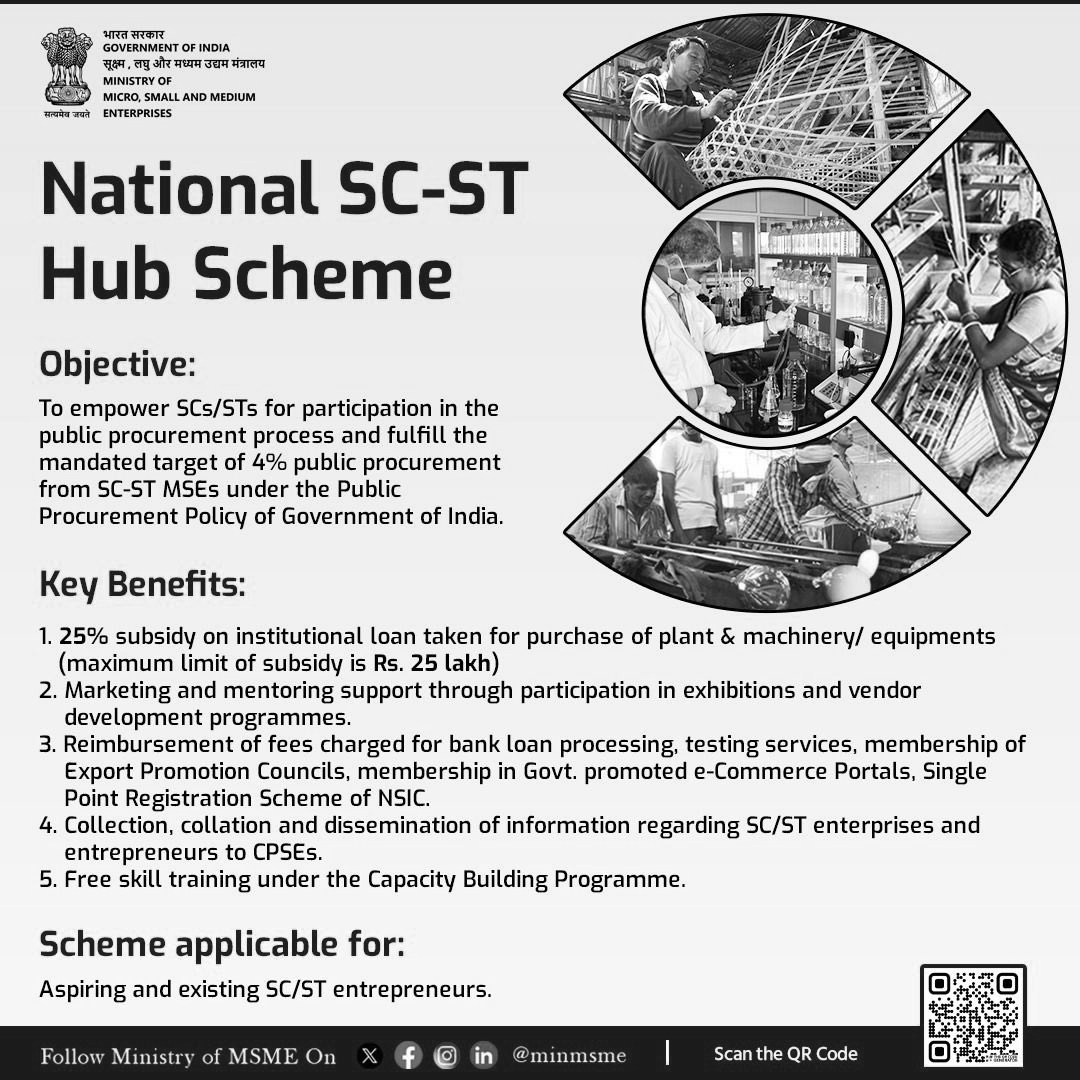
India's journey towards becoming a global manufacturing hub depends not only on attracting investments but also on ensuring that entrepreneurship reaches communities historically left on the margins of industrial growth. While Scheduled Castes (SCs) and Scheduled Tribes (STs) together constitute nearly a quarter of the country's population, their representation in formal manufacturing, technology-driven enterprises and government procurement has remained limited. Recognising this gap, the Ministry of Micro, Small and Medium Enterprises (MSME) launched the National SC-ST Hub (NSSH) in 2016 with a broader vision than conventional financial assistance. The initiative is designed as an integrated enterprise development ecosystem that combines technology upgradation, access to institutional finance, capacity building, mentorship and market linkages, enabling SC/ST entrepreneurs to compete on equal footing in India's industrial landscape.
A Five-Pillar Framework for Inclusive Enterprise
Unlike traditional subsidy programmes, the National SC-ST Hub follows a structured five-pillar framework centred on identification, capacity building, financial access, market integration and continuous handholding. Entrepreneurs voluntarily enrol through Udyam Registration, while eligibility is verified using official SC/ST caste certificates, ownership documents and MSME credentials. The scheme does not identify beneficiaries through surveys or community drives; instead, it relies on government-issued documentation and banking due diligence. Once verified, entrepreneurs are connected with banks, implementing agencies, industry associations and Central Public Sector Enterprises (CPSEs), creating a seamless pathway from enterprise registration to business expansion.
Strengthening Government Procurement
The initiative also supports the implementation of the Public Procurement Policy for Micro and Small Enterprises (MSEs) Order, 2012, which mandates Central Ministries, Departments and CPSEs to procure at least 4 per cent of their annual purchases from SC/ST-owned MSEs within the overall procurement target for micro and small enterprises. To achieve this objective, the Hub prepares entrepreneurs to compete in formal procurement by organising Vendor Development Programmes, Buyer-Seller Meets, Government e-Marketplace (GeM) onboarding, quality certification support and procurement mentoring.
Finance Without Direct Lending
A key strength of the programme lies in its credit facilitation model. Contrary to popular perception, the National SC-ST Hub does not directly provide loans or prescribe concessional interest rates. Instead, it helps entrepreneurs access existing financial products offered by banks while reducing investment costs through government support.
The flagship intervention, the Special Credit Linked Capital Subsidy Scheme (SCLCSS), provides a 25 per cent capital subsidy, subject to a ceiling of ₹25 lakh, for purchasing new plant and machinery financed through institutional term loans of up to ₹1 crore. The entrepreneur pays the prevailing bank interest rate applicable to MSME loans, while the Government bears part of the capital investment through subsidy after the lending institution processes the claim.
Multiple Financing Options Under One Ecosystem
Beyond the SCLCSS, the Hub functions as a gateway to multiple financial schemes suited to different stages of entrepreneurship. Stand-Up India supports first-generation entrepreneurs by providing composite loans ranging from ₹10 lakh to ₹1 crore for greenfield enterprises promoted by SC/ST entrepreneurs and women. The Prime Minister's Employment Generation Programme (PMEGP) combines institutional credit with capital subsidy to encourage new enterprises. Pradhan Mantri Mudra Yojana (PMMY) offers collateral-free loans for micro businesses through its Shishu, Kishor, Tarun and Tarun Plus categories. Businesses requiring collateral-free institutional finance can also benefit from the Credit Guarantee Fund Trust for Micro and Small Enterprises (CGTMSE), under which the Government provides credit guarantees to banks.
Rather than introducing separate loan products, the National SC-ST Hub converges these schemes and guides entrepreneurs towards the most suitable financing option while providing end-to-end assistance during the application process.
Building Entrepreneurs Beyond Finance
Recognising that finance alone cannot create successful businesses, the Ministry has invested heavily in capacity building. Through the Business Acceleration Programme (BAP), the scheme targets existing SC/ST-owned MSMEs, aspiring entrepreneurs and even the wards of entrepreneurs to nurture second-generation business ownership.
Conducted in partnership with premier institutions such as IIM Shillong, IIM Nagpur, IIM Kashipur Foundation for Innovation & Entrepreneurship Development (FIED) and IRMA, these cohort-based programmes combine classroom learning with nearly six months of post-training mentoring. Entrepreneurs receive structured guidance in business strategy, financial management, working capital planning, government procurement, tender participation, branding, exports, digital adoption, regulatory compliance and quality certification. Several cohorts have also focused on encouraging women entrepreneurs and enterprises from underserved regions.
Technology Upgradation Creates New Opportunities
The Ministry's latest success stories illustrate how this integrated approach is transforming businesses across sectors.
In Punjab, Varun Enterprises, led by Hukum Chand, utilised ₹15.67 lakh under the SCLCSS during 2021-22 to install advanced manufacturing equipment, including a fibre laser cutting system, CNC hydraulic press brake, air compressor, UPS systems and supporting electrical infrastructure. The technology upgrade significantly enhanced precision, productivity and operational efficiency, enabling the company to secure a ₹95.99 lakh purchase order from the Modern Coach Factory (MCF), Rae Bareli, for supplying connection boxes used in railway coaches. The order established the enterprise as a credible supplier within the railway manufacturing ecosystem.
Expanding Public Procurement Through Better Infrastructure
In Tamil Nadu, Raju Thangavelu of Tiruvallur, operating in the petroleum logistics sector, received ₹25 lakh under the SCLCSS to strengthen fleet capacity and upgrade transportation infrastructure in compliance with stringent safety standards prescribed by oil marketing companies. The improved capabilities enhanced operational reliability and competitiveness, ultimately helping the enterprise secure a transportation contract from Bharat Petroleum Corporation Limited (BPCL) in April 2026.
Healthcare Manufacturing with Inclusive Growth
Similarly, B. Ortho International Pvt. Ltd., promoted by Rahul and Divya in Ranchi, Jharkhand, demonstrates the value of combining technology support with business mentoring. Benefiting from both the SCLCSS and the Business Acceleration Programme, the enterprise upgraded its production infrastructure while receiving strategic business guidance and market linkages.
Today, the company manufactures nearly 50,000 pairs of latex surgical gloves every day, has doubled its turnover from ₹15 lakh to ₹30 lakh, and created local employment with nearly 60 per cent women workforce participation, highlighting the wider social impact of enterprise development.
A Nationwide Support Ecosystem
Beyond individual success stories, the National SC-ST Hub has steadily built an institutional support network. The Ministry of MSME provides policy direction, while the National Small Industries Corporation (NSIC), National Institute for Micro, Small and Medium Enterprises (ni-msme) and other implementing partners coordinate entrepreneurship development, awareness campaigns and market linkage initiatives. Banks appraise projects, sanction loans and process subsidy claims, while CPSEs and industry bodies facilitate procurement opportunities through structured vendor development.
The Hub also conducts Entrepreneur Awareness Camps, Capacity Building Training Programmes, Special Vendor Development Programmes, Buyer-Seller Meets, credit facilitation workshops, technology awareness sessions and GeM onboarding drives, ensuring entrepreneurs receive end-to-end support rather than one-time financial assistance.
Growing Impact Across the Country
The scale of implementation has grown steadily. During FY 2025-26, the Hub organised 358 Capacity Building Training Programmes, benefiting 10,717 SC/ST participants. It conducted 247 Special Vendor Development Programmes, reaching 9,656 entrepreneurs and MSMEs, facilitated exhibition participation for 141 enterprises, and enabled public procurement worth ₹3,390 crore, benefiting 10,544 SC/ST-owned enterprises.
Since the launch of the Special Credit Linked Capital Subsidy Scheme, 2,841 enterprises have received subsidies amounting to more than ₹321.87 crore, reflecting increasing adoption of technology-led enterprise expansion.
The Road Ahead
While the programme has expanded its reach, experts believe the next phase should focus on measuring long-term outcomes. Official reporting currently highlights beneficiary numbers, procurement value, subsidy disbursals and training programmes, but comprehensive assessments of enterprise survival, sustained revenue growth, employment generation and business competitiveness over multiple years remain limited. Such impact studies would provide a clearer picture of how effectively public investment is translating into durable entrepreneurial success.
Towards an Inclusive Industrial Future
Nevertheless, the National SC-ST Hub represents an important shift in India's development strategy. Rather than treating entrepreneurship merely as a credit issue, it addresses the complete business lifecycle—from registration and finance to technology adoption, skill development, procurement readiness and sustained mentoring.
As India advances towards the vision of Atmanirbhar Bharat, the initiative seeks to ensure that entrepreneurs from SC and ST communities emerge not simply as beneficiaries of government support, but as competitive manufacturers, suppliers, innovators and job creators capable of contributing meaningfully to the country's evolving industrial economy.