
The Moon Is a Two-Layer Cake and India Just Sliced It Open, Chandrayaan-3 Rewrites the Rulebook!
The Moon has long been imagined as a barren, uniform world covered in fine grey dust. However, a landmark new study from India’s Chandrayaan 3 mission has completely reshaped that view, revealing that the lunar surface hides a sharply different structure just a few centimetres below what is visible.
The study, conducted by seven experts from ISRO’s Physical Research Laboratory , the Space Applications Centre in Ahmedabad , and the Department of Engineering Physics at Andhra University, Visakhapatnam , has been published in the April 2026 issue of The Astrophysical Journal , one of the most respected journals in space science.
The discovery traces its origins to a bold last minute experiment during the final phase of the Chandrayaan 3 mission. The so-called “hop experiment” was originally designed to demonstrate engine re-ignition capability for future sample return missions. In a carefully executed manoeuvre, the Vikram lander briefly lifted itself by about 40 centimetres and landed safely a short distance away.
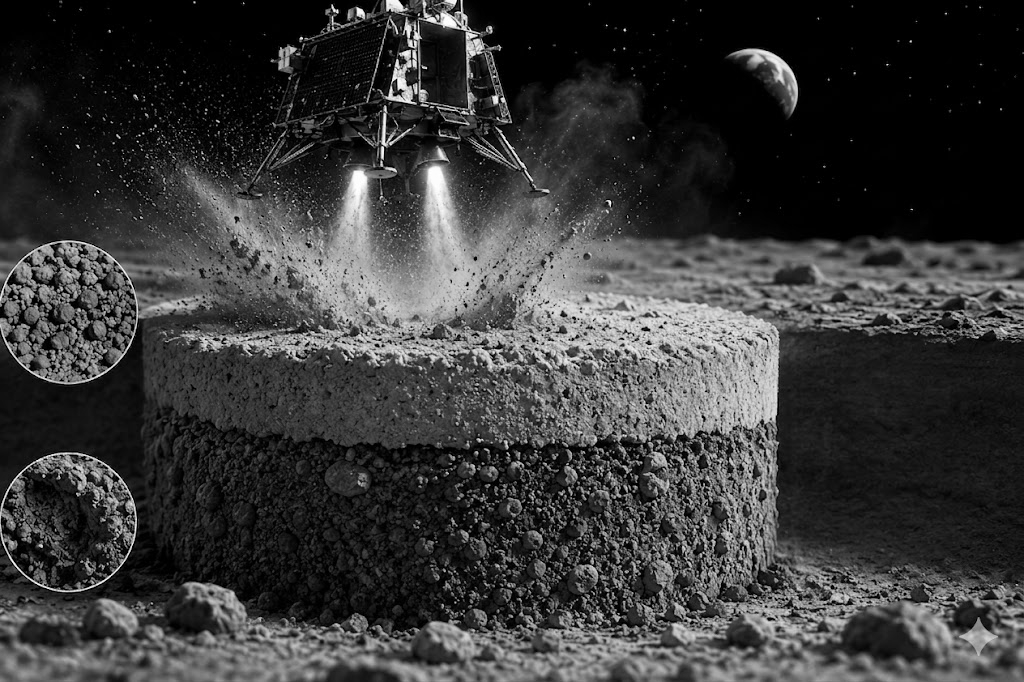
That seemingly simple hop became a major scientific breakthrough. When the engines fired, the exhaust acted like a natural blower, stripping away nearly three centimetres of loose lunar dust and exposing older, more compact material beneath the surface.
Scientists found a striking transition in soil properties with depth. While the upper layer is extremely light and powdery, at just 6.5 centimetres below the surface , the material becomes about twice as dense and nearly five times more cohesive . In simple terms, the top layer feels like dry flour, while slightly deeper layers behave more like damp, stiff clay.
Researchers also emphasise that what is commonly called lunar soil is more accurately described as lunar regolith , made up of shattered rock fragments and sharp, glass like particles formed over billions of years due to constant micrometeorite bombardment . This continuous impact process has effectively reshaped the Moon’s outer surface at a microscopic level.
The experiment also provided important thermal insights. Temperature measurements showed rapid cooling near the surface with noticeable changes in heat behaviour at depths of just a few millimetres. While the uppermost layer loses heat quickly to space after sunset, deeper layers retain heat longer, indicating a strong variation in thermal conductivity within a very shallow depth range.
To validate these observations, scientists used high resolution imagery from Chandrayaan 2 and ran detailed three dimensional simulations, both of which supported the finding of a layered regolith structure .
The implications of this discovery extend far beyond academic interest. The porous upper layer may act as a natural thermal blanket and could play an important role in trapping water ice molecules beneath the surface. This makes it highly significant for future lunar exploration, especially for planned missions aimed at establishing long term bases in the Moon’s southern polar region.
These insights are particularly relevant to upcoming global and Indian missions, including NASA’s Artemis programme and India’s planned Chandrayaan 4 mission , both of which aim to explore the possibility of sustained human presence on the Moon.