
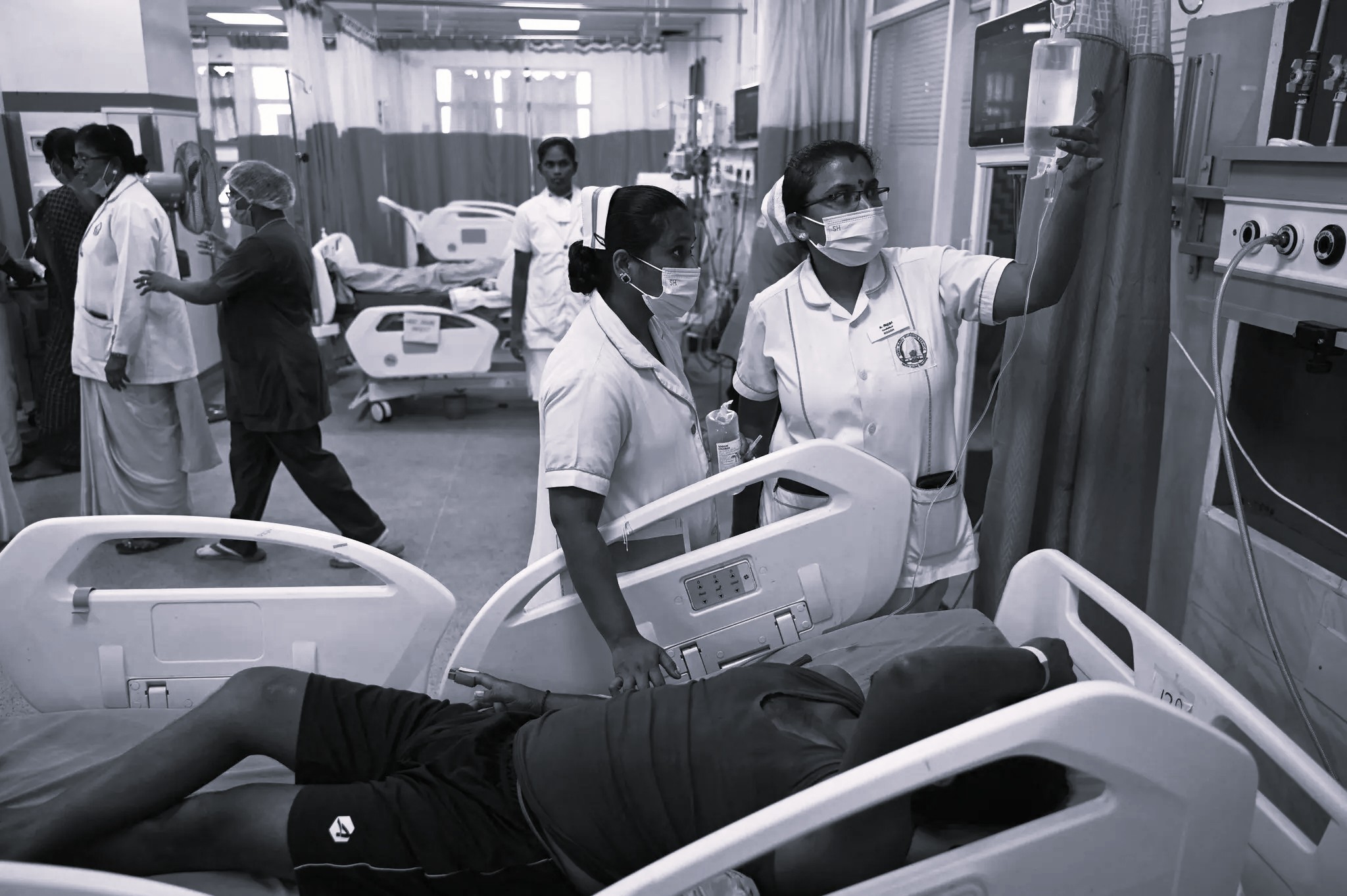
The Monopoly of Medicine - How corporate hospitals are crushing small clinics
Over the past two decades India’s healthcare skyline has glittered with high-rise corporate hospitals, glitzy lobbies, branded specialties, sophisticated machinery and multinational capital. For many urban patients these institutions promise world-class care. But behind the polished façade lies a creeping consolidation that is reshaping access, cost and the very character of medical practice. Small clinics, neighbourhood nursing homes and independent practitioners long the first line of care for millions are being squeezed out by mergers, price pressures, insurance linkages and market behaviour that prioritises scale and revenue. The result is not only an economic shakeout but an erosion of the humane, community-rooted medicine that once sustained India’s health system.
The scale of private dominance and why it matters
Most recent market estimates show the private sector supplies a majority of hospital infrastructure in India. Analyses and industry reports put private hospitals and beds at a very large share of total healthcare infrastructure, with private providers accounting for roughly six in ten hospital beds in many assessments, a ratio that gives corporate players outsize influence over where patients go and what they pay for. This private dominance becomes meaningful when combined with persistent high out-of-pocket spending: households still bear a large share of healthcare costs directly, exposing them to catastrophic bills when care is concentrated in expensive private centres.
From neighborhood trust to corporate brands
Small clinics historically served as the first port of call: an elderly general physician who knew the family history, a local surgeon who managed deliveries and emergencies, a nursing home that stabilised a patient before referral. Those intimate ties created continuity of care and affordable treatment paths. Corporate chains changed that calculus. They bring standardized protocols, advanced tertiary care and capital all valuable but also heavy marketing, vertical integration (diagnostics, pharmacies, rehab) and insurance tie-ups that steer patients into their revenue funnel. As a consequence, patient flows have tilted away from small providers toward branded hospitals, especially for procedures, diagnostics and inpatient care.
Live examples: acquisitions and expansion
The consolidation is not hypothetical. Big chains have been actively acquiring smaller hospitals and expanding into new geographies. Recent strategic moves by major players demonstrate how corporate consolidation proceeds through acquisitions of local hospitals, the creation of integrated retail health arms (primary care, diagnostics, pharmacy) and listings or spin-offs of digital and pharmacy units to attract investment. Such transactions increase market reach and cross-selling opportunities for the corporate hospital but they also shrink the independent market share available to standalone clinics.
Fortis, Apollo and other chains have continued to pursue acquisitions or absorb smaller facilities into their networks, while private equity and foreign investors have shown sustained appetite for health assets, seeing them as high-growth, resilient investments. These financial dynamics enable consolidation at speed and scale and small clinics, which typically lack access to capital markets, cannot match it.
The insurance convergence that favours big players
Corporate hospitals are often the preferred partners for insurers and government schemes. Large hospitals can meet empanelment criteria more easily, have standardized billing systems and can negotiate package rates. Insurance companies, seeking uniformity and predictable claims processing, tie up with these chains which means insured patients are directed to them. Meanwhile, many small clinics lack empanelment or the digital infrastructure to process cashless claims, effectively removing them from the market that insurance covers.
The empirical picture shows mixed signals: while flagship public schemes like Ayushman Bharat initially empanelled tens of thousands of hospitals (including many private setups), more recent reporting indicates a decline in private hospital participation in some years suggesting that scheme dynamics, reimbursements and operational burdens push smaller providers to the margins, even as large chains consolidate their positions.
When scale becomes a licence to set prices
With market power comes pricing power. Corporate hospitals especially where competition thins can command higher tariffs for procedures, ICU stays and diagnostics. Absent robust price transparency or standard ceilings, patients have limited ability to comparison-shop in emergencies. This drives up household out-of-pocket expenditure and raises the risk of catastrophic health spending, a major public health concern in India, where OOPE remains a large portion of health financing. Independent clinics, with leaner overheads, could offer lower-cost care, but they are sidelined in an environment where insured, high-margin clients and elective procedures attract the most attention.
The ethics and incentives problem inside hospitals
Corporate governance introduces metrics: bed occupancy, revenue per bed, profitability by specialty, conversion rates from OPD to inpatient. Those metrics can improve efficiency but also create perverse incentives pressure to recommend tests, procedures or longer hospital stays. Several investigative reports and patient accounts in recent years have flagged instances where billing practices and unnecessary procedures raised ethical questions. While many corporate hospitals adhere to medical standards, the incentives inherent in profit targets sometimes push the bounds of clinical discretion. This tension risks undermining trust, and small clinics that retain discretion and local knowledge are seen as safer, more prudent options yet they are dwindling.
COVID-19 and the asymmetry it revealed
The pandemic sharpened inequalities. Corporate hospitals became focal points for advanced Covid care, but many small clinics were forced to close temporarily or operate with limited services. Debates over bed availability, exorbitant charges for critical care, and differential access for insured versus uninsured patients highlighted the structural imbalance. At the same time, a few corporate chains used scale to provide emergency capacity and specialist care; the mixed picture shows that scale can be both an asset and a driver of inequity depending on governance and regulation.
Case study: a low-cost model versus corporate scale
Not all large private providers behave identically. Some models demonstrate how scale can be harnessed to expand affordable specialist care. The Narayana Health example, a network designed around standardized, high-volume cardiac and other specialty services with cost efficiencies shows that private scale can be used to reduce unit costs and broaden access if coupled with mission-oriented governance. Yet such models remain the exception rather than the norm; most corporate expansion is driven primarily by market returns rather than explicit social pricing strategies.
The human cost: communities and careers
When clinics shut, communities lose immediate access to basic care. In smaller towns and peri-urban areas, delays caused by distance to the nearest corporate hospital can be fatal in emergencies. Moreover, the professional ecology changes: younger doctors are increasingly drawn to salaried roles in corporate hospitals, attracted by pay, predictability and infrastructure. While that solves some workforce issues, it also reduces the number of independent practitioners who would otherwise run primary and secondary care in under-served locales. The culture of independent practice mentoring junior doctors, long patient relationships, local accountability is fading.
Regulatory gaps that allow monopolies to grow
Healthcare regulation in India has struggled to keep pace with market consolidation. There is limited nationwide oversight on hospital pricing, opaque billing practices, and fragmented rules on mergers and acquisitions in health services. Competition law has rarely been tested vigorously in healthcare markets; antitrust scrutiny is nascent. At the same time, state health departments and medical councils have variable capacity to monitor corporate behaviour or protect small providers. This regulatory vacuum leaves scope for monopolistic tendencies to flourish unless corrected.
Policy levers to restore balance
If the goal is an equitable healthcare ecosystem that combines the best of corporate capability and local accessibility, policy action must be multi-pronged:
• Inclusive empanelment and claim systems. Design Ayushman Bharat and other public scheme empanelment criteria so suitably regulated clinics and nursing homes can join the network with simplified compliance pathways and digital onboarding support. This expands patient choice and channels reimbursements to smaller providers.
• Price transparency and standardisation. Mandate clear hospital charge lists for common procedures and publish package rates. Transparency reduces information asymmetry and curbs exploitative billing.
• Antitrust oversight and merger scrutiny. Competition authorities should examine large hospital mergers for potential harm to competition, especially in smaller cities where a single chain’s dominance can create local monopolies.
• Financial support for small providers. Offer low-interest loans, tax incentives or capital grants for clinics to upgrade infrastructure, adopt digital billing and join insurance networks.
• Strengthen primary care and referral systems. Public investment in robust primary care (health and wellness centres) can stabilize patient flows and ensure clinics play a defined role in referral networks.
• Ethics and accountability frameworks. Reinforce medical ethics enforcement, patient grievance redressal and clinical audit systems within private hospitals.
The role of insurers and payers
Insurers and third-party payers shape provider behaviour through network design and reimbursement rates. Encouraging insurers to include accredited clinics and offering higher administrative support for smaller providers can create a more level playing field. Meanwhile, payers must avoid preferential contracting that unduly favours a few large networks and instead promote competitive, quality-based provider panels.
Civil society and media: watchdog and advocate
Civil society, patient groups and the media have roles to play in spotlighting exploitative practices and championing reforms that protect consumers and small practitioners alike. Local stories of clinics that provided lifesaving early interventions or of families ruined by unchecked hospital bills keep policy attention focused and humanise statistics.
Preserve pluralism, Protect patients
Corporate hospitals have brought undeniable advantages: advanced specialties, investments in technology, and the ability to scale complex services. But when corporate expansion morphs into market dominance that sidelines smaller, community-rooted providers, the public interest suffers. The policy challenge is to preserve pluralism in the health ecosystem — to keep small clinics viable while harnessing the strengths of corporate medicine for tertiary care. Left unchecked, consolidation will narrow choice, raise costs and hollow out the compassionate core of medical practice.
Saving the small clinic is not an act of nostalgia. It is an act of public policy to protect access, affordability and the relational qualities of care. The future of Indian healthcare must be built on both excellence and equity: high-tech centres for complex needs, and resilient, trusted neighbourhood care for everyday health. Restoring that balance requires political will, regulatory reform and a public conversation about what kind of healthcare system India wants one that values profit, or one that puts people first.