
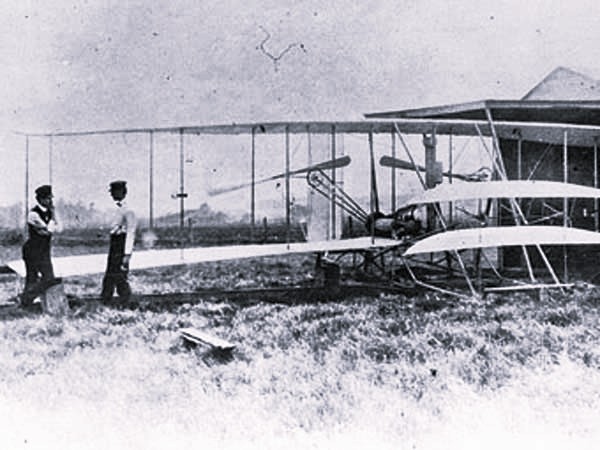
The Journey of the Wright Brothers: Inspiration for the Dream of Flight
When every person standing on Earth looks up at the sky, a silent dream is born in their heart, the dream to fly. It is not just about floating in the air it is the ultimate human aspiration to break free from physical bonds and enjoy freedom. But only a few in this world have turned that dream from a mere wish into their very breath. Such were Wilbur and Orville Wright (the Wright Brothers). They were ordinary men who ran a bicycle shop, but their thoughts resided among the clouds.
The story we are about to hear is not just the story of inventing the airplane. It is a story of childhood wonder, perseverance, lessons learned from hundreds of failures, and the steadfast belief two brothers held deep in their hearts to touch the sky.
In those days, flying was considered something only possible for God. Let us learn how much the Wright Brothers yearned and struggled to break those restrictions and grant man freedom in the air. The source of their inspiration was purer than the sky and stronger than hope. December 17 marks the birthday of aviation pioneer Orville Wright.
In the United States, December 17th is observed annually as Wright Brothers Day . Every year, the government there instructs the people of the United States to observe this day with appropriate celebrations and activities. It is true, is it not, what an impossible feat they made possible, which is why the government there bestowed such an honor upon them.
Wilbur Wright (April 16, 1867) and Orville Wright (August 19, 1871) were American inventors and key figures in the history of aviation. Their life journey has three main phases, Early Life and Inspiration, Research and Invention of the Airplane, and Historical Triumph and Legacy.
Early Life, Inspiration, and Interest in Aviation
The Wright Brothers were born to Milton Wright and Susan Catherine Koerner Wright. Their father was a church bishop who traveled frequently. Their mother, Susan, was a mechanically inclined person. She often made and repaired things at home, which fostered the brothers' scientific curiosity.
The Key Gift (1878):
Returning from a trip, Milton Wright brought his children a small, rubber-band-powered helicopter toy designed by the French inventor Alphonse Pénaud. Seeing this toy fly in the air for a short time, young Wilbur and Orville were greatly astonished. This small toy became the main inspiration for their life's goal.
After completing their education, in 1892, the Wright Brothers opened a bicycle repair and manufacturing shop in Dayton, Ohio. The income from this business became the main source of funding for their aviation experiments. Working with bicycles, they acquired key mechanical skills such as designing lightweight, strong designs, correctly fitting small, complex parts, and solving difficult problems.
Research and Failures in Inventing the Airplane
Wilbur and Orville thought differently from many other inventors. They realized that controlling the aircraft in the air was more important than simply building one. They initially focused on control.
Wing Warping:
Before flying, they tried to understand how to balance an object in the air. They observed birds bending the tips of their wings while flying. From this observation, they developed the idea that the aircraft could be controlled by twisting or warping its wings. This technique is the origin of modern ailerons.
The Wind Tunnel:
Recognizing that the flying tables developed by other inventors were flawed, the Wright Brothers built their own small Wind Tunnel. In 1901, they tested hundreds of wing models in this tunnel, collecting accurate information about air pressure and drag.
Glider Experiments (1900 - 1902)
They chose Kitty Hawk, North Carolina, as their testing center because it had suitable wind and soft sand dunes. During these glider experiments, they developed a system to control the aircraft around three axes in the air, Roll (through wing warping), Pitch (through a forward elevator), and Yaw (through a rear rudder). By 1902, their glider had made nearly 1,000 successful flights. Their control system became the world's first true aircraft control system.
Engine Design:
Since no company was willing to build an engine light and powerful enough for their aircraft, the brothers, with the help of their mechanic, Charley Taylor, built a gasoline engine themselves. This engine produced about 12 horsepower of thrust. Unlike sailors who designed propellers for boats, the Wright Brothers considered the propeller to be a "rotating wing." They designed propellers that could efficiently transfer power into the air.
Historical Triumph and Legacy
On the historic date of December 17, 1903 , the Flyer I (the first aircraft) was prepared by Wilbur and Orville at the sand dunes in Kitty Hawk. At 10:35 a.m., Orville Wright made the first flight as the pilot. This flight lasted 12 seconds and traveled a distance of about 120 feet (36.5 meters). They made a total of four flights that day. Of those, the last flight made by Wilbur lasted 59 seconds and covered a distance of 852 feet (260 meters).
In 1904-1905, they developed the "Flyer II" and "Flyer III," with which they performed complex maneuvers like flying in circles and figure-eights in the air. By 1905, the Flyer III became the world's first practical aircraft because it could stay in the air for an extended period under complete control.
International Recognition:
In 1908 -1909, Wilbur gave spectacular demonstrations in Europe and Orville in America, convincing the whole world of the potential of aviation.
Wright Brothers Day:
Wilbur died of typhoid fever in 1912. Orville Wright continued as the president of the company, sold his share in 1915, and dedicated his time to aviation research. He oversaw the development of aviation until his death in 1948. In commemoration of their first historic flight, the United States government officially declared December 17th as Wright Brothers Day every year.
The Wright Brothers not only taught the world how to fly but also the control, research, engineering, perseverance, and problem solving skills necessary to make that dream a reality. Inspired by them, air travel, cargo, defense, and space exploration are possible today.
Wright Brothers Day also commemorates other achievements in the history of aviation. Many exciting achievements, adventures, and acts of bravery have occurred in aviation. Indeed, many museums and landmarks worldwide showcase fascinating facts about aircraft manufacturing. From the National Aviation Hall of Fame in Ohio to the March Field Air Museum in Riverside, California, to the Air and Space Museum in Washington, D.C., and nearly every state in the U.S., these places fill visitors' imaginations with original and replica aircraft from aviation pioneers of that era. The first frontier of the first space journey is also on the schedule for aviation enthusiasts. Cape Canaveral and Kennedy Space Centers will not disappoint visitors. Naturally, local libraries also help with shelves full of books on every era of aviation. NASA also offers free e-books.
Some Interesting Aviation Facts
• The wingspan of a 747 aircraft is 120 feet, which is longer than the distance of the original Wright Brothers' first flight.
• Food tastes different in the pressurized cabin of an aircraft.
• In the United States, over 6,000 passengers are in the air at any given time.
• For every hour spent on a plane, you can lose about two cups of water from your body. Stay hydrated if you are taking a cross-country trip.
• The President and Vice President of the United States never travel together, nor do they travel with the Speaker of the House of Representatives. Prince Charles never flies with Prince William. Just as a precaution...
Current Aviation Development
The revolution created by the Wright Brothers in aviation history continues today. It has undergone many changes and additions to take on a new form. Aviation has developed wonderfully over the past hundred years. Currently, the aviation industry is focusing on reducing fossil fuel consumption and is looking at alternatives such as Sustainable Aviation Fuels and Hydrogen . Engines are becoming more powerful and using less fuel. Aircraft can travel non-stop to increasingly distant places.
Unmanned Aircraft:
Today's drone technology is being used in a revolutionary way, not just for the military, but also for civilian needs such as medical supply delivery, agricultural monitoring, and weather research. Small, Electric Takeoff and Landing (eVTOL) aircraft (flying taxis) are being developed to reduce traffic problems in cities in the future.
Hypersonic Travel:
Research is underway on technology that can travel more than five times the speed of sound, which will reduce travel time between any two cities in the world to a few hours.
Aviation in the World
Aviation has become the backbone of the modern world. Aircraft transport valuable and perishable goods (pharmaceuticals, fresh food, electronics) to any corner of the world in a matter of hours. Air cargo has become crucial for the economic growth and exports of countries.
Tourism and Cultural Bonds:
Aircraft have brought people and cultures closer. People from different countries learn about each other, and local economies are strengthened through international tourism.
National Security:
Military aircraft, transport planes, and surveillance drones play a vital role in the security of nations and border protection. In the event of earthquakes or floods, aircraft or helicopters are the most important tools for rapidly delivering aid materials, food, and medical teams to the affected areas.
Wright Brothers Day: Lessons for Today's Generation
On this day (December 17), Wright Brothers Day, we should teach children not only history but also the spirit of invention and how aviation has changed the world. We can explore the history of air travel. While doing so, we can learn about other amazing adventurers. We can encourage new ideas in schools. Quizzes, essay competitions, and new invention competitions should be organized for students to learn about important legendary aviators.
The Key Lesson to Teach Children: The Spirit of Invention
Perseverance:
Wilbur and Orville Wright failed repeatedly (in gliding experiments). Yet, they did not give up. Children must be taught that failure is not the end; it is a step in learning to achieve the next success.
Observation Power:
They did not just read books; they spent hours observing how birds fly in the air. We must tell them that great solutions are found by observing the world around us.
Problem-Solving Skill:
They recognized that the real problem was not 'making the aircraft fly' but 'controlling' it. They found solutions like wing warping. We must explain how important it is to identify the root of the problem.
Teamwork:
Wilbur and Orville Wright, two brothers, worked together. They used each other's strengths. We must say that collaboration and partnership are necessary for great inventions. They should be informed that anything can be achieved through teamwork.
Wright Brothers Day is not just a commemoration of past success. It reminds us to look toward the future. Orville and Wilbur did not just build an airplane, they shrank the world. Inspired by their skill and perseverance, today's generation must be ready to break technical limitations. The world's nations rely on aviation routes for commerce, culture, and security. Continuing this legacy, children should prepare to become tomorrow's aerospace engineers, pilots, or innovators to create a sustainable, faster, and safer world. Because the sky is not the limit; it is just the beginning.