
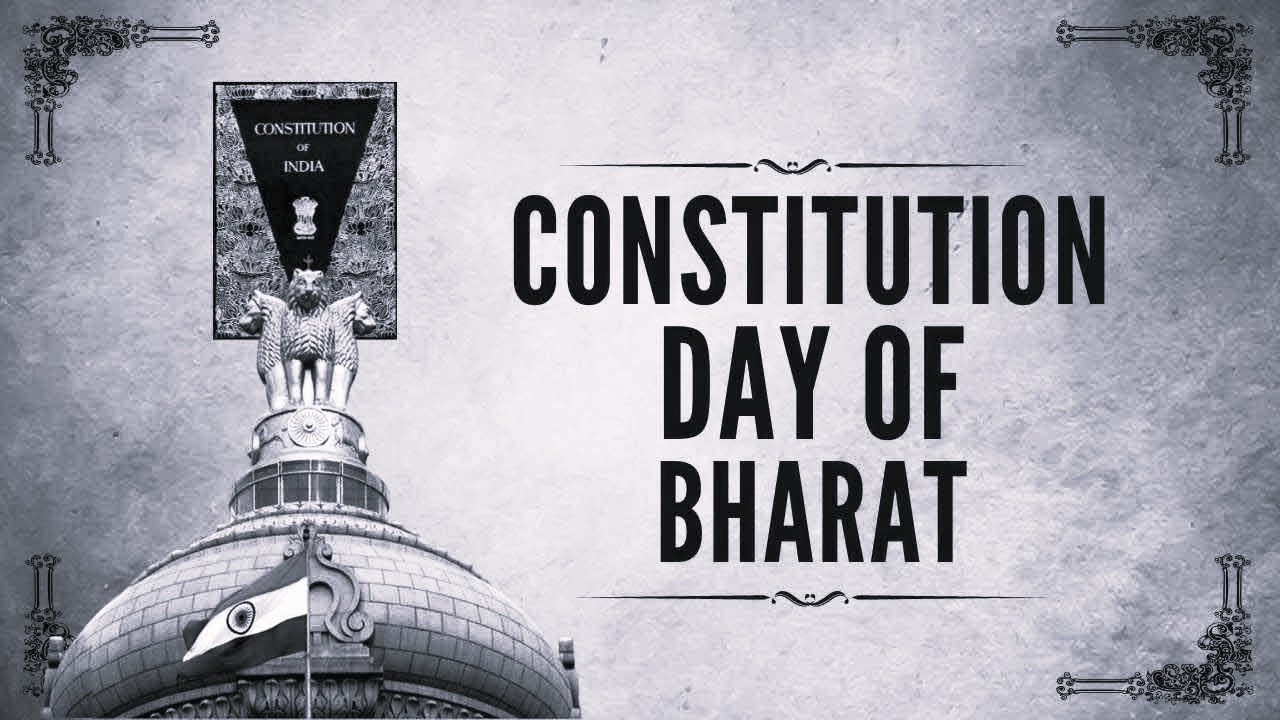
The Indian constitution: A living document of Ideals, Challenges and Evolving possibilities
As India celebrates Constitution Day, we revisit a monumental text that has shaped the social, political and moral architecture of the world’s largest democracy. Drafted in an age of turmoil yet rooted in timeless ideals, the Constitution of India remains not just a legal manuscript but the guiding conscience of a civilisation transitioning into a modern republic. In the words of Dr. B.R. Ambedkar, the chief architect of the Constitution, said, “A Constitution is not a mere lawyer’s document; it is a vehicle of life.” Seventy-five years later, the document continues to breathe, adapt and dispute, reflecting both the dreams and contradictions of a young nation.
A brief historical arc
The Constituent Assembly first met on 9 December 1946, with 299 members representing a mosaic of regions, languages, castes and political ideas. What followed was nearly three years of intense debate, resulting in the adoption of the Constitution on 26 November 1949. It came into force on 26 January 1950, marking the birth of the Republic.
India borrowed constitutional ideas from across the world:
• parliamentary democracy from Britain,
• judicial review from the U.S.,
• federal structure from Canada,
• directive principles from Ireland,
• emergency provisions from Germany.
Yet the final product was uniquely Indian in its balancing of diversity with unity, liberty with authority, and change with continuity. Alladi Krishnaswamy Aiyar noted during the debates: “The Indian Constitution seeks to blend the flexibility of the British system with the strength of the American Constitution.”
Features That Defined a New Republic
The Constitution’s impact lies in its remarkable architecture:
1. A Sovereign, Socialist, Secular, Democratic Republic
These words represent the moral compass of the Indian state. Sovereignty liberated us, democracy empowered us, and secularism became the foundational promise of equality amidst religious diversity.
2. Fundamental Rights
The Constitution guarantees liberties that were once denied under colonial rule. Justice H.R. Khanna observed, “Fundamental rights form the ark of the Constitution.” Right to equality, freedom of speech, protection from discrimination, and more these create an inviolable zone of dignity around every citizen.
3. Directive Principles of State Policy (DPSP)
These are the Constitution’s moral obligations social justice, equitable development, public health, education, welfare. Though not enforceable in courts, they serve as the blueprint for social transformation.
4. Independent Judiciary
A Supreme Court with the power of judicial review acts as the guardian of liberties and the arbiter of constitutional boundaries. Granville Austin famously described the Constitution as “a seamless web of three strands national unity, social revolution, and democracy.”
5. Federalism with a Unitary Bias
India adopted a unique federal model: states have powers, but the Centre is strong enough to maintain national unity, an intentional design in a nation traumatised by partition.
6. Universal Adult Franchise
From day one, every adult had the right to vote an audacious leap of faith when much of the world still restricted voting rights. As Rajendra Prasad said, “We have upheld the dignity of the common man by trusting him with the vote.”
Strengths That Defined India’s Constitutional Journey
1. Stability in a Vast, Diverse Nation
Many newly independent nations broke down under ethnic, linguistic or military pressures. India did not. The Constitution provided a framework that allowed this diversity to coexist under one roof.
2. Successful Democratic Continuity
From the world’s largest elections to peaceful political transitions, India’s democratic record is remarkable. Courts, Election Commission, CAG and other institutions have acted as stabilisers.
3. Social Justice Architecture
Reservation policies, welfare laws, affirmative measures, labour protections these emerge from the Constitution’s commitment to justice.
4. Adaptability Through Amendments
More than 100 amendments have allowed India to correct course when necessary, extending reservations, creating new states, strengthening local bodies, and expanding rights.
5. Empowerment of Marginalised Groups
While challenges remain, the Constitution provided a platform for Dalits, tribal communities, women and minorities to demand justice and representation.
Where the constitution’s implementation faltered
Even the best-designed Constitution depends on political culture, administrative competence and civic responsibility. India’s challenges lie not in design alone, but in execution.
1. Over-centralisation of Power
Though federal, India functions highly centrally:
• Finance commissions favour the Centre.
• Article 356 was misused extensively in the past.
• States depend on the Union for funds and permissions.
This weakens cooperative federalism and fuels political tensions.
2. Judicial Delays and Backlogs
Crores of cases remain pending. Justice V.R. Krishna Iyer warned decades ago: “Delay is the deadliest form of denial.” A brilliantly crafted judiciary loses legitimacy when delivery is slow.
3. Criminalisation and Money Power in Politics
Nearly 40% of MPs face serious cases. The Constitution did not anticipate this scale of erosion in political ethics. Absence of strong constitutional regulation of political parties is a major gap.
4. Ineffective Local Governance
Despite the 73rd and 74th Amendments:
• Panchayats lack financial autonomy.
• Corporations depend heavily on state governments.
• Urban planning remains poor.
Grassroots democracy remains an unfinished promise.
5. Directive Principles Left Weak
Health, education, nutrition, equal opportunity these were intended as goals of social revolution. But since they are non-justiciable, their implementation depends solely on political will, often inconsistent and insufficient.
6. Rise of Majoritarian Tendencies and Erosion of Secular Balance
Though the Constitution envisions equal respect for all faiths, political narratives often inflame communal divisions. Secularism is treated as rhetoric rather than constitutional obligation.
7. Bureaucratic Inertia and Political Interference
The Constitution intended a neutral, professional civil service. Instead:
• Transfers are politically driven.
• Innovation is discouraged.
• Accountability is weak.
The gap between policy and action widens.
8. Challenges in Protecting Liberties
Freedom of speech faces pressure from:
• Sedition laws,
• Misuse of preventive detentions,
• Restrictions on digital privacy.
Though courts defend rights, enforcement varies.
Key Reasons for Constitutional Successes
1. Strong Institutions
Courts, Election Commission, UPSC, CAG these have moderated excesses.
2. Civic Participation
High voter turnout, political engagement, civil society activism reflect deep democratic roots.
3. Cultural Pluralism
India’s society itself is resilient; diversity strengthens democratic instincts.
Key Reasons for Constitutional Failures
1. Political Culture
The Constitution cannot compensate for weak political ethics. Ambedkar warned: “However good a Constitution may be, it is sure to turn out bad because those who are called to work it happen to be a bad lot.”
2. Administrative Weakness
Administrative bottlenecks dilute the promise of rights and welfare.
3. Judicial Overload
Rights exist but take years to enforce.
4. Social Inequality
Deep-rooted caste and economic divisions hinder the constitutional vision of equality.
5. Misalignment of powers
Centre - State tensions, party discipline under anti-defection law, and weak local governments reduce democratic vibrancy.
Has the constitution succeeded or failed? A balanced judgement
The Constitution has succeeded in:
• Keeping India united
• Preserving democracy
• Protecting fundamental freedoms
• Enabling social mobility
• Maintaining judicial independence
But it has struggled in:
• Delivering social justice at scale
• Ensuring efficient governance
• Protecting secularism uniformly
• Preventing criminalisation of politics
• Ensuring timely justice
The Constitution is not merely a success or a failure it is an unending project. It survives because it adapts.
The road ahead: What must Change
1. Strengthen Federalism
• Clear financial autonomy for states
• Reform GST Council functioning
• Limit misuse of central agencies
2. Judicial Reform
• More judges
• Fast-track courts
• Modern case management systems
• Greater transparency in appointments
3. Electoral and Political Reforms
• Regulate political party finances
• Ban candidates with serious charges
• Shift towards partial proportional representation
• Strengthen Parliament committees
4. Empower Local Governments
• Independent revenue powers
• Urban planning autonomy
• Social auditing
5. Protect Digital Rights
Privacy, data protection, and algorithmic governance must become constitutional priorities.
6. Reinforce Constitutional Morality
As Ambedkar said, “Constitutional morality is not a natural sentiment. It has to be cultivated.” The future of the Constitution depends on how political leaders, institutions and citizens uphold this value.
A Living, Growing, Arguing Constitution
India’s Constitution was never meant to be a static rulebook. It is a breathing contract between the state and its citizens, a charter of rights, duties, aspirations and debates. It has endured wars, emergencies, political upheavals, economic transitions and massive social change. It has succeeded magnificently in keeping India democratic. It has failed partially in delivering social and economic justice at the required pace. It continues to evolve through amendments, judicial interpretations and popular movements.
As we celebrate Constitution Day, the task before us is clear:
*To honour not just the words of the Constitution, but the spirit behind them.
To preserve its freedoms, deepen its justice, and strengthen its democracy.
To ensure that the “vehicle of life” envisioned in 1949 continues its journey forward, inclusive, and hopeful.*