
The Great Transformation: Navigating India’s Evolving Labour Landscape
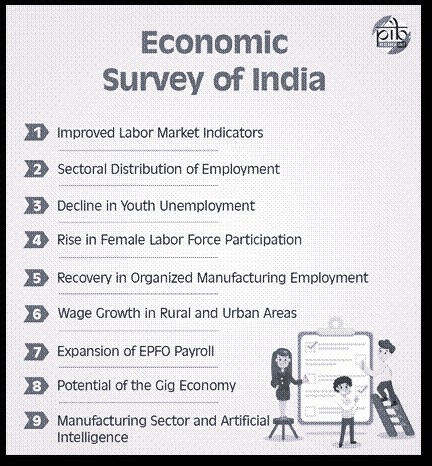
The Economic Survey 2025-26, presented by Union Finance Minister Smt. Nirmala Sitharaman, reveals that India’s labor market is undergoing a profound structural metamorphosis driven by rapid digitalization, the green energy transition, and the burgeoning gig economy. Transitioning from a post-pandemic recovery to a phase of sustainable growth, the government has shifted its focus from the mere quantity of jobs to the enhancement of work quality and human capital. This evolution is underscored by a historic rise in the Female Labour Force Participation Rate to 41.7% and a record low unemployment rate of 3.2%, signaling a more inclusive economic landscape. By integrating structural reforms like GST 2.0 and the new Labour Codes with digital platforms like e-Shram and the National Career Service, India is strategically positioning its workforce to fully harness its demographic dividend in a modern, globalized era.
The Structural Pivot - From Quantity to Quality
The Indian labour market is currently standing at a historic crossroads, undergoing a profound structural metamorphosis that goes far beyond simple employment statistics. As articulated in the Economic Survey 2025-26, presented by Union Finance Minister Smt. Nirmala Sitharaman, the narrative of work in India is being rewritten by three powerful forces: digitalization, the green energy transition, and the rise of the gig economy. In the post-pandemic era, the government’s focus has pivotally shifted from merely creating a "quantity" of jobs to ensuring the "quality" of work. This transition represents a more inclusive and sustainable vision where human capital enhancement is at the core of national policy. By promoting labour-intensive sectors and strengthening skill development, the government aims to fully harness India’s demographic dividend, ensuring that the workforce is not just employed, but empowered.
Deciphering the Positive Employment Momentum
Recent years have showcased a resilient recovery and sustained growth in India’s employment metrics, bolstered by structural reforms, tax rationalization, and a relentless focus on skill development. The data paints a compelling picture of inclusion: the Female Labour Force Participation Rate (FLFPR) has seen a dramatic rise from 23.3% in 2017-18 to an impressive 41.7% in 2023-24. Simultaneously, the overall Unemployment Rate (UR) has plummeted from 5.6% to a historic low of 3.2%. According to the Periodic Labour Force Survey (PLFS), the second quarter of FY26 alone saw the creation of 8.7 lakh new jobs, bringing the total employed workforce (aged 15 and above) to 56.2 crore. This steady improvement in employment conditions signals that the structural reforms, including deregulation and GST 2.0, are finally yielding tangible benefits across both industry and services.
The Urban-Rural Divide and Sectoral Shifts
The Survey provides a granular look at where Indians work, revealing a sharp contrast between rural and urban ecosystems. Rural employment remains traditionally anchored, with 57.7% of the workforce engaged in agriculture and 62.8% being self-employed. In these regions, women play a disproportionately high role in sustaining household enterprises. Conversely, urban India is the engine of the services sector, which accounts for 62.0% of urban jobs. Unlike the rural preference for self-employment, urban workers gravitate toward regular wage or salaried positions, which make up nearly half of the urban employment share. This duality necessitates a multi-pronged policy approach that supports agricultural productivity while simultaneously fostering high-value service roles in metropolitan hubs.
The Manufacturing Renaissance and Unincorporated Growth
A significant highlight of the Survey is the resilience of the organised manufacturing sector. Data from the Annual Survey of Industries (ASI) for FY24 shows a 6% year-on-year increase in employment, translating to over 10 lakh new jobs in a single year. Over the last decade, this sector has added 57 lakh jobs with a steady 4% Compound Annual Growth Rate (CAGR). Parallel to this is the massive "unincorporated" non-agricultural sector, which comprises 7.9 crore establishments employing 12.9 crore people. Interestingly, this sector is witnessing a shift toward entrepreneurship, with "working owners" now making up 60% of the workforce. Digitization is also penetrating this informal space; internet usage among unincorporated business units surged from 26% in 2023-24 to 39% by Q2 FY26, suggesting that even the smallest enterprises are integrating into the digital economy.
Digital Safety Nets - e-Shram and the NCS Revolution
To bridge the gap between informal and formal employment, the government has leveraged technology to build massive institutional databases. The e-Shram portal has emerged as a revolutionary tool for social protection, housing data for over 31 crore unorganised workers, including migrants, gig workers, and street vendors, as of January 2026. Strikingly, 54% of these registrants are women, allowing for targeted gender-focused welfare. Complementing this is the National Career Service (NCS) portal, a one-stop digital hub connecting 5.9 crore job seekers with 53 lakh employers. The NCS has seen a staggering 200% increase in job vacancies in FY24, and its integration with the Ministry of External Affairs’ e-Migrate system now allows Indian workers to access verified international opportunities under safe conditions.
The Dawn of the Labour Codes
A watershed moment in India's legislative history occurred on November 21, 2025, with the notification of the four new Labour Codes. By consolidating 29 complex central laws into four streamlined pillars, Wages, Industrial Relations, Social Security, and Occupational Safety, the government has struck a delicate balance between worker protection and operational flexibility. These codes are not merely administrative changes; they are catalysts for economic development. However, the Survey notes that the success of this transformation depends heavily on the private sector. Companies are now tasked with updating their digital systems, re-evaluating workforce models, and integrating this unified framework into their daily operations to remain competitive in a modernized market.
The Gig Frontier - Flexibility as a New Standard
The "Gig Economy" is no longer a peripheral trend; it is a central pillar of India's modern workforce. From 77 lakh workers in FY21, the sector has exploded by 55% to reach 120 lakh workers in FY25. This growth is fuelled by 80 crore smartphone users and a massive 15 billion UPI transactions per month. Gig work now represents over 2% of India’s total workforce and is projected to contribute ₹2.35 lakh crore to the GDP by 2029-30. The new Labour Codes formally recognise these workers, providing them with portability of benefits and social security for the first time. While this sector offers unprecedented revenue opportunities, the Survey stresses that addressing its inherent challenges, such as job security and consistent earnings, is vital for equitable long-term growth.
The Gender Dimension and the Case for Flexi-Work
The Survey concludes with a poignant analysis of the "Time Use" of Indian citizens. Findings from the 2024 Time Use Survey (TUS) highlight a significant "dual burden" on women. Approximately 41% of women aged 15-59 are primary caregivers for household members, compared to just 21.4% of men. Women spend considerably more time on unpaid domestic activities than their male counterparts, even when they are part of the paid workforce. This reality explains the increasing desirability of flexible work models among female workers. By advocating for "flexi-work" hours and hybrid models, the government acknowledges that supporting women in balancing caregiving with career aspirations is not just a social necessity, but an economic imperative to ensure a truly inclusive demographic dividend.