
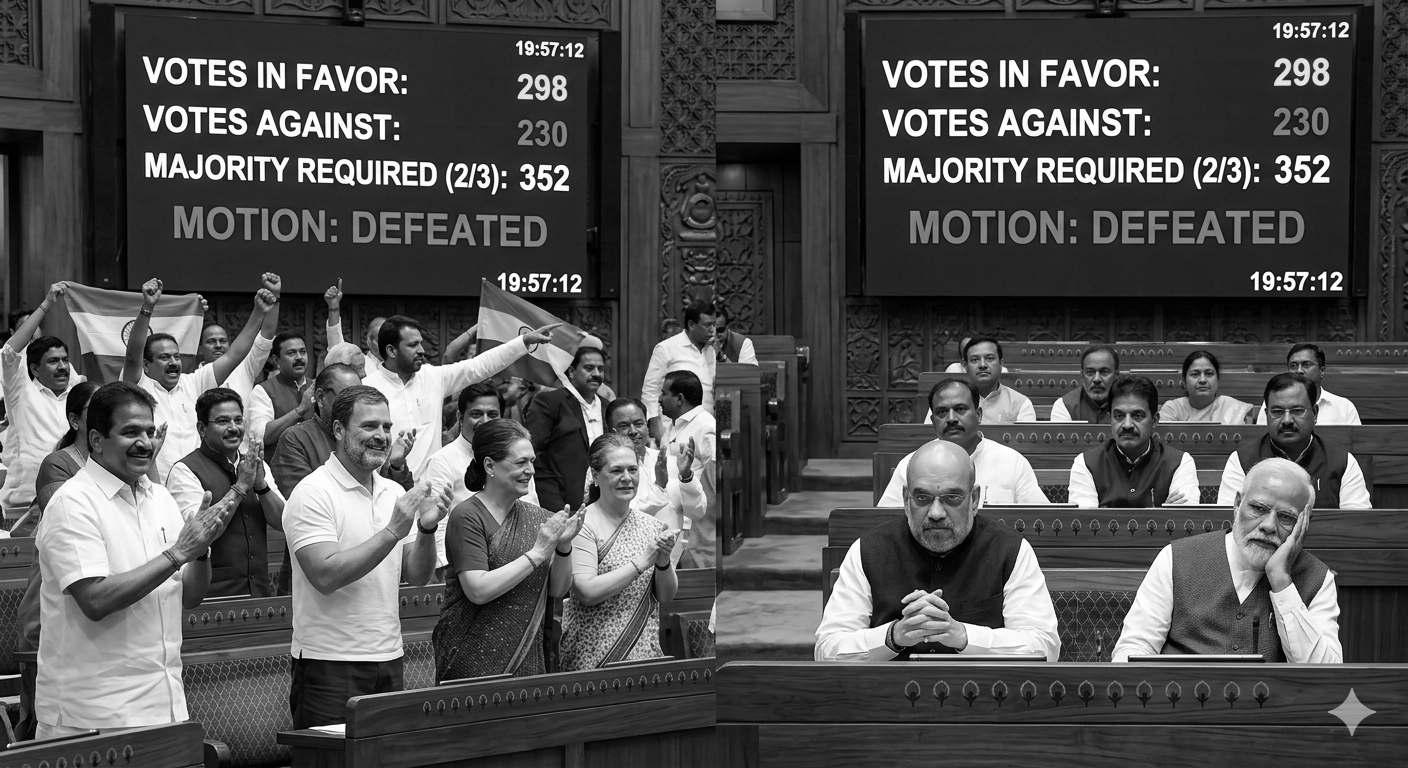
The googly that didn't turn: Modi government suffers its first constitutional defeat in 12 years, delimitation bill dropped
For all the strategic brilliance of the "50 per cent increase for all" formula unveiled on Thursday, it turned out that changing the terms of a debate is not the same as winning the vote. When the Lok Sabha divided on the Constitution (131st Amendment) Bill on Friday evening, the numbers told a simple and brutal story. The Modi government had just suffered the first defeat of a Constitutional Amendment Bill in its twelve-year tenure.
The tally was 298 in favour, 230 against . With 528 members present and voting, the government needed 360 votes to clear the two-thirds threshold required for a constitutional amendment. It fell 62 short . Zero abstentions. The opposition had held together completely, no walkouts, no quiet absences, no convenient headaches on the day. Every member who came to Parliament voted, and the INDIA bloc voted as one bloc .
The government then decided to withdraw the two other bills, the Delimitation Bill and the Union Territories Laws (Amendment) Bill , saying that they were linked to the Constitution Amendment Bill and therefore could not be taken up separately. In a single evening, the entire legislative architecture of the special session , three bills, a three-day sitting, months of political preparation, collapsed.
Parliamentary Affairs Minister Kiren Rijiju called the defeat a "historically disheartening moment" and added that the BJP government would keep fighting for women. It was a remarkable admission from a minister who had spent two days on the floor of the House managing the debate, swatting away opposition arguments, and urging calm. The government's public line, that this was always about women’s empowerment , now sat awkwardly with the fact that the bills are gone.
What made the defeat particularly stinging was how the day had begun. The government appeared confident. Amit Shah was scheduled to deliver his reply to the debate at 6 pm, armed with data, guarantees, and the "50 per cent for all" formula that had seemed to take the wind out of the south-versus-north argument on Thursday. Prime Minister Narendra Modi had made a direct appeal to the opposition to vote in favour of the bills, with crores of women watching the intent and decisions of their lawmakers. There was a meeting between Rijiju and the PM just before the vote. None of it moved a single member across the aisle.
The opposition, for its part, had come with a clear and disciplined strategy. Rahul Gandhi had told the House that the BJP was introducing the bills because it was "scared of the erosion of its strength" and was trying to rejig India's political map. He said the party had done it in Assam and Jammu & Kashmir and was now imagining it could do it across India. Before sitting down, he promised the House that his party would defeat the delimitation bill. He was as good as his word.
The Congress's counter-offer, implementing the 2023 Nari Shakti Vandan Adhiniyam as it stands, on the existing 543 seats, without any expansion of the House, will now hang over the BJP like an unanswered question. KC Venugopal had made the offer explicitly on Friday morning: withdraw the 131st Amendment, call an all-party meeting, and the opposition will help pass women's reservation immediately. The government did not take it. Now it has neither the bill nor the credit.
The structural problem was always hiding in plain sight. The NDA's 298 seats gave it a clear simple majority, enough to run a government and pass ordinary legislation. But amending the Constitution requires something the NDA simply does not have, a two-thirds majority in each House . That gap was never going to be bridged by a last-minute formula, however clever, or by an appeal from a Prime Minister, however heartfelt. It required either genuine political negotiation with the opposition over weeks and months, or a willingness to accept a more limited bill that could actually pass.
The government chose neither. It spent weeks allowing the south-versus-north narrative to build momentum, then unveiled its counter-argument on the floor of the House at the last minute, expecting the drama of the reveal to substitute for the hard arithmetic of consensus. It was a high-risk political gamble. On Friday evening, the House called it.
The Lok Sabha has been adjourned. It will reconvene on Saturday. The Rajya Sabha, which never got to consider the bills, meets again on April 18. The special session that was called to make history ends, instead, having made a different kind of history altogether.