
The Future of Indian Agriculture: Tech-Driven or Farmer-Driven?
Indian agriculture is again standing at a moment of profound transition. In earlier eras, the Green Revolution redefined farming with high-yielding varieties, irrigation expansion and chemical fertilisers. Later, the White Revolution reshaped the dairy sector. Today, the transformation is digital. The entry of artificial intelligence (AI), machine learning, remote sensing, drone technology, sensor-based irrigation, agricultural automation, genetic innovation and digital marketplaces has opened an entirely new chapter. Yet a question echoes across the fields: Will the future of Indian agriculture be driven by technology or by the farmer?
This is not merely an academic debate. It determines who controls data, who guides decisions, who earns profits, and who carries risks. It decides whether millions of small and marginal farmers who form the backbone of the sector will be empowered or marginalised.
1. The Historical Context: Evolution at a Slow but Determined Pace
Indian agriculture has traditionally evolved gradually, absorbing new practices, tools and technologies at a pace dictated by social structures, landholding patterns and local ecology. When the Green Revolution was introduced, not all regions benefited equally. Punjab, Haryana and western Uttar Pradesh rose rapidly due to existing irrigation and land consolidation. Meanwhile, eastern and central India lagged.As a result, Indian farming became a mosaic rather than a uniform system. Even today, the country hosts multiple agricultural realities: rainfed farming, irrigated farming, plantation sectors, horticulture clusters, tribal subsistence agriculture and semi-mechanised rural belts.
Into this complex system enters a wave of advanced technology. But technology cannot be superimposed onto diverse landscapes without understanding the context. That is the core tension: Should technology dictate the future of agriculture, or should farmers through their needs, wisdom and local conditions shape how technology evolves?
2. The Rise of Agri-Tech: Promise, Possibility and Hype
India’s agri-tech sector has expanded fast over the last decade. Hundreds of start-ups now operate across the value chain: precision cropping, soil testing, weather forecasting, drone spraying, market-linkage apps, AI crop diagnosis, automated irrigation, supply-chain management and block-chain-based traceability.
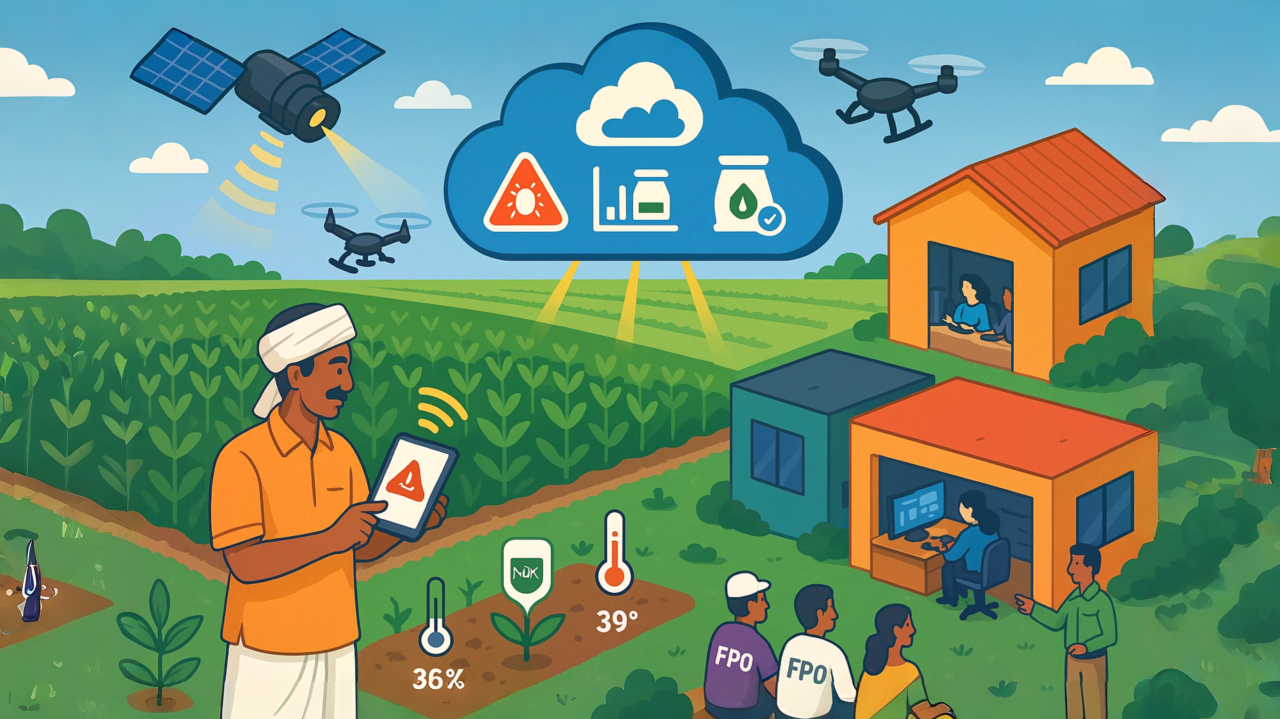
By some estimates, over $3 billion in private investment has entered agri-tech. Every investor and policymaker speaks of the “digital revolution” in the fields. Drones—once associated with military operations—now fly over paddy fields and cotton farms spraying fertiliser or pesticide. Satellite-based advisories reach millions of farmers through mobile apps in multiple languages. Farmer Producer Organisations (FPOs) use digital platforms to aggregate produce and negotiate better prices.
The government has also joined this movement:
The Digital Agriculture Mission 2021–25 encourages the use of AI, IoT and blockchain. The Agristack project aims to create unified digital IDs for farmers. Some states are collaborating with start-ups for precision farming and crop surveillance.
The message is clear: technology will be central to the future of farming. Yet beneath this celebratory narrative lies a complicated ground reality.
3.The Farmer’s Perspective: Challenges, Realities and Aspirations
While technology is advancing rapidly, the conditions of most farmers remain unchanged. More than 85% of Indian farmers are small or marginal, cultivating less than two hectares. For them, investment in drones, sensors, automated irrigation systems or advanced machinery is financially unrealistic.
Even smartphone-based advisories are useful only when:
the farmer has stable connectivity,
the instructions are fully understood,
the recommendations align with local soils,
and the market supports the advised crop.
The digital divide is not merely about owning a device. It's about the ability to use the device meaningfully. Many farmers are hesitant to adopt tools that they cannot repair, maintain or operate independently. They worry about becoming dependent on external companies or service providers. Moreover, the economics of farming remains fragile.Input costs are rising, Climate events are becoming unpredictable, Market prices fluctuate sharply, and the Profit margins remain narrow. In such an environment, technology can appear either as a lifeline or as a threat.
4. Technology as an Enabler, Not a Substitute
The narrative must be reframed. Technology should not replace the farmer’s agency, intuition or decision-making. Instead, it should enhance them.
For example:
A farmer who already observes soil texture and moisture can gain precision through IoT sensors. A traditional practice of staggered planting can be strengthened with weather-forecast intelligence. Knowledge of local pests can be amplified through AI-based crop-disease diagnostics.But technology must adapt to the farmer, not the other way around. This distinction is crucial.
5. Top-Down Solutions vs Bottom-Up Realities
One of the biggest criticisms of current agri-tech efforts is their top-down approach. Many innovations are developed in laboratories or urban offices and later pushed into rural areas. They do not always match the farmer’s needs. A drone spraying system may look impressive, but if landholding sizes are tiny and irregular, the usefulness decreases. Soil advisory apps may recommend certain crops, but water availability or market access may contradict these suggestions.
The result? Adoption remains limited.A technology becomes successful only when it solves real problems, in real contexts, for real farmers.
6. Climate Change: The Most Urgent Driver of Innovation
Climate change is altering rainfall patterns, increasing heat stress, expanding pest ranges and reducing water availability. In this environment, India’s agriculture must become more resilient.
Here technology can play transformative roles:
• GIS-based mapping can identify drought-prone zones.
• Heat-tolerant seeds developed through gene-editing can stabilise yields.
• Automated weather stations can guide irrigation schedules.
• Early-warning systems can alert farmers to pest outbreaks.
But once again, these tools succeed only when the farmer understands them, trusts them and uses them regularly.
7. The Risk of Data Centralisation
As digital systems expand, the ownership and control of agricultural data becomes a vital question.If private entities control soil data, crop behaviour data, satellite readings and market information, farmers may become dependent on platforms that profit from their vulnerability. Regulation must ensure farmer consent,transparency,open-access,data sovereignty,and strict limits on corporate control. Agriculture cannot become a data-extraction industry.
8. The Role of Farmer Producer Organisations (FPOs)
A farmer-driven future requires strong collective institutions. FPOs and cooperatives can reduce input costs, improve bargaining power and enable shared access to technology. An IoT-based irrigation system may be expensive for an individual, but affordable for a cooperative. Drones can be hired through FPO-owned service centres. Digital market platforms are more effective when FPOs negotiate collectively rather than individual farmers selling alone. Technology becomes meaningful when it strengthens collective farmer power.
9. Agri-Extension: The Missing Link
India’s agricultural extension system has weakened over the years. Field-level demonstrations, in-person training and practical guidance have declined. Without human intermediaries, farmers often find technology intimidating. India needs a new cadre of agri-tech extension workers and young professionals who understand both agriculture and digital tools. They can interpret sensor data, translate app-based advisories and help farmers adopt tools step-by-step. This bridge between tech designers and farmers is essential.
10. A Balanced Future: Tech-Driven AND Farmer-Driven
The debate need not be binary. The future of Indian agriculture can and must be both tech-driven and farmer-driven.Technology should bring precision, efficiency, sustainability and market access.Farmers should bring contextual understanding, sustainability practices and decision-making rooted in lived experience.The harmony between scientific innovation and traditional wisdom is the true path forward.
11. Policy Directions for a Sustainable Digital Future
To ensure a balanced future, India must focus on:
• Affordable access to tech through leasing, subsidies and community equipment banks.
• Farmer-led innovation platforms where farmers co-create solutions.
• Digital infrastructure such as rural broadband and local data servers.
• Open-source agri data to prevent monopolies.
• Climate-resilient seed development through public research.
• Credit reforms to support technology adoption.
• Training and capacity building to improve digital literacy.
• Regulation of agri-tech companies to prevent exploitation.
12. Conclusion: A Future Rooted in Empowerment
Indian agriculture has always thrived when farmers were placed at the centre of decision-making. Technology can make farming profitable, sustainable and climate-resilient, but only when it respects the farmer’s experience and agency. The future must not be a choice between smart farms and smart farmers. It must be a partnership. The right question is not “tech-driven or farmer-driven?” The right question is: How can technology serve farmers and amplify their wisdom? When technology becomes a tool in the farmer’s hands not a command over his head Indian agriculture will truly enter its next revolution.