
The End of Maoist Insurgency? Surge in Surrenders!
India’s decades-long Maoist insurgency appears to be entering its final phase. A year of relentless security operations and deepening cracks in the CPI (Maoist) hierarchy has seen several top leaders either killed or surrender the most significant among them being Mallojula Venugopal Rao, one of the movement’s most influential strategists.
Known by his aliases Abhay, Sonu, and Bhupati, Mallojula surrendered to the Maharashtra Police along with about 60 cadres in Gadchiroli, handing over INSAS rifles and AK-47s. Once a key Politburo member, he had recently resigned from the party’s top decision-making body, admitting organizational failures and openly criticizing its deviation from ideological principles.
Carrying bounties between ₹1 crore and ₹10 crore across multiple states, his surrender marks a decisive blow to the movement already weakened by infighting and the loss of veteran commanders. The operation was supervised by IG (Anti-Naxal Operations) Sandeep Patil and SP Nilotpal (Gadchiroli), ensuring a peaceful outcome. Chief Minister Devendra Fadnavis is expected to formally announce the development during his October 16 visit to Gadchiroli.
Parallel Wave of Surrenders in Chhattisgarh
While Maharashtra registered its most high-profile defection, Chhattisgarh witnessed a parallel wave of capitulations in Sukma, one of Bastar’s most volatile districts. On October 16, 27 Naxalites, including 10 women, surrendered before senior officers of the Chhattisgarh Police and the CRPF. Among them, 16 cadres carried combined bounties of ₹50 lakh, underscoring the presence of senior members of the outlawed group.
Sukma SP Kiran Chavan said the cadres had grown “disillusioned with Maoist ideology,” calling it hollow and harmful to tribal communities. Many credited the state government’s Niyad Nellanar (“Your Good Village”) program focused on healthcare, education, and infrastructure in remote tribal belts for restoring faith in mainstream governance.
Under the state’s surrender and rehabilitation policy, each cadre receives ₹50,000 as initial assistance, a monthly stipend for three years, skill-development training, housing support, and land allocation an approach experts say has made reintegration realistic and sustainable. Among the prominent surrenderers yesterday was Oyam Lakhmu (53) of the PLGA’s Battalion No. 1, carrying a ₹10-lakh bounty. Younger cadres such as Madvi Bhima (18) and Sunita alias Kawasi Somdi (24), each with ₹8 lakh rewards, reflect the generational fatigue now evident within the movement.
Leadership Decapitated, Organization in Retreat
The Maoist chain of command has been systematically dismantled this year.
• Ramachandra Reddy alias Pratap Reddy alias Chalapathi , head of the Odisha State Committee, was killed on January 21 in a joint operation along the Chhattisgarh–Odisha border.
• On May 21 , Nambala Keshava Rao (Basavaraj / Gaganna) the CPI (Maoist)’s General Secretary was killed in Narayanpur, becoming the first serving chief to fall in action.
• In September, Kadari Satyanarayana Reddy (Kosa) and Katta Ramachandra Reddy (Raju Dada) were eliminated in Abujhmad forests.
These setbacks have left Thippiri Tirupathi (Devuji), a Dalit leader from Telangana’s Karimnagar district, as the new General Secretary, with Mandavi Hidma—commander of the PLGA’s elite Battalion No. 1 heading the Dandakaranya Special Zonal Committee.
Still at Large: The Elusive Commanders
Despite these losses, a handful of senior figures remain at large, keeping alive the vestiges of the insurgency.
Thippiri Tirupathi alias Devuji, who took over after Basavaraj’s death, continues to direct operations from deep forest zones. Known more for his tactical precision than ideological fervor, he now leads what remains of the CPI (Maoist)’s Central Military Commission. Alongside him, Madvi Hidma, the youngest Central Committee member and a tribal commander revered among rank-and-file fighters, oversees guerrilla warfare across Bastar. His mastery of ambush tactics and intimate knowledge of the terrain make him a persistent threat.
Meanwhile, Muppala Lakshmana Rao alias Ganapathi, the former General Secretary and principal ideologue behind the 2004 merger that created CPI (Maoist), remains untraceable since stepping down in 2018. Security agencies remain uncertain whether he is alive, though his ideological writings continue to circulate within underground cells. Together, Devuji the strategist, Hidma the field commander, and Ganapathi the fading ideologue represent the final remnants of a movement that once spanned 126 districts but is now confined to a shrinking cluster of forests across central India.
A Movement at Its Breaking Point
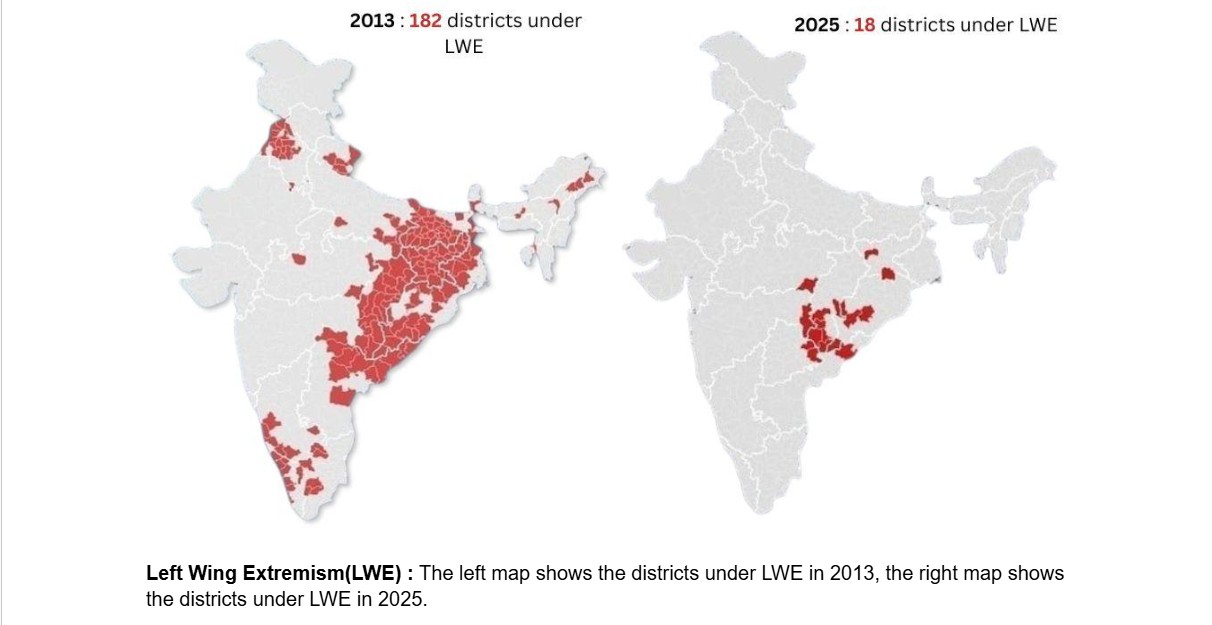
From its peak influence in 2013 to the present, Maoist control has shrunk from 126 districts to just 38 across nine states. Official data puts the active cadre strength below 4,000 down from more than 10,000 a decade ago.
Analysts attribute this decline to a dual strategy of intensified security operations such as Operation Kagar and targeted development initiatives that have eroded the Maoists’ rural support base. Union Home Minister Amit Shah recently reaffirmed the government’s goal of completely eradicating Naxalism by March 31, 2026, ensuring, as he said, that “no citizen ever loses life to extremist violence again.”
With senior cadres surrendering and the remaining leadership in hiding, the CPI (Maoist) now stands at a historic crossroads, its collapse no longer a question of if, but when.
Left Wing Extremism(LWE) : The left map shows the districts under LWE in 2013, the right map shows the districts under LWE in 2025.