
The Drone Revolution in India
Over the past two decades, the global technological landscape has undergone a tectonic shift, directly impacting the lives of the common man. At the heart of this transformation lies drone technology, or Unmanned Aerial Vehicles (UAVs). Once confined to the secretive corridors of national defense or the hobbyist’s recreational use, drones in India have now emerged as a cornerstone of governance, agriculture, infrastructure, and public service delivery.
The acceleration of this sector is not accidental; it is the result of deliberate, progressive policy interventions by the Government of India. Initiatives such as the Liberalized Drone Rules , the Production Linked Incentive (PLI) Scheme , and the Digital Sky Platform have dismantled legacy barriers, fostering an environment where domestic manufacturing and adoption can flourish.
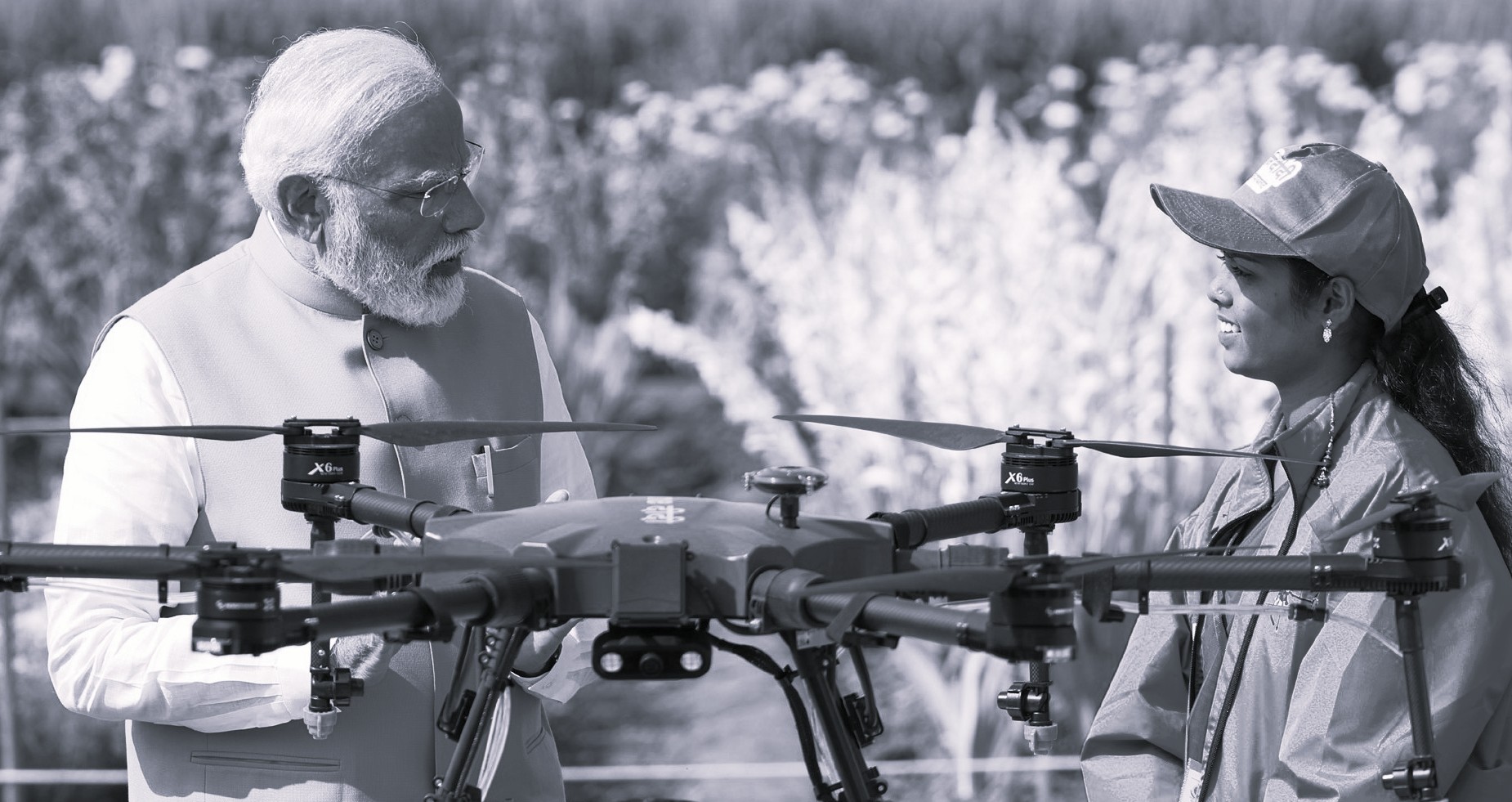
By February 2026, India’s drone ecosystem had reached an unprecedented scale. The country now boasts over 38,500 registered drones (UIN) , a workforce of approximately 39,890 DGCA-certified remote pilots , and 244 approved Remote Pilot Training Organizations (RPTOs) . These figures represent more than just growth, they represent a structured, professionalized industry. In the social sector, the SVAMITVA Scheme has utilized drones to map 3.28 lakh villages, providing 2.76 crore property cards to rural citizens. Simultaneously, the Namo Drone Didi initiative has empowered women by distributing 1,094 drones to Self-Help Groups (SHGs).
As India marches toward its goal of becoming a "Global Drone Hub" by 2030, the drone is no longer just a gadget; it is a catalyst for economic growth and social empowerment. Let us delve deeper into the specific sectors where this technology is making its mark.
The Namo Drone Didi Scheme: A Social Revolution
Launched in November 2023, the Namo Drone Didi Scheme has triggered a profound social revolution in rural India. By integrating high-end technology with the grassroots strength of Women Self-Help Groups (SHGs), the government is transforming rural women into technical experts.
Under this scheme, thousands of women are being trained as certified drone pilots. This training enables them to provide essential agricultural services, such as precision spraying of fertilizers and pesticides. Beyond the technological feat, the economic impact is staggering: these "Drone Didis" are generating an additional annual income of approximately ₹3 lakh for their groups. This initiative is effectively bridging the gender gap in technology, allowing rural women to transition from traditional roles to becoming leaders of a tech-driven agrarian economy.
Precision Agriculture: Redefining the Agrarian Economy
In a country where agriculture is the backbone of the economy, drones are proving to be a game-changer. The traditional method of manual spraying is labor-intensive, time-consuming, and often leads to the uneven distribution of chemicals.
Precision Farming via drones allows farmers to identify specific areas of a field that require intervention, thereby reducing the volume of pesticides and fertilizers used. What once took hours of grueling manual labor can now be completed in minutes with surgical precision. Furthermore, drones eliminate the health risks associated with farmers being directly exposed to toxic chemicals. Beyond spraying, drones equipped with multispectral sensors provide critical data on crop health, soil moisture, and yield estimates, allowing for data-driven decision-making.
SVAMITVA Scheme: Securing Land Rights
Land disputes have historically been a major bottleneck in rural development and judicial systems. The SVAMITVA Scheme (Survey of Villages and Mapping with Improvised Technology in Village Areas) has addressed this through drone-based mapping.
By creating high-resolution digital maps of rural inhabited areas, the government is providing "Property Cards" to villagers. This digital record of rights acts as a legal document of ownership, significantly reducing land-related litigation. Moreover, it empowers villagers to use their property as a financial asset to secure bank loans, fostering a new wave of rural entrepreneurship. The transparency brought about by this digitization is a landmark achievement in Indian governance.
Infrastructure Monitoring and Transparency
The Indian government is leveraging drones to oversee its most ambitious infrastructure projects. The National Highways Authority of India (NHAI) now mandates monthly drone-video recordings for all highway projects to ensure transparency and accountability.
By comparing month-to-month footage, authorities can identify discrepancies in progress and quality immediately. Similarly, the Ministry of Railways employs drones for the inspection of hard-to-reach tracks, bridges, and high-altitude tunnels. The Railway Protection Force (RPF) further uses this aerial surveillance for crowd management at stations and to curb trespassing and theft, ensuring a safer transit environment.
Disaster Management and Emergency Response
During natural calamities, time is the most critical factor. Drones have emerged as "life-savers" during floods, landslides, and earthquakes. In areas where human rescue teams cannot reach due to terrain or safety risks, drones are deployed to deliver food, medicines, and first-aid kits.
Organizations like NECTAR have developed specialized drone systems capable of long-endurance flights to provide live aerial visuals of disaster-hit zones. This real-time data allows command centers to coordinate rescue operations with higher efficiency. Additionally, the use of drones for "Medicine from the Sky" projects is ensuring that life-saving vaccines and blood units reach remote tribal and hilly areas within minutes, bypassing broken road networks.
Defense: Achieving "Atmanirbharta" (Self-Reliance)
Modern warfare and border management have been redefined by Unmanned Aerial Systems. For the Indian Armed Forces, drones are indispensable for 24/7 surveillance along porous and mountainous borders.
Under the "Make in India" banner, domestic startups are now manufacturing sophisticated loitering munitions, tactical surveillance drones, and "kamikaze" drones. The success of drones during operations like Operation Sindoor has highlighted their strategic importance. By shifting from imports to indigenous production, India is not only securing its borders but also building a robust defense-industrial complex that reduces vulnerability to global supply chain disruptions.
Understanding the Types of Drones
India follows a structured classification system for drones based on their weight and design, regulated by the Directorate General of Civil Aviation (DGCA) .
Weight-Based Classification:
Nano Drones:
Less than 250 grams (often do not require registration).
Micro Drones:
250 grams to 2 kilograms.
Small Drones:
2 kilograms to 25 kilograms (commonly used in agriculture and photography).
Medium Drones:
25 kilograms to 150 kilograms.
Large Drones:
Over 150 kilograms (used for heavy logistics and defense).
Design-Based Classification:
Multi-Rotor Drones:
Like the common quadcopter, these can hover in place, making them ideal for photography and surveillance.
Fixed-Wing Drones:
These resemble small airplanes and are used for long-distance mapping and surveys.
Hybrid VTOL (Vertical Take-off and Landing):
These drones combine the hover capability of a multi-rotor with the speed and range of a fixed-wing, making them perfect for medical deliveries in hilly terrains.
Policy Reforms: The Digital Sky and Simplified Rules
The transition from a restrictive regime to a liberalized one was marked by the Drone Rules 2021 . The government replaced 25 complex forms with just 5 and slashed the number of required approvals.
The Digital Sky Platform serves as a single-window system for registrations and flight permissions. One of the most significant reforms was the creation of "Green Zones" across 90% of Indian airspace, where drones can be flown up to 400 feet without prior permission. Furthermore, the requirement for a traditional pilot license was replaced by a simplified Remote Pilot Certificate, making the profession accessible to anyone with a basic government ID.
Economic Incentives and Job Creation
The drone sector is a burgeoning engine for employment. The Production Linked Incentive (PLI) scheme has provided a ₹120 crore cushion to domestic manufacturers, encouraging them to scale up operations.
By reducing the GST on drones to 5% , the government has made technology affordable for small-scale farmers and startups. This has led to the proliferation of the "Drone-as-a-Service" (DaaS) model, where entrepreneurs provide drone services on a rental basis. From hardware engineers to data analysts and certified pilots, the ecosystem is creating a diverse range of high-tech jobs across both urban and rural India.
Global Hub Aspirations and Recent Exhibitions
To showcase India's growing prowess, events like 'Bharat Drone Shakti' and 'Bharat Drone Mahotsav' have been organized on a massive scale. These exhibitions have seen participation from over 75 startups, displaying everything from heavy-lift logistics drones to AI-powered autonomous swarms.
These platforms serve as a bridge between innovators and investors. The live demonstrations at these events prove that Indian-made drones can operate in extreme weather and difficult terrains. By integrating Artificial Intelligence and Machine Learning, Indian drones are becoming "smarter," capable of autonomous navigation and real-time obstacle avoidance.
A Future on the Horizon
India’s journey into the drone era is a testament to its ability to embrace disruptive technology for the greater good. Through a combination of visionary policy, a vibrant startup culture, and grassroots empowerment, the country is positioning itself as a global leader in Unmanned Aerial Systems.
The drone is no longer just a flying camera; it is a tool for social justice, a guardian of national security, and an architect of a modern economy. As we look toward 2030, the continued investment in research and development will ensure that India doesn't just participate in the drone revolution but leads it. This technological leap is giving "new wings" to India’s socio-economic development, promising a future that is smarter, safer, and more inclusive.