
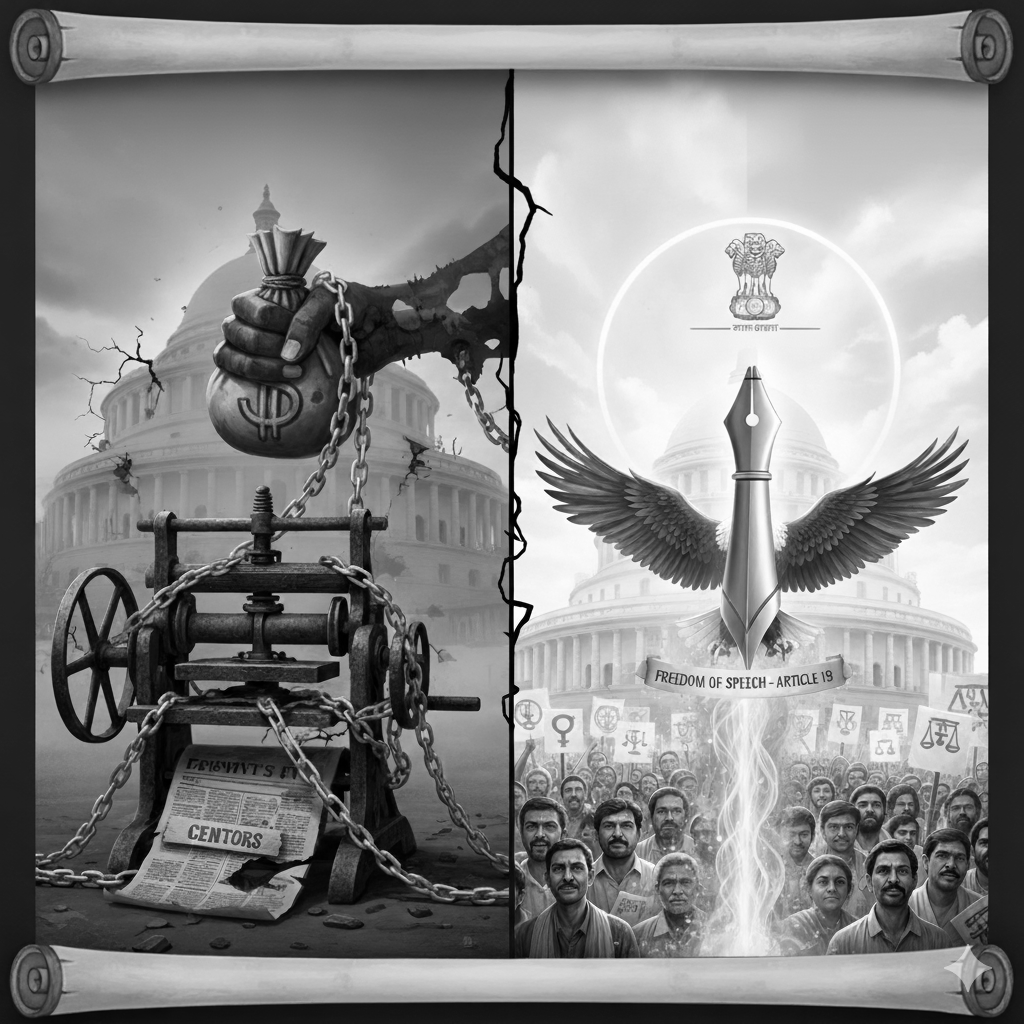
The Compromised Fourth Estate - The Vow Of Press Freedom To Indian Democracy
The year was 1975, and a pall of darkness had descended upon Indian democracy, the dark days of the Emergency. Government police were stationed outside major newspaper offices across the country. Censor board officials, like vultures, scrutinized every single word and line. Any hint of dissent meant the newspaper would be barred from publishing the next day.
In his office in Mumbai, Gopal (name changed), a veteran newspaper editor, faced an agonizing dilemma. Should he comply with the government's dictates and print state propaganda, or follow his conscience and inform the public of the truth? That night, he received an official order to kill a sensitive story critical of the government's crackdown. Gopal, his brow slick with sweat, felt his pen and his weapon was being snatched away. Finally, he made a daring, subtle choice. The next day, in the space where the suppressed story and editorial on the Emergency were meant to appear, he left a massive, conspicuous blank space. The entire column was empty, without a single letter.
The newspaper hit the streets, and the public immediately grasped the profound significance of the silence. That gaping void became a powerful, silent protest against the vicious censorship. It delivered a sharp, unambiguous message: "If we cannot speak the truth, we refuse to print a lie." This act wasn't just journalistic bravado; it was a profound demonstration of the moral values necessary to protect democracy. As we observe National Press Day on November 16th, it is imperative to reflect on this spirit and assess the current integrity of our press freedom.
Historical Roots - The Genesis of National Press Day
National Press Day is celebrated annually on November 16th to commemorate the day the Press Council of India (PCI), the body established to oversee and maintain standards of press freedom in India, began its functions.
When and Why It Started?
Following India's independence, it was recognized that safeguarding press freedom and setting high standards for journalism were crucial for a healthy democracy. After the repeal of certain laws that attempted to curb press rights, the first Press Commission, led by Justice G.S. Rajadhyaksha, recommended the establishment of a statutory body. Based on these recommendations, the Press Council Act was passed in 1965. The Press Council of India was formally established on November 16, 1966. Since then, this day has been designated as National Press Day, a solemn occasion to honor the freedom of the press and to remind journalists of their profound responsibilities towards the nation.
The Crisis of the Fourth Estate
Today, the power of the Indian media is unprecedented. From traditional newspapers to digital platforms and 24/7 news channels, information reaches millions in mere seconds. However, there is a mounting, inescapable criticism that this immense power is being wielded more for profit and influence than for public good, causing more harm than benefit to the public discourse.
The current functioning of the media is plagued by several critical challenges:
Prioritization of Sensationalism over Substance
TRP (Television Rating Points) and online clicks have tragically become the primary editorial yardsticks. Deeply reported, investigative journalism is declining, replaced by sensationalized 'breaking news,' shouting matches, and emotional drama. Critical socio-economic issues are often marginalized in favor of political spectacle.
Corporate and Political Pressure
A vast majority of media organizations are owned by lar ge corporate houses. The commercial interests and political affiliations of these owners inevitably exert pressure, leading to the distortion and suppression of news. This compromises the fundamental purity of journalism.
Speed over Accuracy
In the frenetic age of social media, the rush to be the first to "break" a story often overrides the essential journalistic process of verifying accuracy and integrity. This lack of due diligence has become a primary driver of the rampant spread of Fake News.
The Dark Shadow of Partisanship and Bias
Perhaps the most damaging criticism leveled against the contemporary Indian media is its slide into outright political partisanship. Many major news outlets now appear to operate as mouthpieces for a specific political party or ideological group, aggressively advocating their agenda while suppressing or casting a negative light on the opposition.
Mechanisms of Bias
Agenda Setting and Gatekeeping
Deciding which stories receive prominent coverage and which are deliberately buried or ignored.
Tone and Framing
Using biased language and a specific narrative perspective to portray the same event favorably for one side and unfavorably for the other. For instance, reporting on a government scheme with uncritical praise rather than objective scrutiny.
Selective Panelists
Filling news debate panels solely with commentators who share a similar political outlook, thereby reinforcing a single, polarized viewpoint and stifling genuine debate. When a press organization functions to serve a specific political party or group, it commits a betrayal of democracy. The press, as the Fourth Estate, is constitutionally mandated to serve as the Opposition, the essential watchdog that scrutinizes the government's performance, not as its Spokesperson .
The Moral Compass - What a Journalist Must Uphold
For the press to reclaim its credibility and dignity, journalists must strictly adhere to a set of core Moral Values principles that form the soul of ethical journalism:
Integrity and Truth
The commitment to reporting only the facts, striving relentlessly to uncover the truth without fear or favoritism.
Impartiality and Objectivity
The discipline of setting aside personal opinions and beliefs when reporting a story, ensuring that all sides of an issue are presented in a balanced and fair manner.
Independence
The courage to func tion freely, uninfluenced by pressure from politicians, corporate entities, or any vested interest groups. Both financial and editorial independence are non-negotiable.
Transparency
Being open about the sources of information (where possible) and having the honesty to promptly and publicly correct any errors made in reporting.
Humanity and Minimizing Harm
Reporting with empathy, ensuring that the act of reporting does not cause unnecessary harm to the individuals involved, particularly victims, and respecting their privacy and dignity.
The Moral Erosion - The State of Today's Journalists
Regrettably, in today’s media landscape, these essential moral values are rapidly eroding. The journalistic community is facing a severe "Moral Crisis."
While many young journalists enter the profession with high ideals, they often quickly succumb to the harsh realities of the system:
Predetermined Narratives
Many newsrooms require journalists to adhere to narratives or scripts predetermined by owners or political benefactors, sidelining objective reporting.
Fear and Intimidation
Honest journalists who attempt to report without bias frequently face threats, financial pressures, or the risk of job loss from powerful political and corporate forces.
The Rise of "Lapdog Media" (Godi Media)
The widespread use of this term to describe media outlets that blindly serve the ruling party is a devastating indicator of the extent to which public trust in journalism has collapsed. There is a noticeable shift away from deep investigative reports and grassroots field reporting towards sensationalist studio debates and politically motivated propaganda. This trend threatens to reduce journalism from a pillar of democracy into a mere entertainment industry or a political propaganda tool.
Lessons from the Titans - Indian Press Legends
Our history is rich with examples of journalists who served the nation selflessly and ethically. Their lives offer invaluable lessons for the media fraternity today:
Bal Gangadhar Tilak
Through his Marathi newspaper Kesari , Tilak ignited the flame of the freedom movement. His declaration, “Swaraj is my birthright,” was a fearless statement of press freedom and the right to dissent. Tilak proved that the press could be a powerful public education tool and a force for national unity.
Ramnath Goenka
As the founder of The Indian Express, Goenka stood up courageously against the government during the Emergency. His organization literally fought the state, embodying the spirit that editorial independence is sacrosanct and non-negotiable.
Ganesh Shankar Vidyarthi
He established the newspaper Pratap , focusing primarily on the issues of the common man and the plight of the oppressed. His life teaches us that the primary mission of journalism is the service of the people, not the service of power.
These titans earned public trust by operating without fear and with unwavering impartiality. For them, journalism was not just a job; it was a sacred duty in the service of nation-building.
The Path to Redemption
To regain its honor and credibility, the Indian press must undergo a structural and moral overhaul, focusing on the following vital changes:
Reclaiming the Critical Stance
The press must once again adopt the role of the perpetual skeptic and watchdog, scrutinizing every action of the government and all political parties with deep investigation and doubt.
Financial Transparency and Ethical Funding
Media houses must become more transparent about their revenue streams and political advertisements, allowing the public to understand the potential drivers of bias. Ethical funding models that prioritize reader subscriptions over corporate handouts are essential.
Support for Deep Journalism
News consumers must consciously shift their demand away from sensationalism towards well-researched, investigative stories and ground reports. The audience must be willing to support and pay for quality journalism.
Empowering the Press Council of India (PCI)
The PCI must be granted more authority to enforce its ethical guidelines, including the power to impose hefty fines or cancel licenses in cases of severe ethical violations or partisan conduct.
Mandatory Balanced Reporting
Strict internal editorial guidelines must ensure that every news report or debate offers a balanced platform, presenting the arguments of all major stakeholders fairly, rather than aggressively promoting a single viewpoint.
A New Vow for Democracy
On National Press Day, November 16th, our task is not merely to reminisce about history but to make a profound vow for the future. Press freedom is a patriotic duty. This duty rests not only on journalists but on every citizen who must demand better quality and question the media that reports to them.
The press must remain the beacon of truth, the shield against the misuse of power. A media that sacrifices morality loses the trust of the people. Only when it sheds its partisanship and operates with integrity, courage, and impartiality can the press truly stand as the unwavering Fourth Estate of democracy. Otherwise, this pillar will crumble, placing the entire democratic structure in peril. Let this National Press Day be a renewed commitment by every journalist to fight once more with the pen for the truth.