
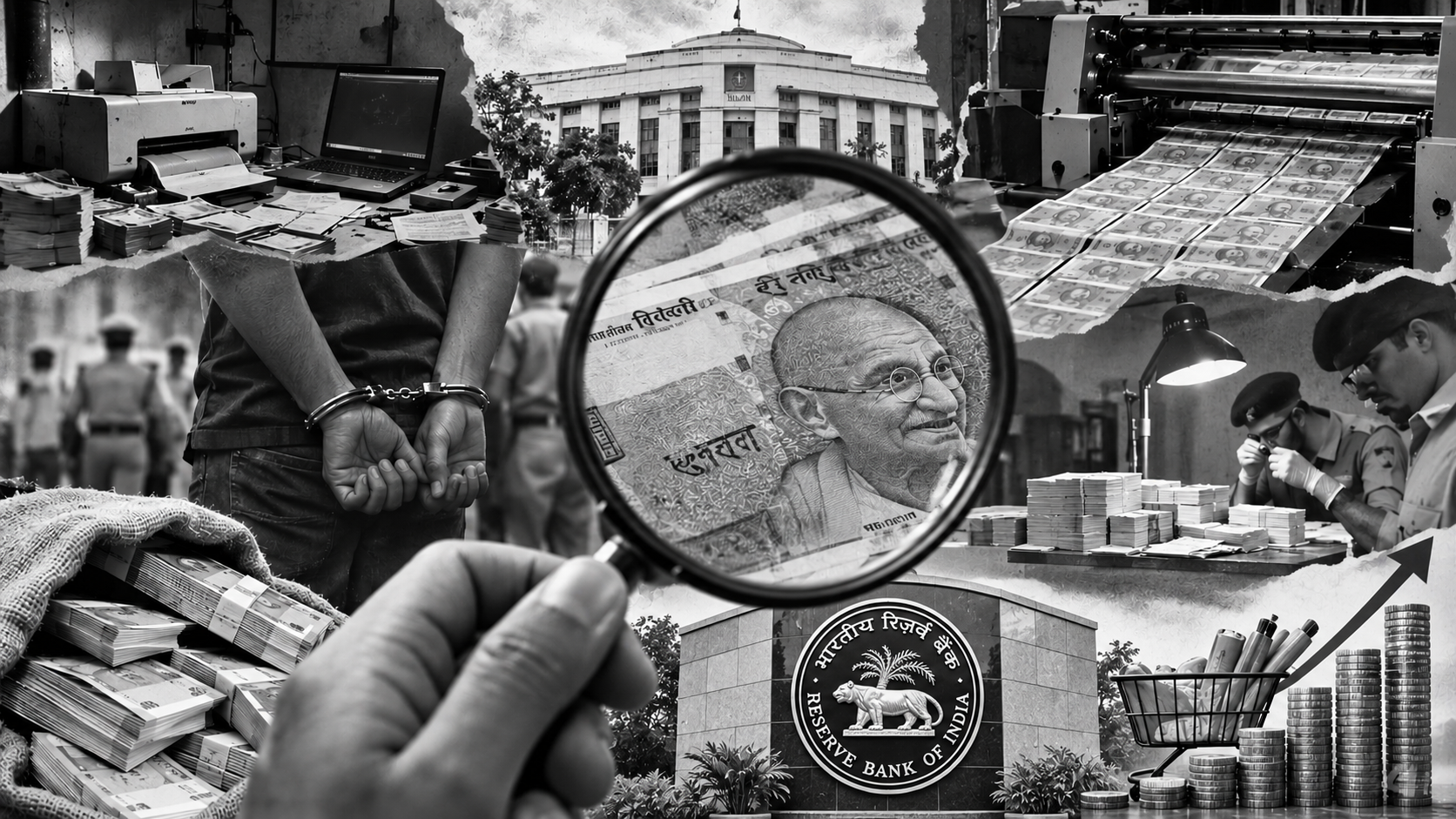
The Business of Fake Money: Inside India's Counterfeit Currency Networks
India's fight against counterfeit currency has entered a new phase. Nearly a decade after demonetisation, the number of fake notes detected in the banking system remains substantially lower than the levels recorded before the November 2016 exercise. However, recent figures suggest that counterfeit currency continues to pose a challenge to financial security, law enforcement and public confidence in the monetary system. The threat has evolved from large organised networks to smaller, decentralised operations capable of producing and circulating fake notes through multiple channels.
According to the Reserve Bank of India's (RBI) annual reports, banks detected 7,62,072 counterfeit notes in 2016–17, compared with 2,29,746 in 2025–26. The detection rate shown in the accompanying historical data declined from approximately 76 notes per crore in circulation to 13.4, representing a fall of about 82%. This is a measure of detected counterfeit notes relative to currency in circulation, not a direct estimate of the total fake currency present in the economy. The distinction is important because undetected counterfeit notes remain difficult to quantify.
Recent Figures Reveal a Changing Pattern
The RBI's latest figures show that counterfeit-note detections stood at 2,22,639 in 2023–24, declined to 2,17,396 in 2024–25 and rose to 2,29,746 in 2025–26. The latest increase of around 5.7% indicates that the problem has not disappeared. Of the notes detected in 2025–26, 2,24,334, or 97.6%, were identified by banks other than the RBI, while the central bank detected 5,412.
The ₹500 denomination accounted for the largest share, with 1,41,907 notes, approximately 61.8% of the total. Another 45,621 counterfeit ₹100 notes and 30,591 fake ₹200 notes were detected. The RBI also reported increases of 47.4% in counterfeit ₹20 notes and 20.5% in ₹500 notes compared with the previous year. These figures highlight why vigilance cannot be limited to high-value denominations.
Seizures Across States Expose the Geographic Spread
Banking-system detections tell only part of the story. Notes seized by police and enforcement agencies are recorded separately, and their figures can vary sharply from year to year. Parliamentary data on seizure value showed ₹34.71 crore in 2019, ₹17.99 crore in 2020, ₹20.39 crore in 2021, a significant spike to ₹382.54 crore in 2022, and ₹16.76 crore in 2023. The exceptional 2022 figure, associated with the seizure of approximately 42 lakh counterfeit notes, should not be interpreted as proof of a comparable rise in fake currency circulating across the country. A major operation or a small number of large seizures can substantially influence annual totals.
State-level reports also point to the spread of the problem. A media report citing NCRB data for 2024 placed Karnataka's reported seizure value above ₹32 crore, followed by Assam at ₹4.9 crore, Chhattisgarh at ₹3.8 crore, Telangana at ₹1.57 crore and West Bengal at ₹1.5 crore. In Telangana, the reported seizures included 31,388 counterfeit ₹500 notes, 43 ₹200 notes and 54 ₹100 notes. These figures are selected reported state-level findings, not a complete national ranking or a measure of where counterfeit notes are actually produced.
From Cross-Border Networks to Localised Printing Units
The methods used by counterfeit networks have also changed. The Directorate of Revenue Intelligence (DRI), in its Smuggling in India Report 2024–25, described a shift towards decentralised domestic printing units. Instead of relying exclusively on large cross-border networks, suspected operators have increasingly used smaller facilities, ordinary printing equipment and imported materials. Such units can be moved or dismantled quickly, making detection more difficult.
A major DRI operation in February 2025 exposed a suspected network involving security-grade paper imported from Hong Kong under the declaration of ordinary A4 paper. Authorities seized 203 sheets containing security-thread features and arrested individuals linked to alleged operations across several states. Subsequent searches uncovered additional suspected modules. The DRI reported busting seven more modules, including four in Maharashtra and one each in Haryana, Bihar and Andhra Pradesh, with nine arrests. These operations demonstrate the reach of the networks, although the locations of suspected units do not establish the total volume produced in each state.
The Economic Cost: Black Money, Corruption and Inflation
Counterfeit currency is often discussed alongside black money, but the two are not the same. Black money refers to genuine currency generated through undisclosed or illegal economic activity, whereas counterfeit currency is unauthorised imitation of legal tender. Both can undermine financial transparency, but they require different enforcement responses.
Fake notes can finance criminal activity, facilitate illegal transactions and weaken trust in cash payments. They may also create opportunities for corruption if officials, intermediaries or financial-sector personnel knowingly assist criminal networks. However, allegations of institutional collusion must be supported by evidence; the existence of counterfeit operations alone does not establish widespread official involvement.
Counterfeit currency can theoretically add unauthorised purchasing power and distort transactions if it enters circulation on a significant scale. Yet there is no reliable evidence establishing it as a major driver of India's overall inflation. Food prices, fuel costs, supply disruptions, demand conditions and monetary and fiscal factors remain central to inflation dynamics. The RBI has also highlighted the difficulty of estimating counterfeit currency because detected and seized notes represent only the observable portion of the problem.
Currency Printing and the RBI's Security Framework
India's currency production is tightly controlled. Under Section 22 of the RBI Act, 1934, the Reserve Bank has the sole right to issue banknotes, while the design, form and material of notes are subject to the statutory approval process under Section 25. Banknotes are printed at four facilities: the Currency Note Press in Nashik, the Bank Note Press in Dewas, and the presses at Mysuru and Salboni. The first two are operated by Security Printing and Minting Corporation of India Limited, while the latter two are run by Bharatiya Reserve Bank Note Mudran Private Limited, a wholly owned RBI subsidiary.
Indian banknotes incorporate security features such as watermarks, security threads, microlettering, intaglio printing, see-through registers and other denomination-specific elements. Printing facilities use inspection systems and specialised testing processes to maintain quality and detect defects. The RBI spent ₹4,875.2 crore on security printing in 2025–26, compared with ₹6,372.8 crore in the previous year, reflecting a lower indent for banknotes.
Banks and Agencies Strengthen Detection
Banks remain the first line of defence because counterfeit notes frequently enter circulation through everyday cash transactions. The RBI's September 2026 Master Direction sets out procedures for detecting, impounding, reporting and monitoring fake notes. Banks are required to train cash-handling employees, use prescribed authentication processes and maintain records. Counterfeit notes must be impounded rather than returned to customers or credited to their accounts, with an acknowledgement issued to the person tendering them.
In July 2026, the RBI directed banks to strengthen staff training, prioritise branches in districts along international borders and ensure that such branches have note-authentication and sorting machines. It also called for bank-level Fake Note Vigilance Cells to analyse detection patterns and identify potential hotspots.
At the national level, the Fake Indian Currency Notes Coordination Group (FCORD) facilitates information-sharing among central and state agencies. The National Investigation Agency's Terror Funding and Fake Currency Cell, the DRI, CBI, NCRB, customs authorities and state police contribute through investigation, intelligence-sharing and enforcement within their respective mandates. High-quality counterfeit currency activity can also attract provisions of the Unlawful Activities (Prevention) Act when the statutory requirements are met. Under the Bharatiya Nyaya Sanhita, Section 178 provides for punishment for counterfeiting currency, including imprisonment for life or a term extending to ten years, along with a fine.
Vigilance Must Go Beyond Demonetisation
The fall in the counterfeit-note detection rate is encouraging, but it should not create a false sense of security. The recent rise in detections, the dominance of ₹500 notes and the emergence of decentralised printing networks underline the need for continuous monitoring. Better bank-level authentication, timely intelligence-sharing, stronger border surveillance and swift prosecution remain essential. Demonetisation may have altered the counterfeit currency landscape, but the long-term challenge is to prevent fake notes from entering the financial system in the first place. India's success will ultimately depend not only on how many counterfeit notes are seized, but also on how effectively the networks behind them are dismantled.