
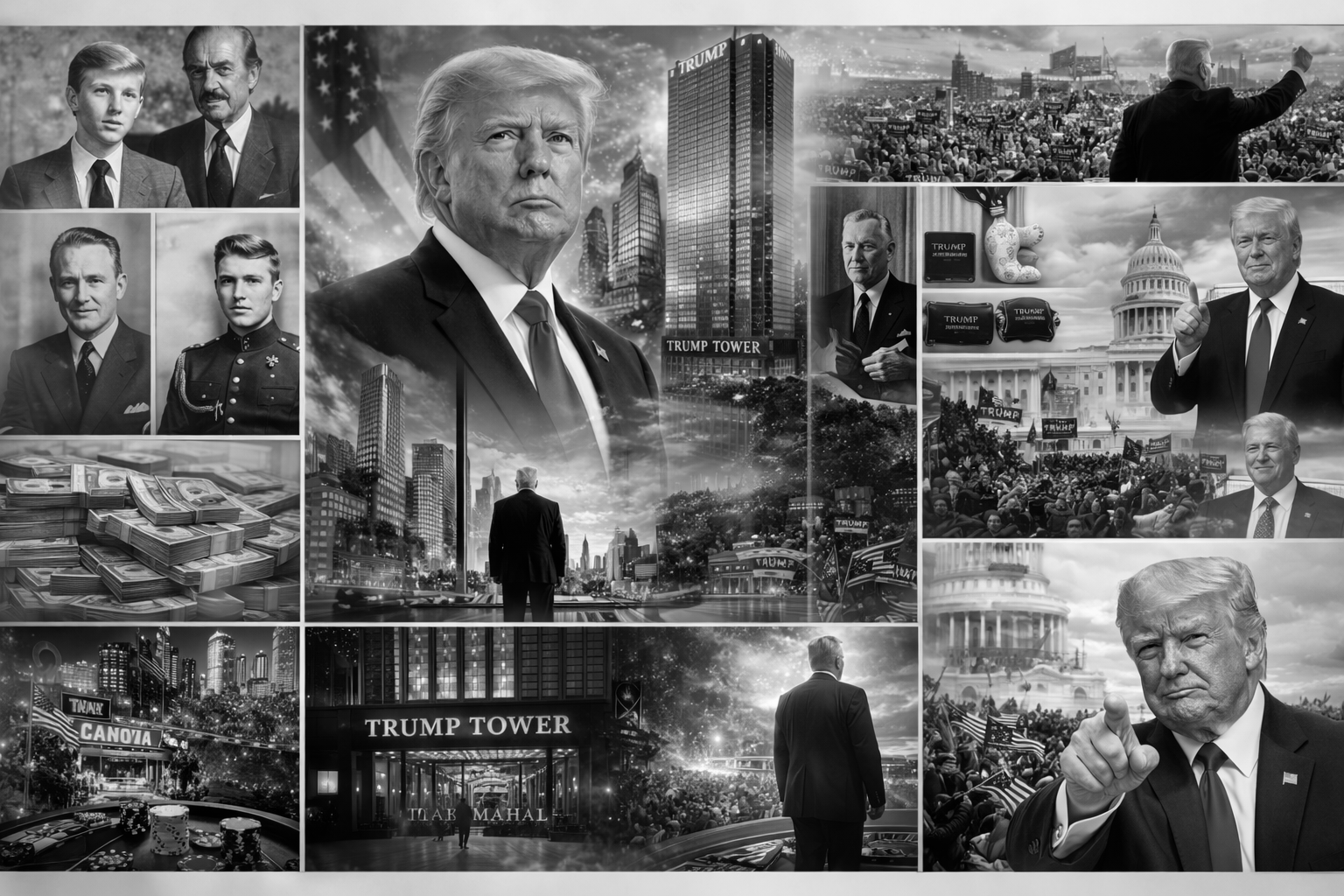
The Art of the Deal…With Reality: How Donald Trump Built Power on Perception
In 1984, a New York reporter picked up a phone call from a man who introduced himself as “John Barron,” the public relations agent of Donald Trump. The caller spoke glowingly Trump was successful, admired, irresistible to high society.
The only problem
The voice sounded exactly like Trump himself. Years later, recordings confirmed it. Trump had been playing his own spokesperson. It wasn’t just self-promotion. It was self-manufactured mythology one man, two roles, and a narrative fully under control.
Decades later, that instinct would resurface in different forms. A crowd size larger than reality, a claim repeated louder than evidence, even a pandemic briefing that left scientists blinking twice. Different moments, same philosophy: reality is not fixed it is negotiable.
Trump did not invent this instinct overnight. It was forged early, in the home of his father, Fred Trump, a man who saw the world as a ruthless scoreboard. You either won or you didn’t exist in any meaningful way.
This philosophy came at a cost. His elder brother, Frederick Trump Jr., chose a different life. He became a pilot. For that, he was mocked, diminished, and slowly broken. As Mary L Trump recounts in “Too Much and Never Enough”, Freddy’s decline into alcoholism was not sudden it was carved, day by day, by expectation and rejection.
Young Donald sat at that table, watching. He didn’t protest. He learned. Kindness was weakness. Weakness was fatal. And survival required something else entirely. At 13, Trump was sent to the New York Military Academy. It was meant to discipline him. Instead, it refined him.
As David Cay Johnston writes in “The Making of Donald Trump”, Trump discovered something more useful than discipline he discovered leverage. Authority did not reward honesty as much as it rewarded confidence.
When mistakes happened, he didn’t admit them. He redirected them. Preferably onto someone junior. And strangely enough, that worked.
The lesson stuck: it is not always important to be right. It is important to appear right.
By the time Trump reached Fordham University and later the Wharton School, the path ahead looked polished. But like many polished things, it reflected more than it revealed.
Mary Trump suggests connections played a helpful role in admissions. The Vietnam War came and went Trump did not. Bone spurs appeared at the right time, excused him from service, and quietly exited the story thereafter. And then there was the famous “small loan.”
Small, in this case, meant hundreds of millions. As detailed in Lucky Loser by Russ Buettner and Susanne Craig, Trump’s financial foundation was less bootstrap and more conveyor belt.
The real turning point came in 1973. The U.S. government sued the Trump business for racial discrimination. Most would have settled quietly. Trump escalated. He hired Roy Cohn a lawyer who treated courtrooms like boxing rings.
Cohn’s advice was simple, almost poetic in its aggression: Attack. Deny. Never concede. Trump followed it perfectly.
• He countersued the government for $100 million.
• He lost.
• He settled.
• He never apologised.
And yet, step outside the courtroom, and the story changed. Publicly, it was a victory.
Reality, from that moment on, became something flexible like a press release waiting to be edited.
From there, Trump moved into Manhattan not just to build, but to be seen building.
The Grand Hyatt deal gave him visibility. Trump Tower gave him identity. Glass, brass, spectacle. A building that didn’t whisper luxury it announced it with a microphone. When historic sculptures meant for preservation ended up as rubble instead of museum pieces at the Metropolitan Museum of Art, outrage followed. Trump didn’t apologise. He recalibrated.
Controversy, after all, brings attention. And attention, if handled correctly, becomes value.
Somewhere along the way, Trump realised something profound:
Owning things is complicated. Being seen as owning things is scalable.
As explored in “TrumpNation” by Timothy L O'Brien, Trump began licensing his name. Hotels, towers, golf courses many weren’t his. But they carried his identity. It was branding distilled to its purest form.
Why build every empire when your name can travel faster than construction?
Then came casinos. A business where the odds are mathematically tilted in favor of the owner. And yet, multiple bankruptcies followed.
It was, in its own way, impressive. Losing in a system designed to win requires either extraordinary risk or extraordinary confidence in recovery.
Trump survived. Because by then, the business was no longer just casinos. It was the “Trump” brand.
Around 2011, Trump stepped into politics the same way he entered real estate loudly. He questioned the citizenship of Barack Obama. The claim lacked evidence but gained traction. It wasn’t about proof. It was about presence.
By 2015, when Trump announced his candidacy, many assumed it was performance. They weren’t entirely wrong. But it was also effective.
Using Twitter like a direct broadcast channel, he bypassed traditional media. His rallies became events. His words became headlines.
And in 2016, he won the 2016 United States presidential election, defeating Hillary Clinton. The outsider didn’t just enter the system. He rebranded it. His presidency was a mix of policy, performance, and perpetual controversy. Investigations like the Russia investigation followed him. Impeachments first in 2019 and then again made history.
Even governance seemed to follow the same playbook: attack, deny, declare success. Then came 2020. Trump lost the 2020 United States presidential election to Joe Biden. But losing, in Trump’s vocabulary, is a negotiable term. Claims of fraud followed. Courts disagreed. Supporters did not. The narrative built over decades found its most dramatic expression in the January 6 United States Capitol attack.
It was no longer just rhetoric. It was consequence. And yet, even after leaving office, Trump did not exit the stage. Through rallies and platforms like Truth Social, he remained present, visible, central. Because for Trump, influence is not tied to position. It is tied to attention.
If there is one thread that defines this entire journey, it is this:
• Trump did not just build buildings.
• He did not just win elections.
• He built narratives.
Guided by Roy Cohn’s ruthless playbook attack relentlessly, admit nothing, claim victory he turned setbacks into statements and defeats into declarations. Critics called his style loud, excessive, even tasteless.
Trump, meanwhile, understood something simpler:
• Attention is currency.
• Perception is power.
This is not just the story of a man.
It is the story of how personality, pressure, privilege, and performance fused into a force powerful enough to reach the White House. And somewhere along that journey, truth didn’t exactly disappear.
It just got… outperformed.