
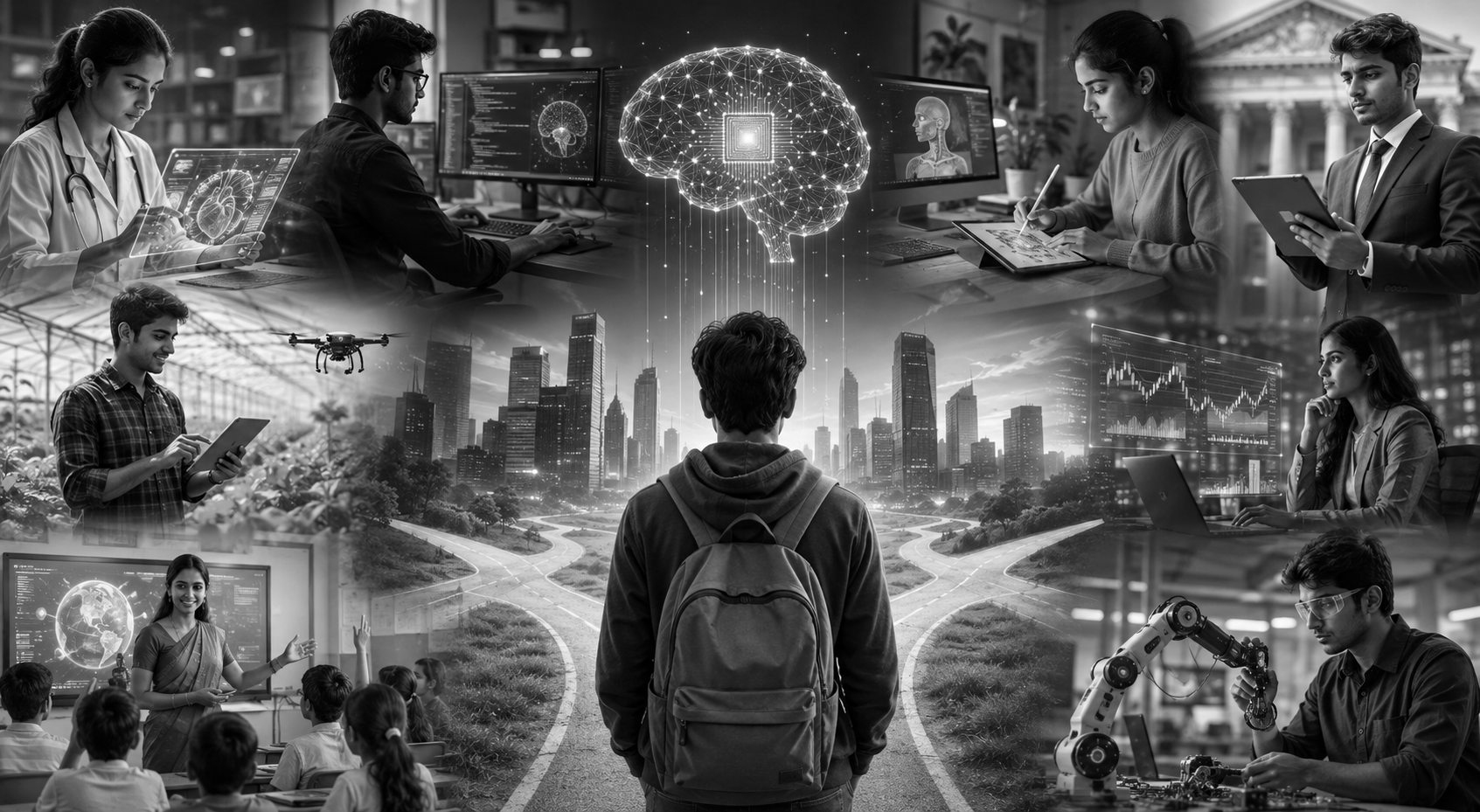
The AI Generation: How Artificial Intelligence Is Changing What Young Indians Want To Become
For generations of Indian families, the career path for young people followed a familiar pattern. A good degree was considered the first step towards a secure future, followed by a respectable profession such as medicine, engineering, government service, banking, teaching, law or business. Parents encouraged children to choose careers that offered stability, social status and predictable growth. But the arrival of artificial intelligence is beginning to change that conversation, with students increasingly questioning not only which careers offer security, but also which skills will remain valuable in a workplace where machines can perform tasks once considered exclusively human.
Artificial intelligence is no longer a distant technology limited to research laboratories or large technology companies. Young Indians are encountering AI in classrooms, smartphones, workplaces and online platforms, while generative AI tools are becoming part of how students learn, search for information, write, create presentations, develop software and explore new ideas. This growing familiarity is influencing career aspirations at an important moment in India's development, as millions of young people prepare to enter a labour market that is likely to look very different from the one their parents entered.
The scale of this change is particularly significant for India because of its young population. More than 65% of India's population is under the age of 35, according to government figures, making the country's youth central to its economic future. At the same time, demand for AI-related skills is increasing. Government analysis has reported that AI-related job postings in South Asia rose from 2.9% of vacancies in January 2023 to 6.5% by March 2025, while demand for AI skills grew faster than demand for non-AI skills. For young Indians, these trends are sending a clear message that understanding AI could become an important part of remaining competitive in the future workforce.
For students who are comfortable with mathematics, programming and technology, artificial intelligence and machine learning have emerged as particularly attractive career options. Courses in Artificial Intelligence, Machine Learning, Data Science, Robotics and Computer Science are increasingly being viewed as pathways into a technology-driven economy. Yet the AI employment market is already expanding beyond the traditional roles of data scientists and machine-learning engineers, with growing attention being given to positions such as GenAI engineers, agentic AI developers, AI architects, AI platform engineers and AI product managers. The changing range of opportunities means that students interested in AI no longer have to imagine their future as simply writing algorithms or building models in a laboratory.
The more significant transformation, however, may be the rise of careers that combine AI with traditional areas of expertise. A doctor who understands AI can use intelligent systems in healthcare, while a financial professional can combine financial knowledge with data analytics and automation. Lawyers can work in areas such as AI regulation and technology law, journalists can use AI for research and data analysis, designers can work with generative tools and teachers can use AI to create more personalised learning experiences. This is creating a broader idea of the future professional, where the winning combination may not be AI alone but AI plus deep knowledge of another field.
This shift also changes the question students need to ask when choosing their careers. Instead of thinking only about whether they should enter technology, young people may increasingly ask how technology can strengthen the profession they already want to pursue. The future could produce professionals who combine agriculture with AI, education with AI, finance with AI, healthcare with AI, law with AI or media with AI. In such a world, domain expertise will not necessarily become less important because of artificial intelligence; instead, people who understand both their profession and the technology transforming it could have a significant advantage.
Few questions are creating as much uncertainty among technology students as the future of coding. Programming has long been considered one of the most reliable pathways into the technology industry, with Indian students investing years in learning languages such as Java, Python, C++ and JavaScript. AI tools can now generate code, explain errors, write SQL queries, create scripts and assist with software development, leading many students to wonder whether learning programming still makes sense when machines can produce code in seconds.
The answer is that coding is unlikely to disappear, but the value of coding knowledge is changing. AI may reduce the amount of routine code that developers need to write manually, but software development involves much more than syntax. Someone still needs to understand the business problem, design the architecture, determine how databases should work, evaluate security risks, test the application and decide whether the generated code is reliable. A developer who simply accepts whatever an AI system produces could become dependent on the technology, while a developer with strong fundamentals who knows how to review and improve AI-generated code could become considerably more productive.
This could lead to a new definition of what it means to be a programmer. In the past, being able to write large amounts of code was often viewed as evidence of technical ability. In an AI-assisted workplace, the ability to understand systems, break down complex problems, evaluate different solutions and identify weaknesses in generated code could become more important. The programmer of the future may therefore write fewer lines of code while spending more time on problem-solving, architecture, debugging, testing and decision-making.
Artificial intelligence is also challenging another long-standing assumption in the Indian employment market: that a degree by itself is sufficient proof of professional ability. Degrees will continue to be essential for many careers and will remain an important source of knowledge and formal qualification. But in rapidly changing fields, employers can increasingly assess candidates through practical assignments, projects, internships, portfolios, coding tests and work samples. This means young Indians may need to think of education not as a final destination but as a foundation on which practical skills and experience are built.
The distinction between qualifications and capability could become increasingly important. A graduate may have a degree in data analytics, but an employer may want to see whether that person can actually analyse data and use the findings to solve a business problem. A student may claim to know AI, but the stronger candidate could be the one who can demonstrate how an AI tool was used to improve a real process or develop a working project. The degree can show what a person studied, while practical work can show what that person can actually do.
This does not mean technical knowledge will become less important. Instead, young professionals are likely to need a broader combination of skills. Problem-solving will remain valuable because AI can generate answers but cannot eliminate the need to identify the right problem. Critical thinking will become even more important because AI systems can produce convincing information that may still be inaccurate or incomplete. Communication will remain essential because professionals must explain ideas, work with teams, negotiate with customers and communicate decisions clearly.
Creativity is also unlikely to lose its value simply because AI can generate content. When millions of people have access to tools capable of producing text, images, designs and ideas, the ability to identify meaningful ideas and make good decisions about what should be created may become even more important. Similarly, emotional intelligence, leadership, collaboration and relationship-building will remain important in workplaces where humans continue to make decisions and work with other people. The future employee may therefore need both technological confidence and distinctly human capabilities.
Perhaps the most important skill in this changing environment will be adaptability. Technology evolves rapidly, and the tools that dominate the workplace today may be replaced by different systems in the future. A professional who spends years mastering only one platform could find that knowledge becoming outdated, while someone who understands how to learn new technologies may remain competitive for much longer. The ability to learn, unlearn and relearn could become more valuable than simply possessing a fixed list of technical certifications.
The impact of AI on employment remains one of the biggest uncertainties surrounding the technology. Artificial intelligence is capable of automating many repetitive and predictable tasks, including some forms of data processing, administrative work, basic customer support, routine content generation and certain entry-level programming activities. This has understandably created anxiety among young people who are preparing for their first jobs, particularly because many traditional entry-level positions have involved precisely the kinds of repetitive tasks that AI can increasingly perform.
Yet automation does not necessarily mean that entire professions will disappear. Technology can remove certain tasks while creating demand for new activities, new industries and new occupations. India's growing AI economy is already producing demand for professionals who can develop, integrate, manage, secure and govern intelligent systems. At the same time, AI can increase the productivity of existing workers, allowing a teacher to prepare learning material more efficiently, a programmer to automate repetitive development work, a financial analyst to process more information and a small business to handle parts of its marketing and customer service more efficiently.
For young Indians, however, the biggest employment challenge may not be the disappearance of an entire profession but the changing nature of the first job. Traditionally, graduates entered organisations by handling relatively simple tasks before gradually developing the experience needed for more complex responsibilities. If AI begins performing many of those routine tasks, companies and educational institutions may need to rethink how young employees gain their first practical experience. Internships, apprenticeships, projects and industry exposure could become more important because graduates may increasingly be expected to demonstrate practical ability before they enter the workforce.
Artificial intelligence is simultaneously creating a new opportunity for entrepreneurship. In the past, building a technology product often required large teams of programmers, designers and specialists, along with significant financial resources. Generative AI can reduce some of these barriers by helping small teams develop prototypes, analyse markets, create content, automate processes and experiment with software ideas. This does not mean every young person will become an entrepreneur, but it could make it easier for students and first-time founders to test ideas before making large investments.
This could also change where India's technology businesses emerge. Digital tools allow entrepreneurs to build and reach customers without necessarily being located in the country's biggest technology centres. A talented young person in a smaller city may be able to use AI-enabled tools to develop a product, run a digital business or offer specialised services to customers elsewhere. If supported by better infrastructure, training and access to capital, this could broaden the geographical spread of India's technology economy.
There is, however, a danger in treating AI as a shortcut to knowledge. Students can now ask AI systems to write assignments, solve mathematical problems, generate code and summarise complicated subjects within seconds. If they use those capabilities without developing the underlying understanding, they may become dependent on AI without developing the judgement needed to recognise when its answers are wrong. The challenge for education will therefore be to teach students not simply how to use AI, but how to question, verify and improve what AI produces.
For India, the stakes are particularly high because of the size of its young workforce. The country has the opportunity to become a major producer and user of AI-powered products and services, but demographic strength alone will not guarantee success. Colleges will need to strengthen links with industry, students will need greater access to practical training and existing workers will need opportunities to reskill. The objective should not be to turn every young Indian into an AI engineer, but to ensure that young people in different professions understand how AI can be used responsibly and productively.
The career map for India's young generation is therefore becoming more complicated, but it is also becoming broader. A student no longer has to choose between being a traditional professional and becoming a technology expert. There is growing space for people who combine professions, skills and technology in ways that were difficult to imagine a decade ago. The future engineer may be an engineer who understands AI, the future journalist may combine reporting with data and AI, and the future financial professional may combine domain knowledge with automation and intelligent analysis.
The traditional formula of degree, job and experience may gradually evolve into something more flexible: education, practical skills, technology, experience and continuous learning. A degree will still open doors, but the ability to demonstrate skills may increasingly determine how far a person progresses. Coding will still matter, but understanding problems and systems may matter more than writing every line manually. AI may eliminate certain tasks and jobs, but it could also create new professions and make existing workers more productive.
For today's young Indians, the most important question may therefore not be, “What job will AI leave for me?” It may be, “What can I learn that will allow me to work effectively with AI?” That change in mindset could determine how successfully the next generation navigates the transformation of the workplace.
Artificial intelligence will undoubtedly reshape careers, education and employment. Some occupations will contract, some roles will be transformed and new professions will emerge. But the future is unlikely to belong exclusively to people who know the most about AI or to those who avoid it altogether. It is more likely to favour people who combine deep knowledge, practical skills, human judgement and the ability to use technology intelligently.
For India's AI generation, the biggest career advantage may therefore not be choosing the perfect profession today. It may be developing the ability to keep adapting as the definition of work itself changes. The young people who learn how to think critically, communicate clearly, solve meaningful problems and work alongside intelligent machines could find that AI is not simply changing what they want to become, it is giving them entirely new possibilities for what they can become.