
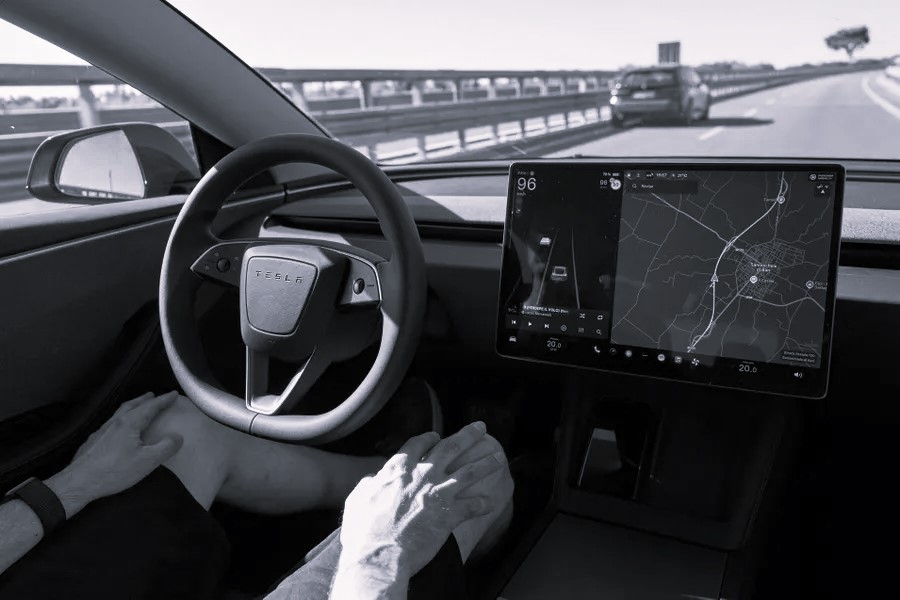
Tesla’s full Self-driving probe renews debate on AI’s role behind the wheel
Tesla’s ambitious Full Self-Driving (FSD) software has once again come under scrutiny, as U.S. traffic safety regulators have opened an investigation into potential violations and unsafe behaviors linked to the system. The probe follows reports suggesting that vehicles operating under FSD may have engaged in risky maneuvers including running red lights, improper lane changes, and wrong-way driving raising concerns over how effectively the software interprets and responds to real-world driving conditions.
At its core, Tesla’s FSD is an advanced driver-assistance suite powered by neural networks and computer vision. It processes data from eight external cameras, ultrasonic sensors, and radar to interpret the car’s surroundings and make driving decisions without human input. The AI behind FSD continuously learns through fleet learning, meaning data collected from millions of Tesla vehicles worldwide is used to train algorithms that aim to predict and respond to complex traffic scenarios. This constant iteration is what makes FSD unique; it is essentially a learning system on wheels.
However, the same learning-driven design that gives FSD its adaptability also introduces uncertainty. Critics argue that the system’s dependence on real-world data and probabilistic decision-making makes it prone to unpredictable behavior, particularly in unstructured environments such as intersections, pedestrian zones, or construction areas. Technical analysts point out that while Tesla markets FSD as a step toward autonomous driving, the system remains Level 2 automation under international safety standards meaning the driver must remain alert and ready to take control at all times.
The latest investigation underscores ongoing regulatory challenges surrounding partially automated vehicles. Authorities have long struggled to define accountability when software makes decisions traditionally handled by human drivers. In Tesla’s case, incidents involving FSD have sparked debate over the company’s marketing language, which some regulators say may overstate the technology’s capabilities and mislead users into over-reliance on automation.
From a technical standpoint, several limitations have been identified within FSD’s perception and decision-making stack. The vision-based system, while powerful, can misinterpret environmental cues for instance, mistaking faded road markings or reflective surfaces for drivable areas. Weather conditions such as heavy rain or fog can further degrade sensor performance. Experts also point out that FSD’s reaction times, though faster than a human in many cases, lack the contextual understanding humans possess such as predicting erratic behavior from pedestrians or cyclists.
The broader implications extend well beyond Tesla. The outcome of this investigation could shape the future of AI-driven transportation, influencing how companies like Waymo, Cruise, and Apple develop and deploy self-driving systems. Regulators worldwide are watching closely, as the balance between innovation and safety becomes a defining challenge for the automotive industry. A regulatory precedent set against Tesla could lead to tighter testing protocols, mandatory software transparency, and standardized driver-assist performance benchmarks across the sector.
To enhance FSD’s reliability, experts suggest several pathways forward. One involves the integration of sensor fusion, combining Tesla’s camera-based vision with radar or LiDAR systems to create a more robust perception model. Another key improvement lies in AI explainability developing systems that can justify their driving decisions, making it easier for engineers to identify and correct errors. Enhanced simulation testing, stricter real-world validation, and collaborative data-sharing among automakers could also accelerate safer deployment of autonomous technologies.
Despite the challenges, Tesla’s Full Self-Driving software represents a significant technological leap in the evolution of intelligent vehicles. It showcases both the promise and peril of AI autonomy, a system capable of learning from billions of driving miles, yet still vulnerable to the unpredictable nature of human environments. As regulators investigate and developers refine, one thing remains clear: the road to fully autonomous driving will demand not only smarter algorithms, but also stronger oversight and a renewed commitment to public safety.