
Telangana’s Third Discom: Agricultural Power Reform or Financial Restructuring?
The creation of TGRPDCL aims to improve agricultural power management, but mounting losses, unpaid electricity bills and dependence on government subsidies raise questions about its long-term financial sustainability.
Telangana’s decision to establish a third electricity distribution company marks a significant restructuring of the state’s power sector. The Telangana Rythu Power Distribution Company Limited (TGRPDCL) is designed to handle agricultural electricity and selected water-supply consumers. However, beyond the administrative changes, the move raises a fundamental question: will the new company improve financial accountability and electricity services, or merely redistribute existing costs, unpaid bills and liabilities?
The Government Order, G.O.Ms.No.17, dated October 12, 2026, establishes the framework for transferring consumer connections, distribution infrastructure, power purchase agreements, personnel, assets and liabilities. The restructuring is intended to provide dedicated attention to agricultural power supply, improve energy accounting and strengthen services for farmers and essential water-supply projects. Its success, however, will depend on whether the new company receives adequate and timely financial support.
A new Discom amid mounting financial pressure
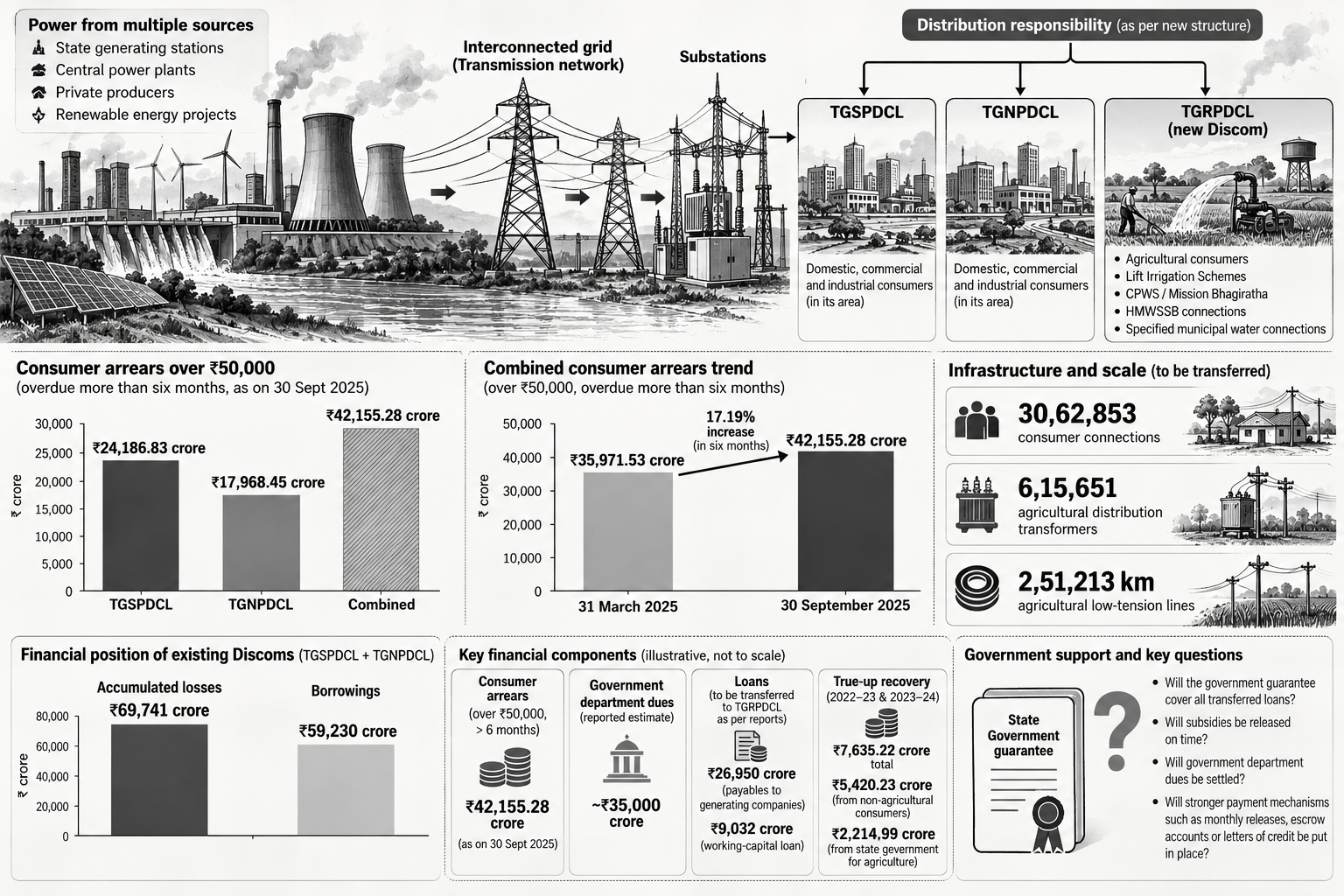
The financial condition of Telangana’s existing distribution companies provides the backdrop to the restructuring. According to an October 2026 report, the combined accumulated losses of Telangana Southern Power Distribution Company Limited (TGSPDCL) and Telangana Northern Power Distribution Company Limited (TGNPDCL) stood at ₹69,741 crore, while their borrowings amounted to ₹59,230 crore. These figures represent the wider financial position of the existing Discoms, not the amount of government electricity bills alone.
The collection problem is also substantial. Regulatory submissions recorded ₹42,155.28 crore in consumer arrears exceeding ₹50,000 and overdue for more than six months as of September 30, 2025, compared with ₹35,971.53 crore on March 31, 2025. The increase over six months was ₹6,183.75 crore, or approximately 17.2 per cent.
These arrears cover different consumer categories and cannot be attributed entirely to government departments. Nevertheless, government agencies have accumulated substantial electricity dues, particularly in irrigation and water-supply operations. Reported estimates have placed government-department arrears associated with the restructuring at around ₹35,000 crore, although the final amount transferred under the new scheme requires reconciliation.
When consumers fail to pay their electricity bills, Discoms must still purchase power, maintain infrastructure and meet operating expenses. Borrowing can bridge the immediate funding gap, but it adds interest costs and can restrict investment in the electricity network.
What will TGRPDCL take over?
The new company will handle agriculture, Lift Irrigation Schemes, CPWS/Mission Bhagiratha, Hyderabad Metropolitan Water Supply and Sewerage Board connections, and specified municipal water connections with separate distribution transformers.
Schedule A of the Government Order lists 30,62,853 consumer connections, including 30,60,821 agricultural connections, 512 lift irrigation connections, 105 HMWSSB connections, 1,145 CPWS/Mission Bhagiratha connections and 270 specified municipal water connections. These figures are indicative and subject to finalisation.
The transfer also involves substantial infrastructure. Schedule B lists 6,15,651 agricultural distribution transformers and approximately 2,51,213 kilometres of agricultural low-tension lines. Their indicative book values are ₹2,123.46 crore and ₹1,039 crore, respectively.
The scheme additionally provides for reallocating power purchase agreements and transferring relevant personnel, assets and liabilities. TGRPDCL is therefore being established to operate a substantial distribution network, rather than merely administer agricultural subsidies.
How will electricity reach the new Discom?
Creating TGRPDCL does not require an entirely separate electricity-generation or transmission system. Electricity will continue to come from Telangana’s generating stations, central power plants, private producers and renewable-energy projects. It will travel through the interconnected grid and transmission network before reaching distribution systems.
The principal change is the allocation of commercial and administrative responsibility. Power purchase agreements, energy requirements and associated costs must be distributed among the three Discoms according to the transfer scheme and regulatory arrangements.
This is particularly important because eligible agricultural consumers receive free electricity under the existing policy. The company must pay for the power supplied and maintain its network despite receiving little or no direct retail revenue from those consumers.
Transformer-level monitoring could improve energy accounting and help identify technical losses, overloaded equipment and abnormal consumption patterns. A proposal reported in 2025 involved smart meters for approximately 5.22 lakh distribution transformers, at an estimated cost of ₹1,300 crore. However, transformer readings alone cannot determine the precise electricity consumed by every individual agricultural pump set.
Is the new company inheriting the debt?
Loans, consumer arrears and accumulated losses are different financial categories. Loans are borrowed funds, arrears are amounts owed to the utility, and accumulated losses reflect financial losses recorded over time. They must not be treated as interchangeable figures.
Earlier restructuring reports cited ₹26,950 crore in payables to power-generating companies and a ₹9,032 crore working-capital loan associated with TGRPDCL. These figures require reconciliation with the final transfer statements before being treated as the company's confirmed opening liabilities.
Transferring an unpaid government bill from one Discom to another does not automatically clear the debt. Similarly, transferring a loan does not eliminate the obligation to repay it. The financial outcome will depend on the final allocation of liabilities, recovery of receivables and settlement of outstanding payments.
What guarantee has the government provided?
During the licensing proceedings, TGRPDCL stated that its transferred loans would be backed by a State Government guarantee and that its revenue gap would be met through timely subsidy releases. It also indicated that the government could provide additional equity if required.
These assurances are important because the new company will depend heavily on government funding. Unlike a conventional Discom with substantial commercial and industrial revenue, TGRPDCL will predominantly serve subsidised consumer categories.
However, a loan guarantee is not automatically a guarantee that every subsidy or electricity bill will be paid on time. The legal terms, coverage, conditions and enforceability of the guarantee must be examined separately. Stakeholders have raised concerns about delayed subsidies, recoverability of government dues and the need for stronger payment arrangements, including monthly releases and mechanisms such as escrow accounts or letters of credit. These proposals should not be mistaken for arrangements already implemented.
The test will be financial accountability
The Telangana Electricity Regulatory Commission approved ₹7,635.22 crore in true-up recovery relating to FY 2022–23 and FY 2023–24. Of this, ₹5,420.23 crore was allocated for recovery from eligible non-agricultural consumers, while ₹2,214.99 crore attributable to agriculture was to be recovered from the state government. The reported recovery mechanism was scheduled to begin in November 2026.
These amounts are separate from the government-department arrears and transferred loans. They demonstrate how costs from electricity already supplied can remain payable years later.
TGRPDCL could improve agricultural power management, infrastructure maintenance and subsidy accounting. But its creation alone will not eliminate the existing sector’s financial problems. Its sustainability will depend on transparent transfer accounts, affordable power procurement, reliable subsidy payments and the government's ability to settle its electricity bills.
Ultimately, the success of Telangana’s third Discom will not be measured simply by the number of connections or assets transferred. It will depend on whether the company delivers reliable electricity, publishes transparent accounts and meets its financial obligations without creating another cycle of unpaid bills and mounting debt.