
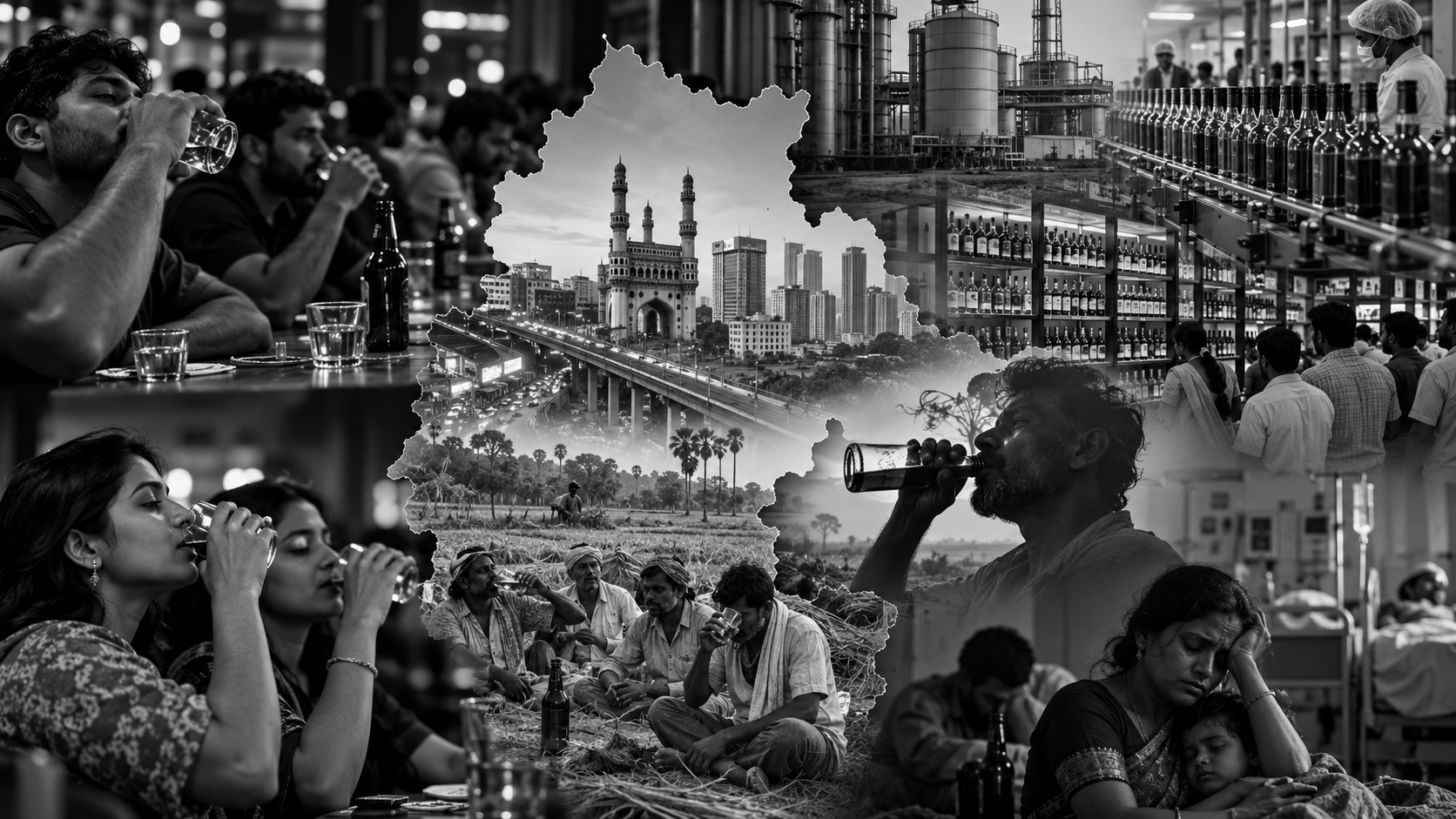
Telangana’s Alcohol Story: Big Sales, Rural - Urban Divide and a Public Health Challenge
With liquor sales crossing ₹40,000 crore, nearly 44% of men reporting alcohol use and women’s consumption emerging as a significant demographic question, Telangana’s drinking habits reveal a complex intersection of public health, retail expansion and government revenue.
Telangana’s relationship with alcohol is increasingly defined by a striking contrast: a liquor market generating more than ₹40,000 crore in annual sales, a high prevalence of reported drinking among men and substantial differences between rural and urban populations. While the state’s excise economy has expanded dramatically since its formation in 2014, the latest health survey findings raise questions about who drinks, how consumption patterns are changing and whether rising sales necessarily mean that more people are drinking.
The figures reveal a story that extends well beyond the number of bottles moving through liquor shops. They point to a state where alcohol is a major commercial industry and a significant source of public revenue, while drinking patterns vary across gender and geography.
A ₹40,000-crore liquor market
Telangana’s reported annual liquor sales increased from ₹10,883 crore in 2014–15 to ₹20,859 crore in 2018–19 and ₹30,086 crore in 2021–22. Sales reached ₹37,487 crore in 2024–25 before climbing to ₹40,209 crore in 2025–26, a year-on-year increase of approximately 7.3%.
The expansion highlights alcohol’s importance to the state’s economy. Telangana’s retail network includes 2,620 licensed A4 liquor shops, while the Excise Department’s dashboard lists 1,107 renewed 2B bar licences and 88 elite-bar licences for the 2025–26 and 2026–27 licensing period. The latest retail licensing exercise attracted 95,628 applications for 2,620 shops.
However, sales value must not be confused with excise receipts or actual consumption. Higher prices, inflation, premium products and population growth can increase market value without a proportionate rise in the quantity consumed.
Who drinks more?
The National Family Health Survey-6 (NFHS-6), covering 2023–24, found that 43.9% of men aged 15 and above in Telangana reported consuming alcohol, compared with 18.9% nationally. Among women, the corresponding figures were 7.1% in Telangana and 1.1% across India.
The rural–urban divide is significant. Alcohol use was reported by 46.6% of rural men, compared with 36.3% of urban men. Among women, the figures stood at 8.6% and 2.8%, respectively.
District-level differences are equally striking. Jangaon recorded the highest reported prevalence among men at 61.6%, followed by Jayashankar Bhupalapally at 56.6% and Warangal Rural at 56.5%. Hyderabad recorded 30.4%, demonstrating that a large urban liquor market does not necessarily correspond to the highest proportion of residents reporting alcohol use.
These figures measure prevalence, not drinking frequency, quantity consumed or spending per person. They nevertheless challenge the assumption that alcohol consumption is primarily an urban phenomenon.
Women’s consumption: An underexamined trend
Women’s reported alcohol consumption in Telangana is substantially higher than the national average, although it remains well below the rate among men.
NFHS-6 recorded the highest reported prevalence among women in Nagarkurnool at 15.6%, followed by Medak at 15.2%, Kamareddy at 13.8%, Mahabubnagar at 13.1% and Ranga Reddy at 12.9%. Hyderabad recorded 1.1%.
Published comparisons indicate that women’s prevalence rose from 6.7% in NFHS-5 to 7.1% in NFHS-6. However, comparable age groups and survey definitions must be checked before interpreting changes over time.
The available sales data do not establish what proportion of liquor purchases are made by women, which beverages they prefer or how much they spend. Gender-disaggregated research on drinking frequency, quantity and expenditure is needed to understand these patterns without relying on assumptions.
Sales growth versus actual consumption
The expansion of Telangana’s liquor market does not automatically mean that the proportion of people drinking has risen at the same pace. Prices, population growth and changing product preferences can influence sales values independently of consumption prevalence.
National household expenditure research illustrates this distinction. Between 2022–23 and 2023–24, reported monthly beer quantities among rural households consuming the beverage declined from 0.99 litres to 0.90 litres. Among urban households, reported beer quantity remained at 1.20 litres. These are national household-survey figures, not Telangana-specific estimates.
The latest state survey comparisons also require caution because NFHS-5 and NFHS-6 figures cited in published reports do not always cover identical age groups. A definitive ten-year assessment requires consistent annual data on physical sales volumes, prices, population and comparable survey estimates.
Beer, spirits and seasonal demand
Telangana’s 2025–26 sales figures show different trajectories for major beverage categories. IMFL sales increased from 372.25 lakh cases in 2024–25 to 382.91 lakh cases in 2025–26, while beer sales fell from 536.13 lakh to 487.34 lakh cases.
Festival periods produce sharp fluctuations. During the four-day Dasara period in October 2026, reported liquor sales reached ₹755.14 crore, compared with ₹698 crore a year earlier. Sales from October 1 to 19 totalled approximately ₹2,054.5 crore, up 37% year-on-year. Beer dispatches rose around 40.9%, while IMFL dispatches increased approximately 29.8%.
These figures indicate seasonal demand, but dispatches to retailers do not necessarily equal immediate consumption, as advance stocking can influence the numbers.
Manufacturing and the wider economy
Telangana’s supply chain includes breweries, distilleries and bottling facilities associated with companies such as United Breweries, Carlsberg India and Allied Blenders and Distillers. Allied Blenders operates an integrated facility at Rangapur, including an extra-neutral alcohol distillery and an IMFL bottling unit. Its announced bottle-manufacturing facility has a reported annual capacity exceeding 600 million bottles and involved an investment of approximately ₹115 crore.
Other companies appear in state supplier records, but registration alone does not establish current production volumes or confirm where each brand is manufactured. Plant capacity, employment, investment and the proportion of products sold within Telangana require further examination.
The public-health cost
The World Health Organization tracks alcohol consumption in litres of pure alcohol per person aged 15 and above, a measure distinct from total beverage volume. A peer-reviewed study estimated that India’s pure-alcohol consumption per adult rose from approximately 1.97 litres in 2000 to 4.92 litres in 2019, alongside a 26% increase in alcohol-attributable mortality rates. These are national estimates, not Telangana-specific outcomes.
For Telangana, further investigation is needed into alcohol-use disorders, liver disease, road crashes, treatment access and household spending. The state’s excise receipts should also be examined alongside prevention and treatment expenditure, without assuming that total healthcare spending represents alcohol-related costs.
Telangana’s alcohol economy is expanding, but the full story cannot be measured through revenue alone. The crucial task is to establish how prices, physical sales, drinking frequency and demographic changes interact and how the resulting economic gains compare with the wider public-health burden.