
Telangana Records 994 Tiger, Carnivore Signs in AITE-2026 Survey
Telangana’s forests have yielded encouraging early signals from the All India Tiger Estimation (AITE)-2026 , a nationwide wildlife monitoring exercise that assesses not only tiger presence but overall ecosystem health. Conducted between January 19 and 25 , the survey covered forest areas in 32 districts under protocols designed by the National Tiger Conservation Authority (NTCA) and the Wildlife Institute of India (WII) . The operation represents one of the largest coordinated ecological field exercises in the country, combining scientific methods with extensive ground participation.
During the six-day survey, teams recorded 994 preliminary pieces of evidence of tigers and other carnivores , alongside 552 signs of large herbivores . These findings suggest an active predator–prey dynamic, an essential indicator of a stable forest ecosystem. Field staff carried out 15-km carnivore sign surveys and daily 2-km transects , documenting animal traces, prey sightings, and vegetation conditions. Over 4,500 Forest Department personnel and around 1,700 volunteers took part, demonstrating the scale and collaborative nature of the exercise.
A key technological component was M-STRIPES (Monitoring System for Tigers – Intensive Protection and Ecological Status) , a GPS-enabled mobile application that allows frontline staff to log geo-tagged wildlife signs such as pugmarks, scat, and scratch marks. The system also records patrol routes, habitat observations, and potential threats like poaching or illegal grazing. By uploading data to a centralized platform, M-STRIPES supports real-time monitoring, hotspot identification, and more strategic protection planning.
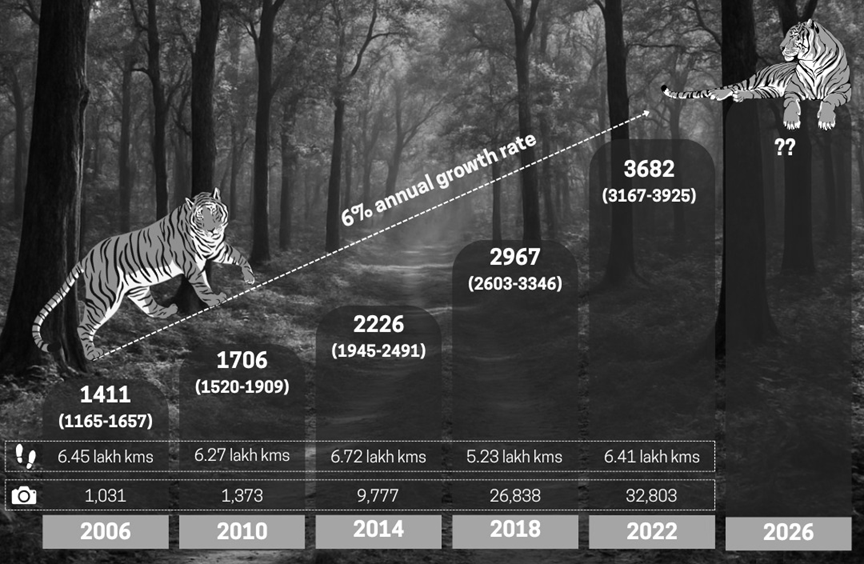
Importantly, experts clarify that these figures represent indirect wildlife signs , not confirmed population numbers. The AITE process will now advance to scientific stages involving camera trapping , DNA analysis , and capture-recapture models to identify individual animals and produce reliable population estimates. These methods ensure statistical accuracy and long-term trend analysis rather than relying solely on field indicators.
The survey highlights both strengths and priorities. The presence of herbivores indicates a viable prey base , while conservation planners stress the need for habitat restoration , protection of wildlife corridors , and improved forest connectivity to maintain genetic flow. Field incidents, including the loss of a forest watcher and injuries during wildlife encounters, have also prompted calls for stronger field safety protocols and better medical preparedness.
Crucially, the findings do not signal a tiger population decline . Instead, they form part of routine national monitoring aimed at understanding ecosystem health , distribution patterns, and conservation challenges. Telangana’s results portray biologically active forests and reinforce that sustained success depends on scientific monitoring, technology integration, and community-supported conservation efforts.