
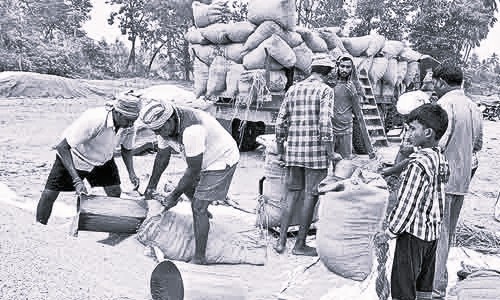
Telangana Deploys 8,525 Procurement Centres, Targets 90 LMT Paddy
Telangana has launched an extensive and fast-paced paddy procurement drive for the ongoing Yasangi (rabi) season, aiming to surpass last year’s record performance while improving efficiency and farmer experience. With total production estimated at around 141 lakh metric tonnes , the state government has set an ambitious procurement target of 90 lakh metric tonnes , signalling a significant scale-up in operations.
To ensure smooth procurement, the government has planned 8,525 procurement centres , of which over 6,500 are already operational across the state. Nearly 43,000 trained personnel have been deployed to monitor and manage operations, while 6,500 trucks are engaged in continuous transportation of grain from centres to rice mills. So far, about 8.5 lakh metric tonnes of paddy has been procured, with more than 7 lakh metric tonnes already dispatched for milling.
A key focus this season is on quality control and farmer convenience . The government has introduced widespread use of automated dryers, moisture meters, cleaners, and tarpaulins to reduce moisture content and prevent crop damage. Additionally, around 20 crore gunny bags have been readied to avoid storage disruptions. Officials say these steps are aimed at minimising rejection of produce and ensuring that farmers receive the Minimum Support Price (MSP) without delays.
Financially, the state has procured paddy worth ₹2,031 crore , with ₹323 crore already credited directly to farmers’ bank accounts through a transparent payment system. The emphasis on direct benefit transfers (DBT) is expected to significantly cut delays and improve trust among farmers.
This year’s drive builds on a record-breaking 2025 Yasangi season , when Telangana procured over 70 lakh metric tonnes of paddy , the highest in its history. That season saw large-scale farmer participation, supported by MSP payments and incentives, firmly establishing the state as a leader in decentralized procurement.
However, 2026 marks a strategic shift . While last year focused on expanding procurement volumes, the current season is centred on speed, efficiency, and infrastructure strengthening . The early pace of procurement and rapid activation of centres indicate a more streamlined and prepared system compared to previous years.
At the same time, structural challenges remain. The state continues to bear a significant financial burden under the MSP regime, with ongoing Centre–state differences over procurement limits, rice allocation, and cost-sharing mechanisms . Storage constraints, milling capacity, and management of different paddy varieties also continue to pose operational challenges.
Beyond paddy, procurement of other crops is progressing simultaneously. The state has procured 3.46 lakh metric tonnes of maize , benefiting 64,779 farmers , while 30,220 metric tonnes of chickpeas have supported 15,933 farmers . Additionally, 3,492 metric tonnes of sunflower have been purchased, aiding 2,512 farmers , reflecting a gradual push toward crop diversification .
Overall, Telangana’s procurement strategy is evolving from a volume-driven model to a more efficient, technology-enabled system . If the current momentum continues, the state is poised not only to exceed its targets but also to set a benchmark for farmer-centric procurement reforms in India .